|
LESOTHO - Country Profile
|
Updated: Feb 2005 |
|
|
|
National Strategic Framework
Status
Completed (2001-2004)
National policies
- National policy on HIV/AIDS.
- Sectoral HIV/AIDS policies in education, health and workplace.
Ministry of Health and Social Welfare (MOHSW)
Department of Health
Contact person: Nthabiseng Mabitle
P.O. Box 514, Maseru 100, Lesotho
Tel: +266 22 314 404 / +266 22 322 180
Fax: +266 22 310 667
Website: www.lesotho.gov.ls
Lesotho AIDS Programme Coordinating Authority (LAPCA)
Contact person: Mrs Monaheng, Director
P.O. Box 11232, Maseru 100, Lesotho
Tel: +266 22 326 794 / +266 22 322 180
Fax: +266 22 327 210 / +266 22 323 010
The national AIDS programme is an integrated approach towards the prevention and control of this devastating disease, with countrywide activities.
HIV/AIDS Organisations:
-
Care Lesotho
Contact person: Gillian Forest
P.O. Box 682, Maseru 100, Lesotho
Tel: +266 22 314 398
Fax: +266 22 310 195
Email: [email protected] / [email protected]
Website: www.caresa-lesotho.org.za
· CARE works with civil society, private sector and government partners to develop strategies for HIV/AIDS mitigation for vulnerable groups.
-
Christian Health Association of Lesotho (CHAL)
Contact person: Agnes Lephoto
P.O. Box 1632, Maseru 140
Tel: +266 22 312 500
Fax: +266 22 310 314
Email: [email protected]
· Medical care; advice; support; exchange of information; access to resources; policy influence and advocacy; capacity building and providing technical assistance on HIV/AIDS.
- The Green Crescent Trust
Contact person: Dr. Abdul Elgoni and Dawood Ponoane
P.O. Box 0838, Maseru 105, Lesotho
Tel: +266 22 866 923
Fax: +266 22 310 322
Email: [email protected]
-
Lesotho Network of AIDS Service Organisations (LENASO)
Contact: Mrs Lois Sebatane
P. O. Box 553, Ladybrand 9745, South Africa
Tel: +266 22 322 038 Ext 3971
Tel: +266 22 340 474 / +266 22 213 005
Fax: +266 22 340 000
Email: [email protected]
Website: www.sanaso.org.zw
-
Maseru Children€™s Village
Contact person: Mphonyane Mofokeng MCV Manager
P.O. Box 151, Maseru 100
Tel: +266 22 322 559
Email: [email protected]
· HIV/AIDS orphanage; networking; care and support; advocacy; capacity building and providing technical assistance.
- Positive Action - Lesotho
Contact person: Ingo Seifert
P.O. Box 1895, Maseru 100
Tel: +266 22 885 0069
Email: [email protected]
Website: www.positive-action.org
· Fund-raising and income generation activities; information dissemination; self-help groups; skills building.
- Population Services International (PSI)
Contact person: Aaron Maselwane, Programme Manager
P.O. Box 15863, Maseru, Lesotho
Tel: +266 22 236 825
Fax: +266 22 311 200
Email: [email protected]
· Uses social marketing to deliver health products, services and information that enable low-income and other vulnerable people to lead healthier lives.
-
Red Cross Society - Lesotho
P.O. Box 366, Maseru 100
Tel: +266 22 313 911
Fax: +266 22 310 166
Email: [email protected]
· Training; technical assistance; education; information; awareness; support; care; income generation activities; advocacy.
- Society of Women and AIDS in Africa (SWAA)
P.O. Box 200, Maseru
Tel: +266 22 311 906
Fax: +266 22 323 092
· Counselling; training; education; information; awareness; support; care; income generation activities; advocacy.
-
Expanded UN Theme Group on HIV/AIDS, Chair
Ms. Hodan Haji Mohamud
UNDP Resident Representative/UN Resident Coordinator
P.O. Box 301
Maseru 100, Lesotho
Tel: +266 22 313 790
Fax: +266 22 310 042
Email: [email protected]
Website: www.undp.org
· Supports an expanded response and policy advice on preventing transmission of HIV, providing care and support, reducing the vulnerability of individuals and communities to HIV/AIDS.
-
UNAIDS Country Coordinator
Contact person: Tim Rwabuhemba
P.O. Box 301, Maseru 100, Lesotho
Tel: +266 22 313 790
Fax: +266 22 313 571
Email: [email protected]
Website: www.unaids.org
· UNAIDS leads, strengthens and supports an expanded response aimed at preventing transmission of HIV, providing care and support, reducing the vulnerability of individuals and communities to HIV/AIDS.
|
| Country Indicators |
|
| Demographic data |
Year |
Estimate |
Source |
| Total population (thousands) |
2004 |
1,800 |
UN population division database |
| Female population aged 15-24 (thousands) |
2004 |
224 |
UN population division database |
| Population aged 15-49 (thousands) |
2004 |
861 |
UN population division database |
| Annual population growth rate (%) |
1992-2002 |
1.1 |
UN population division database |
| % of urban population |
2003 |
17.9 |
UN population division database |
| Average annual growth rate of urban population |
2000-2005 |
0.87 |
UN population division database |
| Crude birth rate (births per 1,000 pop.) |
2004 |
30.6 |
UN population division database |
| Crude death rate (deaths per 1,000 pop.) |
|
27.8 |
UN population division database |
| Maternal mortality rate (per 100,000 live births) |
2000 |
550 |
WHO (WHR2004)/UNICEF |
| Life expectancy at birth (years) |
2002 |
35.7 |
World Health Report 2004, WHO |
| Total fertility rate |
2002 |
3.9 |
World Health Report 2004, WHO |
| Infant mortality rate (per 1,000 live births) |
2000 |
94 |
World Health Report 2004, WHO |
| Under 5 mortality rate (per 1,000 live births) |
2000 |
149 |
World Health Report 2004, WHO |
|
For consistency reasons the data used in the above table are taken from official UN publications
| Socio-economic data |
Year |
Estimate |
Source |
| Gross national income, ppp, per capita (Int.$) |
2002 |
2710 |
UN population division database |
| Gross domestic product, per capita % growth |
2001-2002 |
2.6 |
World Bank |
| Per capita total expenditure on health (Int.$) |
2001 |
101 |
World Health Report 2004, WHO |
| General government expenditure on health as %of total expenditure on health |
2001 |
78.9 |
World Health Report 2004, WHO |
| Total adult illiteracy rate |
2000 |
16.6 |
UNESCO |
| Adult male illiteracy rate |
2000 |
27.4 |
UNESCO |
| Adult female illiteracy rate |
2000 |
6.4 |
UNESCO |
| Gross primary school enrolment ratio, male |
2000/2001 |
112 |
UNESCO |
| Gross primary school enrolment ratio, female |
1996 |
118 |
UNESCO |
| Gross secondary school enrolment ratio, male |
1996 |
30 |
UNESCO |
| Gross secondary school enrolment ratio, female |
1996 |
36 |
UNESCO |
|
For consistency reasons the data used in the above table are taken from official UN publications
Source: WHO/UNAIDS epidemiological fact sheets on HIV/AIDS and Sexually Transmitted Infections, 2004 Update.
Email: [email protected]
|
| Epidemiological Fact Sheet |
|
Estimated number of adults and children
living with HIV/AIDS, end of 2003
|
| These estimates include all people with HIV
infection, whether or not they have developed symptoms of
AIDS, alive at the end of 2003: |
| Adults and children |
320,000 |
|
| Adults (15-49) |
300,000 |
Adult rate(%) 28.9 |
| Women (15-49) |
170,000 |
|
| Children (0-15) |
22,000 |
|
|
Estimated number of deaths due to AIDS
|
| Estimated number of adults and children who died of AIDS during 2003: |
| Deaths in 2003 |
29,000 |
|
|
Estimated number of orphans
|
| Estimated number of children who have lost their mother or father or both parents to AIDS and who were alive and under age 17 at the end of 2003: |
| Current living orphans |
100,000 |
|
Assessment of the epidemiological situation (2004)
HIV information among antenatal clinic attendees is available from sentinel surveillance studies beginning in 1991. The sentinel surveillance sites selected are from the lowlands
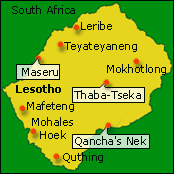
and do also include women from the mountain areas such as Quthing and Mokhotlong. In Maseru and Mafeteng, the major urban areas, 5 percent of antenatal clinic women tested HIV positive in early 1990s. However, in 1994, HIV prevalence among antenatal clinic attendees rose dramatically to over 20 percent. By 2003, the median prevalence of antenatal clinic women tested in all six sentinel sites, was 30 percent. HIV prevalence among women tested in Leribe, Maluti, and Quthing increased from 2 percent in 1991 to over 20 percent in 1996. The median syphilis prevalence among antenatal women was 2.7 percent in 2003.
There is no information available on HIV prevalence among sex workers.
HIV sentinel surveillance information is available for STD clinic patients since the early 1990s. In Maseru, HIV prevalence among STD clinic patients tested increased from 6 percent in 1989 to 11 percent in 1993. In 2000, 65 percent of STD patients tested were HIV positive. Outside of Maseru, HIV prevalence among STD clinic patients increased from 6 percent in 1991 to 59 percent in 1996. In 2000, 51 percent of patients tested were HIV positive. However, this figure may well be biased as testing took place at various hospitals and there is no standardized protocol for testing in hospitals.
|
|
|



