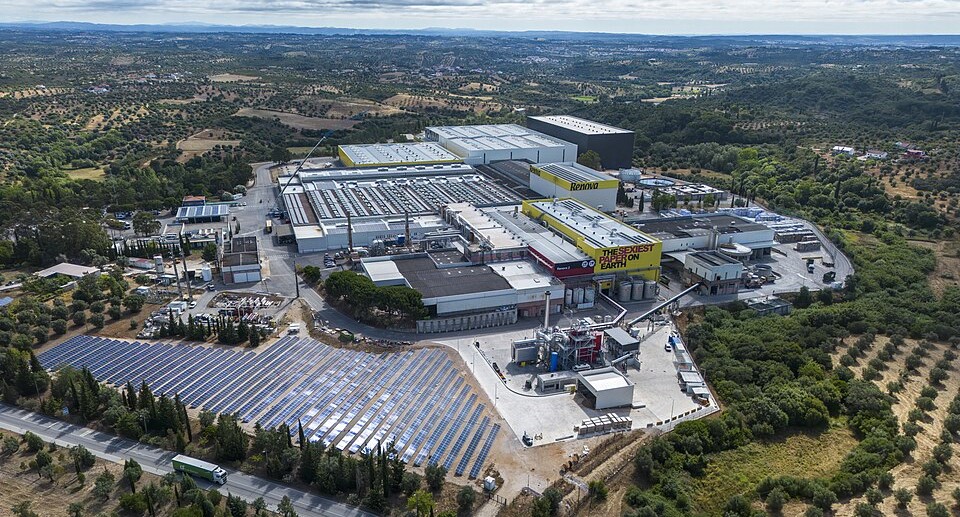
Renova yesterday inaugurated, in Torres Novas, a decarbonization project worth 11 million euros that reduced by 50.6% the carbon dioxide emissions of Factory 2, strengthening competitiveness and reducing dependence on natural gas.
“With this project we took a giant step in the energy transition and in decarbonization,” said Renova’s Chairman of the Board, Paulo Pereira da Silva, during the inauguration of the Decarbonize@Renova project, in Zibreira, Torres Novas, in the Santarém district, a ceremony attended by the Secretary of State for Energy.
The investment, supported by the Recovery and Resilience Plan (PRR), had as its main component the installation of a biomass plant, which replaces a large portion of the natural gas used in steam production with a renewable energy source, enabling a reduction of more than half in the direct and indirect emissions of the industrial unit.
According to Paulo Silva, the project also represents a gain in competitiveness.
“It brought us energy savings, competitiveness, a reduction of the carbon footprint and a lot of coherence for our products,” he stated, emphasising that the commitment to sustainability accompanies the brand’s innovation strategy.
The official highlighted that the project constitutes another step in a continuing investment cycle at the unit installed in Zibreira, in the municipality of Torres Novas.
“In the last 12 years we have invested more than 150 million euros here,” he said, noting that this amount was applied to expanding productive capacity, logistics, automation, energy efficiency and industrial innovation.
Paulo Pereira da Silva also stressed that internationalization remains one of the pillars of the company’s strategy, which exports most of its production.
“It is possible to be a Portuguese brand in the world,” he said, noting that Renova competes with large multinationals in more than 70 countries and records around 10 million purchasing transactions per month worldwide.
The project director, Filipe Almeida, explained that the PRR application initially anticipated a 43% reduction in carbon dioxide emissions, equivalent to about 54,000 tonnes per year, a target that ended up being surpassed.
“We already had a very ambitious project (…), but we managed not only to meet the objectives but to surpass them, reducing 50.6% of our emissions in a single project,” he stated.
According to Almeida, the investment, supported by around 5.8 million euros from the PRR, was carried out through seven energy efficiency measures, with the new biomass plant standing out, which allowed reducing the factory’s natural gas consumption by about half.
The official explained that the company installed the first electric drying unit for paper, strengthened residual heat recovery systems and increased environmental monitoring of industrial processes, measures that contribute to the goal of carbon neutrality.
At the ceremony, the Secretary of State for Energy considered that the project to be “a good example” of the link between energy policy and industrial policy, arguing that decarbonization should be treated as a factor of competitiveness.
“Industrial decarbonization cannot be an abstract idea. It takes shape in the investment decisions of companies, in the modernization of production units and in reducing consumption,” said Jean Barroca.
The official added that projects of this nature demonstrate how public investment can boost the modernization of the national industry.
“We want to see public investment allied with the ambition of our industries to create value, produce more, export more and make the economy more competitive,” he said.
Created in 1939, near the source of the Almonda River, Renova employs 650 workers, is present in more than 70 countries and closed 2023 with a turnover of 248 million euros, 60% of which coming from international markets.