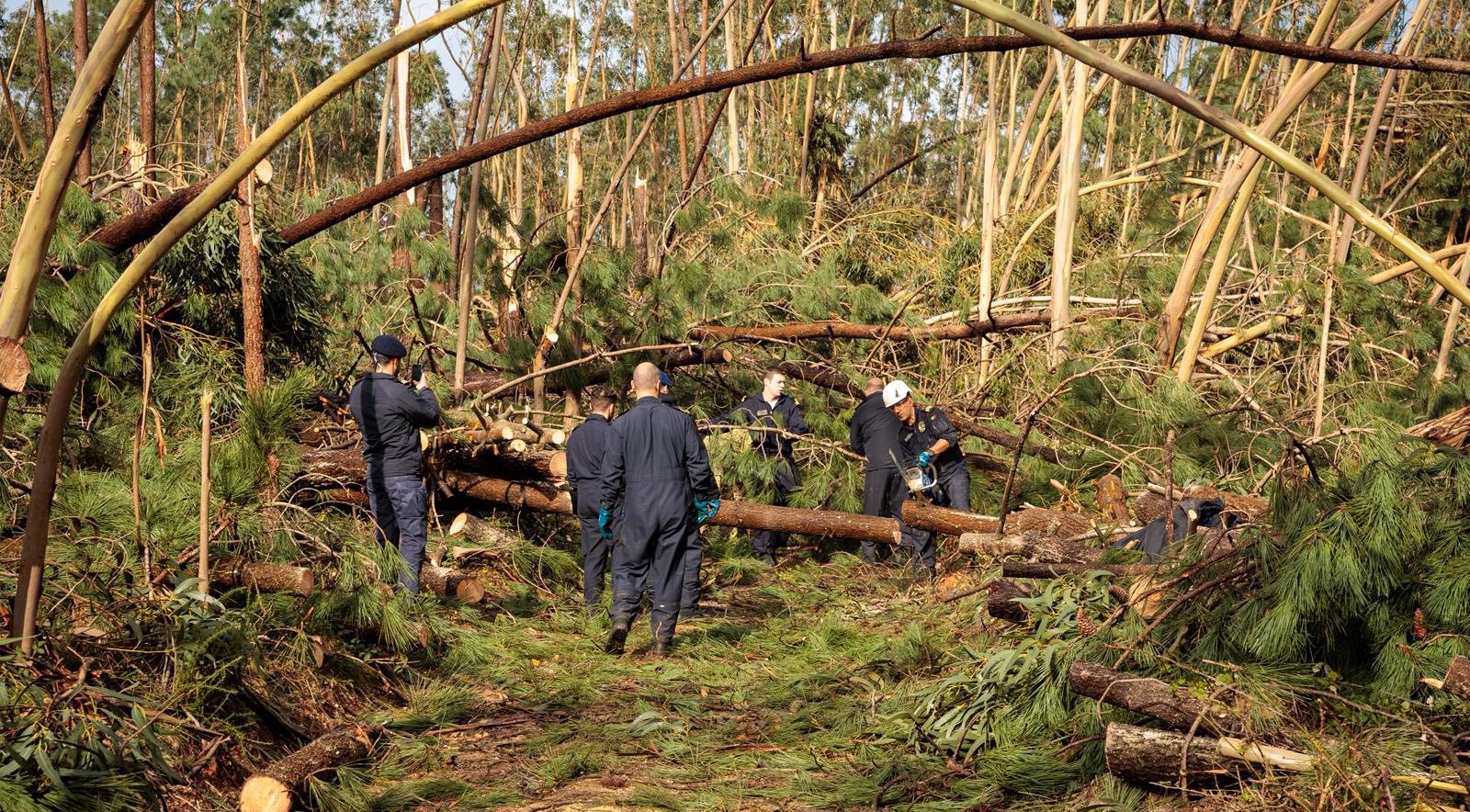
The Institute for Nature Conservation and Forests (ICNF) expects to complete on Wednesday the procedures to remove broken or fallen wood due to Storm Kristin in the area of the Mata Nacional de Leiria bordering urban space.
“If, as we expect, they [the lots] are sold tomorrow [Wednesday], we will have successfully completed the first phase of the Mata Nacional de Leiria, namely the disposal of “all broken or fallen timber that lies in rural-urban interface areas” and that borders dwellings, caravan parks, or the city of Marinha Grande itself,” said the regional director for the ICNF’s Centre region, Paulo Farinha Luís.
“According to Paulo Farinha Luís, ‘this was the first major objective,’ to make available lots that ‘would be the first to be disposed of and would also be the first to be extracted,’ because ‘they pose a greater risk to people and property,’ alluding to the forest fires.
The Mata Nacional de Leiria, also known as Pinhal de Leiria or Pinhal do Rei, covers two-thirds of the Marinha Grande municipality and has 11,021 hectares.
In the October 2017 fires, 86% of its area burned, and what survived those fires — 1,200 hectares, mostly mature trees — was broken or toppled by the Kristin depression about five months ago.
At the end of April, early May, the ICNF held an auction with 29 lots (from different areas, 23 of them in the Mata Nacional de Leiria) of fallen or broken wood for extraction, and the removal of timber from five of them was awarded.
Questioned by the Lusa agency whether five lots is a small number, the ICNF’s board member also explained that “it was always the option not to put on the market earlier and at more favorable prices the State’s timber, allowing private individuals to carry out their own sales as well, without the market being affected by State timber.”
“Since there is a lot of State timber, the timber owned by private individuals was much more abundant, and therefore the risk [of fire] in that regard was greater, and the objective was that that timber could be removed as quickly as possible, especially since private owners have more difficulty in negotiating or finding someone to remove the timber,” admitted the regional director.
Two procedures followed: direct negotiation with a specific person, in this case by invitation to companies that expressed interest in the auction.
In the first procedure, with 22 lots from the Mata de Leiria, the removal of timber from seven of them was awarded, while the second procedure, which is being concluded now, has three lots from Pinhal de Leiria.
Paulo Farinha Luís estimated 23,000 cubic metres of timber to have been removed and to be removed from this woodland at the rural-urban interface through these three initiatives.
After this phase is completed, the ICNF will move forward with a new public auction, which will include the sale of broken or fallen timber from inside the Mata Nacional de Leiria, a state-owned property managed by the ICNF.
“That is the one that, obviously, carries fire risk, but probably the risk to people and property is lower or, I would even say, much lower, because it is in remote zones,” he said, ensuring that this task will not be hindered by accessibility.
The official explained that “accessibility is good in all places, in so far as the first task and the first step” after the Kristin depression was “the cleaning and clearing of the road network.”
“Everything related to accessing forest exploitation, we have already completed,” he assured.
In this work of removing from the forests the wood that bad weather destroyed, the regional director for the Centre pointed out that the greatest difficulty lies in factors beyond the public institute’s control.
“The first major external factor that escapes our control (…) is the installed capacity of operators who can, in a very short time, remove the timber from the affected areas. It was a very large area, and in a short time there was a lot of timber to remove. And the private companies themselves, all, even if they allocate their means to the whole Centro region, are too few for what we want,” he acknowledged.