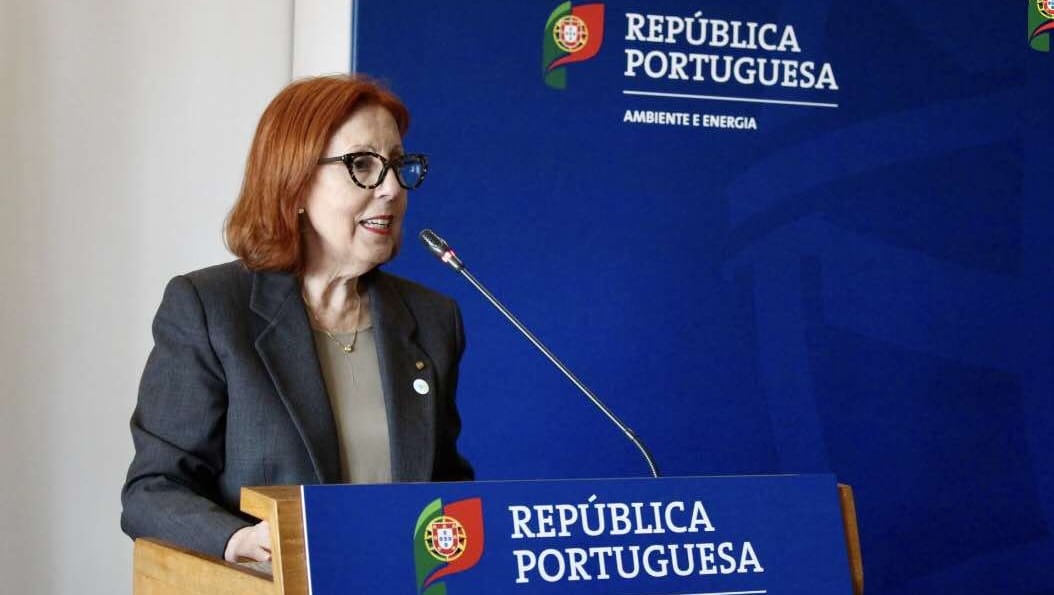
The Government today unveiled a strategy to store energy using batteries and pumped-hydro storage, aiming to bridge periods of deficit, achieve greater sovereignty, and contribute to price stabilization.
The National Storage Strategy, developed based on studies by INESC-TEC and the Instituto Superior Técnico, will also enter public consultation, and the part concerning hydro storage requires authorization from Brussels, said the Environment and Energy Minister, Maria da Graça Carvalho.
The document presented at the ministry in Lisbon outlines different scenarios for the horizon 2026–2030 and 2026–2040, aimed at Portugal reducing its need to import energy and to incorporate more renewable energy.
“It will enter public consultation and we will choose the scenario,” said the minister, indicating that there will always be “a mix between battery storage and pumped-hydro storage.”
If battery storage does not require negotiations with Brussels, except for the capacity mechanism – in which negotiations have already begun – for hydro storage, the next step is to negotiate with the European Commission: “It is a matter of state aid, but it will surely be a negotiation that will be concluded quickly,” added Maria da Graça Carvalho.
“As soon as we have Brussels’ authorization, we will open a tender for pumped-hydro storage, which we hope will still be possible by the end of the year,” she indicated.
“Storage is important, because it allows us to take advantage of the available renewable energies. When there is a lot of sun and little consumption, in a sense we lose that energy and this will enable storing and using it when there is less sun and less wind and high consumption,” the official explained to journalists at the end of the presentation of the technical reports.
According to the minister, the measure is important for security of supply, for price, for the system’s competitiveness, and for decarbonization.
Municipalities hosting the projects to be auctioned in this first phase of battery installation will retain part of the annual revenue, with a 2.5% share foreseen.
“If we do not have more storage and greater capacity of the electricity grid, we are reaching a limit; we are already in the eighty-something percent range and, therefore, to move forward safely we need pumped-hydro storage, batteries, and strengthening of the grids,” she argued.
Regarding the grids, Maria da Graça Carvalho also announced that this week (the 2nd) the very high voltage interconnection between Portugal and Spain, in Alto Minho, will be inaugurated, in a 44-million-euro investment, which began in July 2024.