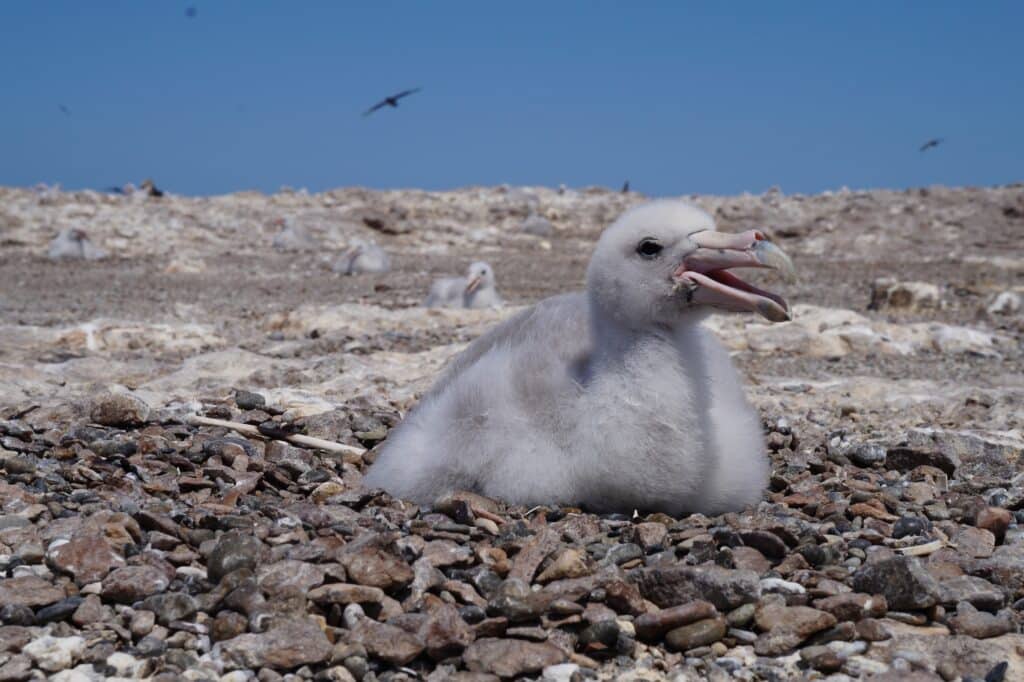
The Antarctic petrels (Macronectes giganteus) are birds that inhabit the southernmost marine and coastal zones of the planet, from Antarctica to Chile, passing through Argentina, the southern part of Africa and the Australian coast. Yet, not even in the remote regions where they live are they protected from the pollution generated by humans.
A study conducted by researchers at the Institute of Marine Organism Biology (IBIOMAR), of the Universidad Nacional del Litoral, both in Argentina, and the University of California at Davis (United States of America) reveals the risks faced by Antarctic petrel chicks due to plastic pollution carried by ocean currents.
Plastics tend to accumulate at the surface of the sea, where adult seabirds also search for food for themselves and to take to their chicks, which wait for the parents on land. However, adults may be carrying much more than fish.
In an article published in the journal ‘Ecotoxicology and Environmental Safety’, the scientists say they detected plastic in the stomachs of more than 71% of the chicks they studied at two colonies in Argentina, on the Arce and Gran Robredo Islands. All indications point to the parents ingesting plastics at sea and inadvertently feeding them to their chicks as if they were food.
When analyzing the development of the chicks, the team realized that even small quantities of plastic, relative to the animal’s body mass, have significant impacts on the health of the young birds, especially those about one month old.
“Counting pieces of plastic is only part of the story,” says Luciana Gallo, the paper’s first author.
The IBIOMAR researcher explains that “these chicks seemed healthy, and the amount of plastic we collected was minuscule, but we still saw changes in indicators related to nutrition, metabolism and immune function.”
The changes were more subtle or even non-existent in chicks around three months old, near the age when they learn to fly, but the scientists do not know whether this is because the animals’ bodies learn to compensate for plastic contamination or whether younger chicks are more exposed to pollution.
In any case, the authors of this work believe that the results should raise greater attention toward this species and other seabirds. Even though this is not an endangered species, in the long term plastic pollution could have significant impacts on Antarctic petrels.
“In the case of long-lived seabirds, such as the Antarctic petrels, which reproduce slowly and are already exposed to multiple pressures at sea, even small effects on development, survival and, subsequently, on chick recruitment can have long-term importance,” explains Marcela Uhart, the study’s principal co-author.