A large number of plankton travel from the cold, dark depths of our oceans to the surface, only to descend back into the darkness in a perpetual rhythm.
However, the way in which unicellular phytoplankton, most of which lack appendages to help it swim, make this pilgrimage has remained a mystery.
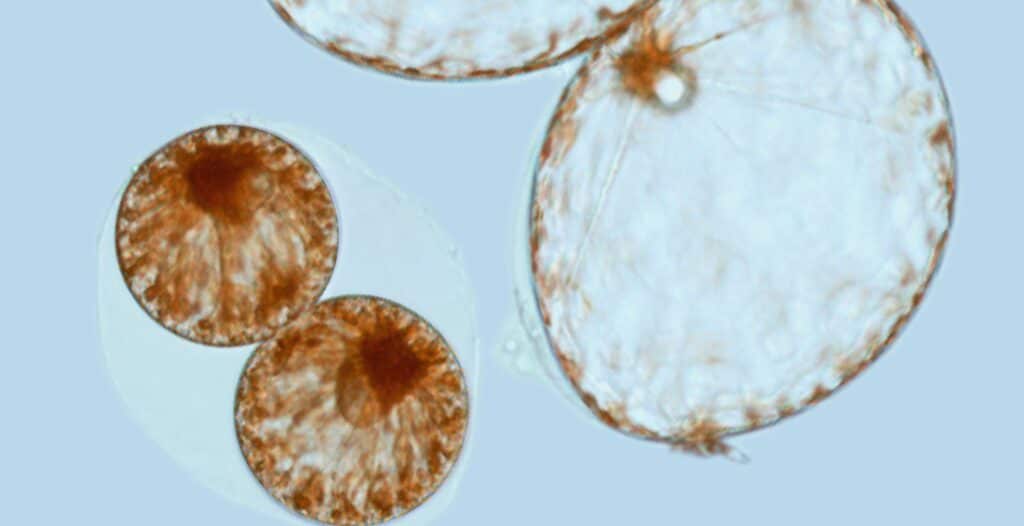
In a article published in the journal Current Biology from Cell Press, the researchers describe a bioluminescent species of phytoplankton, called Pyrocystis noctiluca, that becomes six times larger than its original size of a few hundred microns.
This massive inflation allows the plankton to travel up to 200 meters toward the ocean surface to capture sunlight, then sink again, which constitutes a unique strategy for traveling long distances in the ocean.
Phytoplankton, on average, is 5%-10% heavier than seawater, which means that if they want to remain at the surface to photosynthesize, they must find a way to overcome gravity. “We decided to work with things that apparently have no appendages to swim,” says senior author Manu Prakash (@PrakashLab), a marine biologist and bioengineer at Stanford University.
“What we discovered in this article is that these cells of P. noctiluca are like small submarines that can control their density with such precision that they can choose where they want to be in the water column,” he explains.
On a research vessel off the coast of Hawaii, Prakash and a Stanford University postdoctoral researcher, Adam Larson (@Planktonico), one of the study’s early authors, encountered a proliferation of P. noctiluca and, surprisingly, found two sizes very different in their networks.
“It took some time to figure out why, until we recorded videos in which we saw the cells inflating en masse,” Larson says. “It can happen very abruptly, so if we sleep beside the microscope for 10 minutes, we might not see it,” he reveals.
To test the effects this rapid growth could have on the plankton, the research team used their new “gravity machine.”
“The gravity machine lets us see a single cell with subcellular resolution in an infinite column of water,” says Prakash. “It’s a bit like a Ferris wheel for gerbils or mice, but for a single cell. It is the size of a dinner plate and it rotates, so the cell does not know that it is not moving up or down in its own frame of reference.”
By altering the pressure and density of the water inside the gravity machine, the team can create an environment of virtual reality that mimics the depths of the ocean.
With the machine, the team discovered that the inflated cells were less dense than the surrounding seawater, which allowed them to escape the downward force of gravity and float toward the virtual surface.
Further investigations revealed that this expansion occurs as part of the plankton’s natural cell cycle. When a unicellular plankton divides into two, an internal structure called a vacuole, a kind of flexible water reservoir, takes in freshwater, causing the two new cells to swell enormously in size. These two daughter cells, now inflated with the lighter freshwater, navigate upward.
“We realized that this is a very clever way to essentially cast a spear into the ocean during cell division,” says Prakash. “So, what happens during normal times? We are producing many proteins, we have tons of sunlight and we produce a lot of biomass until we become heavier and sink. Then, cell division occurs in the deeper waters and inflation is used to return to the mother’s size.”
The complete cell cycle lasts about seven days, coinciding with the vertical search for light and nutrients by the plankton. “Thus, we can see how this cell cycle may have evolved,” says Prakash. “I think this is the first time we have clear evidence that the cell cycle, a fundamental mechanism of cellular control and cell division, is possibly controlled by an ecological parameter.”
With these insights in mind, using a theoretical framework, the team identified the ecological parameter that acts as a fundamental limit driving this evolution.
“All cells suffer a downward gravitational pull and, unless they or their descendants push back, they will sink forever to the bottom of the ocean in a gravitational trap,” says the postdoctoral fellow Rahul Chajwa, the other lead author of the study, also from Stanford University.
Now, using the gravity machine results, as well as their ecological and physiological observations, the research team developed a mathematical framework that can be generalized and applied to all of the ocean’s plankton.
For future projects, Prakash’s lab aims to unlock the hidden mysteries of a vast number of plankton that might use the new biochemistry to regulate density and move up and down the water column.
“Right now, we have around 600 species in our Behavioral Atlas and we are systematically measuring all kinds of mechanisms. We are systematically measuring all kinds of mechanisms. It is emerging that there are four or five different tricks that co-evolved for this function. I think one of the most fun aspects is the fact that we have a long list of organisms to study; since there are millions of species living in the ocean, this is the tip of the iceberg.”
Hongquan Li, a graduate student in the Prakash lab, is also one of the study’s authors.