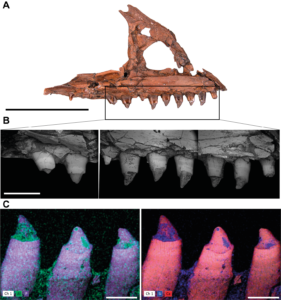
An international team led by researchers from the Faculty of Sciences of the University of Lisbon (Ciências ULisboa) identified one of the rare known examples worldwide of direct evidence of digestion preserved in fossils of non-avian dinosaurs. The study, published in the journal Papers in Palaeontology, describes corrosion marks caused by gastric juices on the maxilla of a newborn Allosaurus, originating from the Guimarota deposit in Leiria.
The research was led by Elisabete Malafaia, of Instituto Dom Luiz and Ciências ULisboa, in collaboration with Bruno Maggia (Instituto Dom Luiz/Ciências ULisboa) and Oliver Rauhut (Bayerische Staatssammlung für Paläontologie und Geologie and Ludwig-Maximilians-Universität München).
The fossil, about 155 million years old, belongs to a newborn individual of Allosaurus, one of the principal predators of the Late Jurassic. The analyses revealed an unusual pattern of corrosion concentrated at the tips of the teeth, compatible with the action of gastric fluids. The researchers conclude that the animal would have been partially digested before being regurgitated by a predator.
This is the first record of a partially digested theropod dinosaur from the Late Jurassic in Portugal and one of the few known cases worldwide with digestion marks preserved in non-avian dinosaurs. The discovery provides direct evidence of predator-prey relationships in ecosystems around 155 million years old and opens new perspectives for the study of the ecology and feeding behavior of these animals.
The Guimarota deposit, recently distinguished as a Geo-collection by the International Union of Geological Sciences (IUGS), is internationally recognized for the richness and diversity of Late Jurassic fossils, preserving primitive mammals, crocodilomorphs, pterosaurs and various groups of dinosaurs.
This work results from a collaboration between Instituto Dom Luiz / Ciências ULisboa, the Bayerische Staatssammlung für Paläontologie und Geologie, Ludwig-Maximilians-Universität München, the HERCULES Laboratory (University of Évora), Instituto Superior Técnico, the Geological Museum (LNEG) and the National Museum of Natural History and Science of the University of Lisbon.