
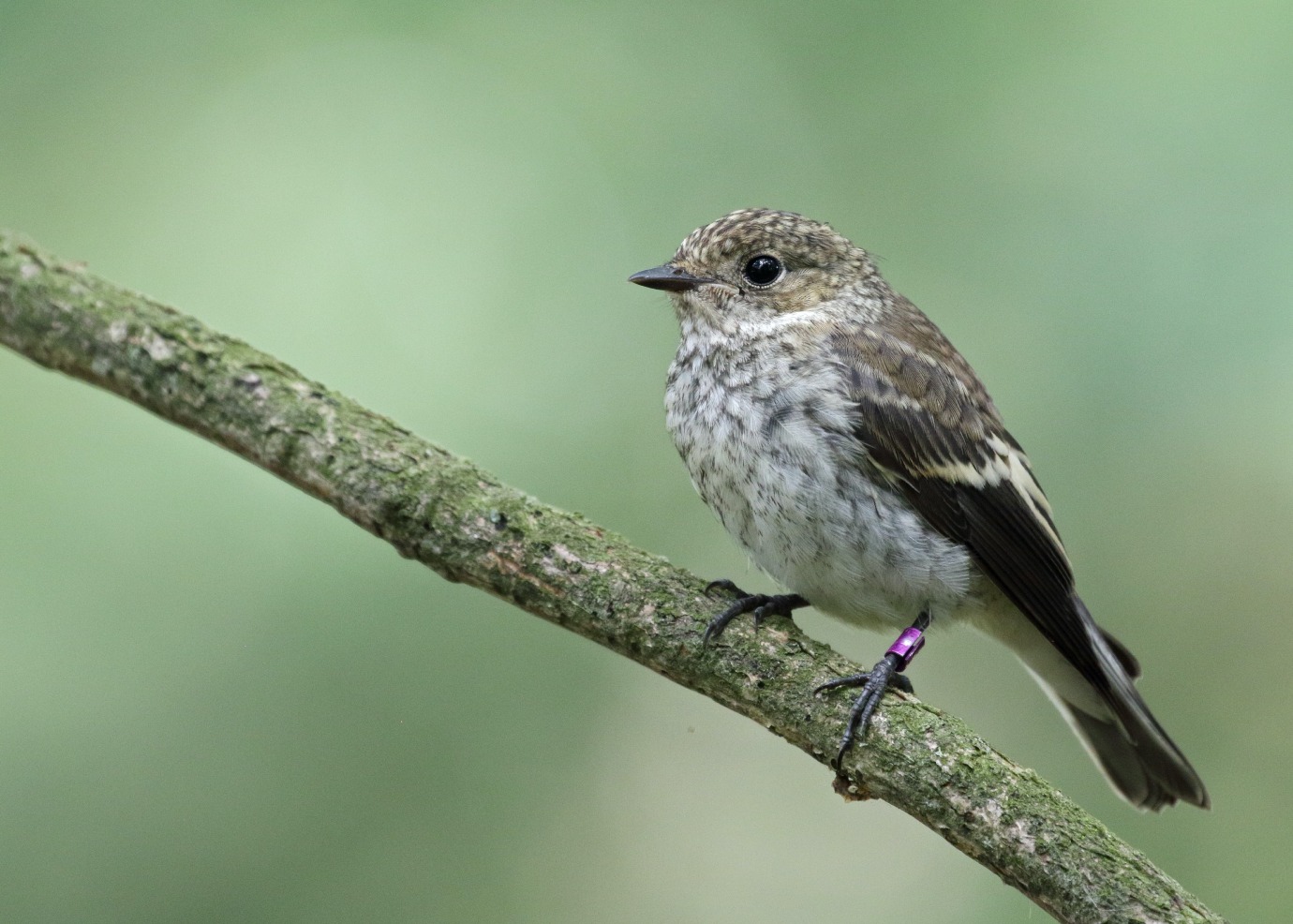
Migratory journeys are among the greatest mysteries and wonders of the natural world. Every year, several animals travel hundreds or thousands of kilometers to feed, reproduce, or to pass the coldest or hottest months.
However, how these sites are chosen and how the animals manage, so precisely, to hit them has remained questions without answers, at least without leaving large margins for doubt. Now, a new investigation shows that the migratory routes of a species of songbird are defined by both its genetic code and environmental factors.
Through devices strapped on like small “backpacks,” a group of scientists studied the migrations of the black flycatchers (Ficedula hypoleuca), tracking the small birds over thousands of kilometers on land and at sea.
Coordinated by the University of Groningen (the Netherlands), in collaboration with other European institutions, the research reveals that black flycatchers from different regions of Europe end up reaching the same wintering locations in Africa, following consistent routes, even if they are not the most direct.
Starting from Spain, the Netherlands, Sweden, or Siberia, the birds were followed to their wintering sites. According to the results, all populations first paused in Spain or Portugal to pass the autumn. From there, they embarked on a non-stop flight of about 40 hours across the Atlantic to the westernmost tip of Africa, before turning eastward.
Some black flycatchers did not venture much farther, such as those from the population that breeds in Spain, which traveled about 3,000 km, but those from Siberia, on the contrary, went as far as Nigeria, flying almost 13,000 km because of the detour they took toward the Iberian Peninsula.
“It is incredible that these black flycatchers from Siberia make such a large detour,” says Koosje Lamers, from the University of Groningen and the first author of the article published in the journal Science.
The researcher notes that, for example, if they had taken a more direct route, crossing the Mediterranean near Italy and then crossing the Sahara Desert, they would have shortened the journey by almost 4,500 km. In fact, that route is used by a close relative, the collared flycatcher (Ficedula albicollis), to migrate from Central Europe to Africa.
“Thus, it is plausible that this peculiar detour is a vestige of the past, when, during the Ice Ages, the black flycatchers occurred only in the western region of Africa and in Europe,” suggests Lamers.
Year after year, the black flycatchers from a given breeding area migrate to Africa for the same wintering grounds. That is, those that breed in Spain occupy one area and those from Siberia another, a pattern that repeats every year.
Through laboratory experiments, in which eggs of the Ficedula hypoleuca from the Netherlands were taken and raised in Sweden, the researchers found that the specific wintering locations these birds pass the winter at are determined by the combination of genetic and environmental factors.
The Dutch black flycatchers spend the winter about 500 km away from those in Sweden. However, the Dutch birds that were born and raised in Sweden chose wintering locations halfway between those of the natural Dutch and Swedish populations.
“This study demonstrates that the place where the black flycatchers spend the winter is, in part, inherited and, in part, determined by the environment in which they grow up,” explains Malcolm Burgess, from the University of Exeter and coauthor of the study. And he adds that the fact that the data indicate migratory behavior “is not learned from the parents” could prove important for understanding how migratory birds may adapt to climate change.
“The migration calendar is undergoing significant changes due to climate change, and the birds’ ability to anticipate that calendar is linked to the place where they spend the winter in Africa,” he notes.