Nearly 25% of the continental Portugal coastline is retreating due to rising sea levels, with more than 100,000 people currently living in coastal zones at high risk.
This is one of the main conclusions of a report released this Thursday by Greenpeace Portugal. With the title Destruction Along the Entire Coast – Portrait of a Portuguese coastline at risk, the analysis points out that the vulnerability of the Portuguese coast is not only due to the effects of climate change, but also to “decades of occupation and urban pressure” and to “weaknesses in the application of the rules that should protect the coast.”
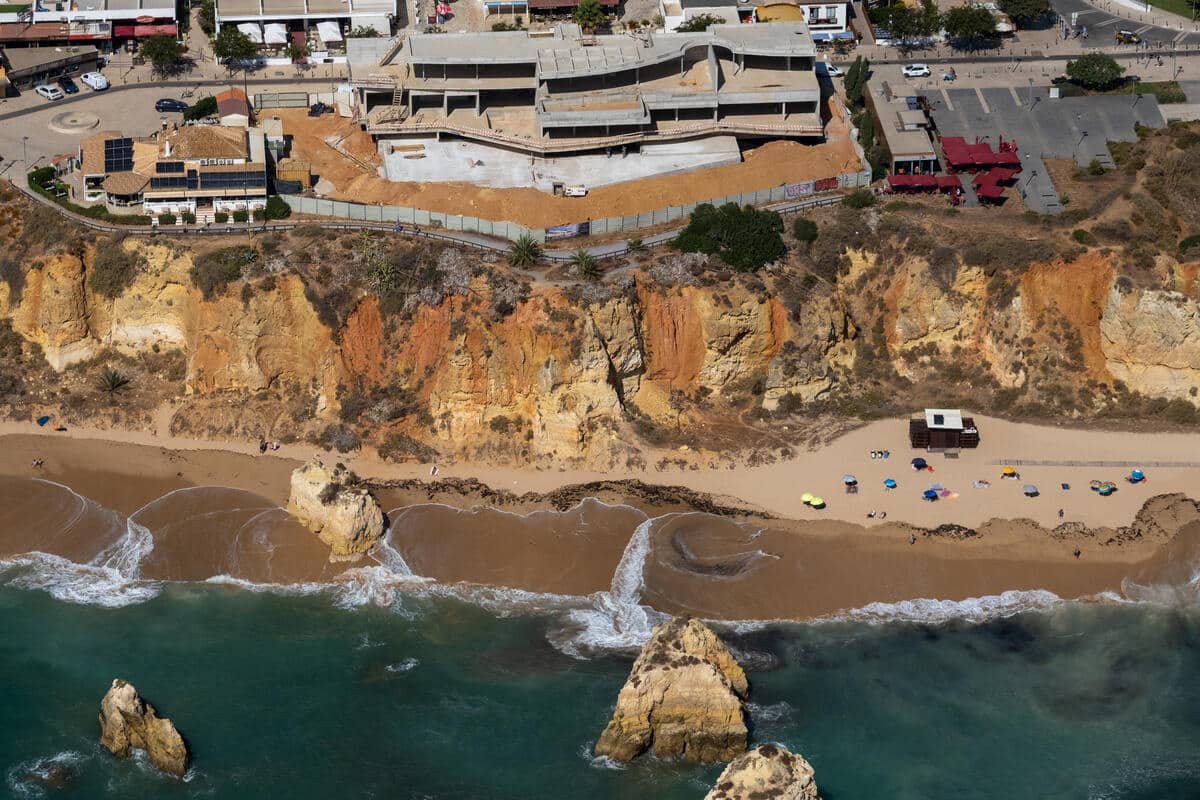
The environmental organization highlights examples from the Cascais area, where the average sea level has risen 9.7 centimeters in the last 25 years, and from the Algarve, where it is predicted that 40% of beaches could disappear under the waves by 2050 “without urgent adaptation measures.”
Acknowledging that Portugal has legislation and planning instruments “intended to protect the coastline,” but that there continue to be “weaknesses in the application, enforcement, coordination and updating of the rules in light of evolving risks,” Greenpeace states that the Portuguese coast is “trapped between the advance of the sea and the advance of construction.”
“Portugal has long known the risks that threaten its coast,” says the director of Greenpeace Portugal, adding that “we have scientific knowledge, legislation and planning instruments.”
For this reason, Toni Melajoki Roseiro believes that “we cannot keep waiting for a beach to disappear, a cliff to collapse or an infrastructure to be put at risk, in order to act.”
“The challenge now is to turn what we know into coherent political decisions and into a long-term strategy capable of protecting people, nature and a territory that belongs to all,” declares.
However, there is still time to rescue Portuguese beaches from the ongoing advance of the sea onto land. Ana Farias Fonseca, Campaigns and Mobilization Coordinator of the Portuguese organization, says that for this it is necessary “to halt new occupations in vulnerable areas and to invest in prevention and restoration of ecosystems, ensuring that today’s decisions do not become irreversible problems and the high public costs of tomorrow.”
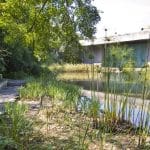
Preserving and restoring coastal ecosystems and wetlands, such as dunes and salt marshes, is a fundamental part of these coastal protection efforts, as they help absorb the energy of storms, reduce the impacts of erosion and floods, and increase the coastal strip’s capacity to adapt to extreme events.
Without these defenses, the coastal zones, along with all their natural heritage, as well as infrastructure and people, are exposed to the force of the sea and storms, which are expected to become more frequent and intense as climate change worsens.
The report is accompanied by an interactive map that gathers photographs and information about around 350 of the Portuguese coast’s most vulnerable points.
From Costa da Caparica to Espinho, from Costa Nova to Figueira da Foz, from Tróia, Comporta, Carvalhal and Melides to the Alentejo coast, from the Algarve to Madeira and the Azores, the map allows visualizing what Greenpeace describes as “different faces of the same problem”: erosion and retreat of the coastline, urban pressure, occupation of vulnerable zones, degradation of ecosystems and difficulties adapting to climate change.
The organization asserts that, with this map, its objective “is not to create a ranking of the most severe zones, but to show that risk takes different forms across the whole territory and that no region can be analyzed in isolation from how Portugal chooses to occupy, protect and adapt its coast.”