Amphibians are considered the most threatened group of vertebrates in the world. It is estimated that about 41% of all species worldwide are at risk of extinction, and the populations of this class continue to decline.
Between 1980 and 2004, 91% of the worsening conservation status of amphibians was caused by disease and habitat loss. Since then, climate change has taken on an increasingly prominent dimension in the list of threats faced by these animals, a threat whose effects are amplified by the ongoing destruction of their habitats.
With approximately two in five amphibian species currently being pushed ever closer to the brink of extinction, scientists are calling for urgent measures to conserve their habitats and curb the causes of large losses.
One of the great “laws” of the sciences devoted to Nature conservation states that you cannot protect what you do not know. Therefore, knowing how amphibians, and other organisms, cope with the effects of climate change is essential to know how and where action is needed.
A group of researchers, led by scientists from the Centre for Ecology, Evolution and Environmental Changes (CE3C) of the Faculty of Sciences of the University of Lisbon, discovered that a frog occurring in the Iberian Peninsula, southern France and northern Africa is capable, when still in the tadpole stage, of adapting to the increasing water temperature where it is developing. However, this capacity has limits, which may be severely tested as the Earth’s average temperature continues to rise, because humans keep releasing greenhouse gases into the atmosphere.
Changing feeding habits
Like reptiles and most fish, amphibians are ectothermic animals, or, if you prefer, “cold-blooded.” This means that their body temperature is essentially regulated by the temperature of the surrounding environment. Thus, the water temperature in which tadpoles hatch and grow can not only determine whether they develop healthily and may face health problems as adults, but also, ultimately, their survival.
In warmer waters, the animals’ metabolism speeds up, spending more energy and, therefore, forcing them to consume more calories to maintain a good body weight. In an article published in the journal Scientific Reports, the researchers found that the tadpoles of the common toad (Bufo spinosus) are capable of altering what they eat according to the water temperature.
To do this, they created, in the laboratory, tadpoles captured in the Sintra Mountains, under different temperature conditions of 12, 16 and 20 degrees Celsius, and with distinct feeding regimens.
While studying the little toads, it was noticed that when the water was cooler, they consumed more animal-based foods, in this case, mosquito larvae. However, in warmer waters, the tadpoles ate more plant matter (spinach, in this experiment) and increased the rate of consumption.
To Green Savers, Sara Bento, CE3C researcher and the study’s first author, says that this diet adaptation to the water temperature allows common toad tadpoles to “reduce some of the negative effects associated with rising temperatures.” However, she warns that this capacity has limits, because, beyond a certain point, when the water becomes too hot, it is possible that there will be no diet change that allows the small amphibians to turn the problem of energy loss around.
“In that situation, even a balanced and considered optimal diet may no longer be sufficient to compensate for the metabolic costs,” the scientist notes.
And the limits of this adaptation capacity are especially strained when the water temperature remains above average for a long time or during heatwaves. As this study only tested temperatures up to 20 degrees, Sara Bento says it was not possible to know exactly from which temperature this capacity is nullified, which, to discern, will require further investigations at higher temperatures.
Faster development, but poorer physical condition
The investigation also revealed that, in warmer waters, common toad tadpoles develop faster, but, when in the final form, they end up smaller than toads that developed in cooler waters and exhibit poorer physical condition.
“This relationship is already widely known in ectothermic animals and is referred to as the ‘temperature–size rule,’” explains Sara Bento. “In hotter conditions, development tends to accelerate more than growth, causing animals to reach maturity with a smaller body size.”
Thus, tadpoles that spent their larval phase in warmer waters may, after metamorphosis, move to dry land with less weight and also with fewer energy reserves. And this, according to the researcher, “may affect their performance during the juvenile and adult stages in the terrestrial environment.” Still, it is possible, though not certain, that common toads that left the water smaller could recover when in the semi-aquatic portion of their lives and compensate for the problems caused by the higher temperatures of the waters where they developed.
Therefore, Sara Bento tells us that “our results do not allow us to state that this isolated effect represents a threat to the species’ survival.” However, she acknowledges that they point to a “potential risk factor,” which she describes as “important,” especially if the warming of water temperature combines with other factors such as food shortage, drought or predation.
In addition to the temperature effects on the development of frogs, this work also showed that warmer waters alter the concentrations of nitrogen and carbon in the tissues of the animals in their final life stages, i.e., during the juvenile and adult phases of their lives.
This suggests that, at higher temperatures, tadpoles struggle more to maintain “the balance of nutrients in the body,” as the scientist notes, which may result from changes in the diet the animal makes to compensate for the effects of higher temperatures.
Although this was not assessed in this study, Sara Bento does not rule out the possibility that frogs, when they leave the larval stage, may later recover the nutrient balance in their tissues. But it is possible that this imbalance could render common toads, at least the juveniles that emerged from warmer waters, less nutritious prey for their predators.
More knowledge is needed to be able to protect
The common toad is listed on the IUCN Red List of Threatened Species with the status of “Least Concern,” and thus is not considered a species at risk of extinction. This status is also reflected in Portugal’s Red Book of Vertebrates of 2005, when it still bore the scientific name Bufo bufo.
In the Atlas of Amphibians and Reptiles of Portugal, published in 2008, it is stated that the common toad is a species that occurs “continuously” from north to south of the country. However, according to the same source, this species previously regarded as “very abundant” was at the time undergoing “a generalized decline in its populations across much of the Iberian Peninsula and, in particular, in the drier zones.” This decline was largely due, the specialists wrote, to the destruction of its breeding sites, harmful algal blooms in the ponds and reservoirs where they live due to intensive farming, competition with exotic species and even to the persecution they face from humans, driven by aversion.
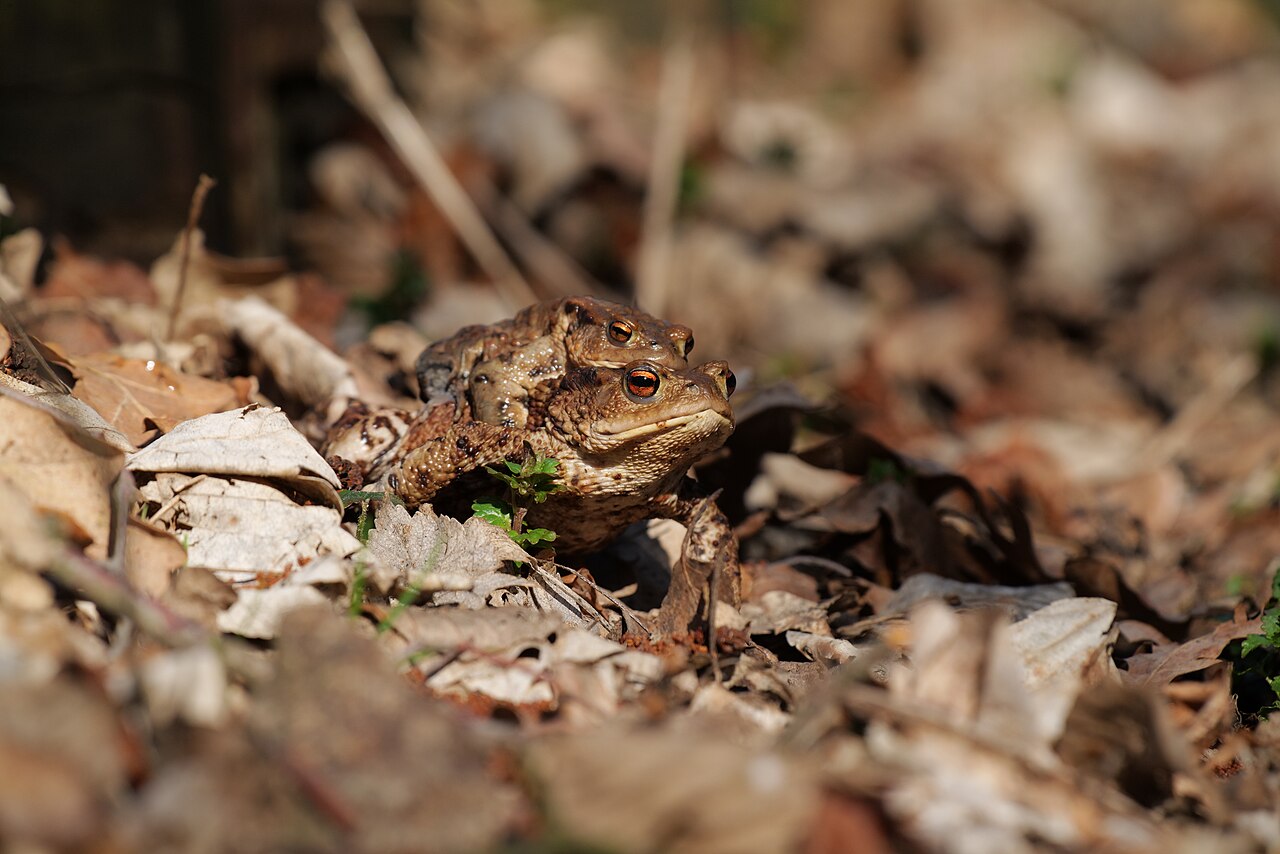
Moreover, these toads can travel several kilometres to reach breeding sites, which leads to high mortality due to roadkill.
However, “there are not enough recent data to characterize, with confidence, the current population trend of this species in Portugal,” says Sara Bento. Therefore, she argues that an “update” of information on common toads in the country would be important, “based on standardized monitoring of the distribution, abundance and reproductive success of populations.”
“Only with these data will it be possible to detect declines, identify their causes and evaluate more rigorously the possible worsening of the conservation status of this and other species,” declares the CE3C researcher.
For now, she says that “the priority should be to protect local breeding habitats,” such as pools, ponds and stretches of riverbank, to ensure they retain water “long enough for the tadpoles to complete metamorphosis.”
“With the expected rise in temperatures and extreme climatic events such as heatwaves and severe droughts in the Mediterranean region, this water-covered period may become shorter and more irregular,” she warns. Therefore, she underlines that it is important “to limit drainage and water extraction during the breeding season, preserve water quality and riparian vegetation, maintain shaded areas that function as thermal refuges and restore or create networks of shallow pools with different depths.”
And these measures would not benefit only the common toads, but also “many other amphibian species and organisms dependent on these ecosystems,” she assures.
Putting the common toad in the lead role, serving as a “model species,” this team of scientists sought to understand how ectothermic animals, especially amphibians, respond to rising temperatures, an indelible feature of the climate changes currently afflicting the planet.
But Sara Bento says that the mechanisms she and the rest of the team observed during this investigation “could be relevant for many other species, including species with more concerning threat status.”
In addition to CE3C, this work also involved the Terra Associated Laboratory, CHANGE – Institute for Global Changes and Sustainability, the Polytechnic Institute of Leiria, the MARE – Center for Marine and Environment Sciences, and British and Swedish institutions.