Leading the sustainable transition was the leitmotif of the 8th Green Savers Conference, which took place this Tuesday, October 27, at the Orlando Ribeiro Library Auditorium in Telheiras, Lisbon. The morning brought together companies, associations, academia, and local authorities around three verbs, transform, cooperate, and mobilize, and also marked the sixth anniversary of the Green Savers magazine.
At the opening, Rogério Junior, CEO of Green Savers, recalled that the transition “is no longer done in sustainability reports,” but in investment decisions, in the selection of suppliers, and in energy management. At a time when Brussels is easing some reporting obligations, he posed the question that ran through the morning: “what keeps the course when the pressure of the law eases?” The answer, he argued, lies in leadership, and the challenge to the audience was for each person to leave the room “with at least one concrete decision” to put into practice the following week.
A problem for centuries
It fell to Filipe Duarte Santos, president of the National Council for the Environment and Sustainable Development (CNADS), to draw the global portrait. The geophysicist reminded that sustainability is a concern little more than 50 years old, since the United Nations Conference on the Human Environment, in Stockholm, in 1972, and that of the nine planetary boundaries identified by scientists six have already been breached. He warned that climate change is “a problem that will persist for centuries,” because part of the carbon dioxide emitted remains in the atmosphere for a long time.
Regarding Portugal, he highlighted that 71% of electricity came from renewable sources in 2024 and 68% in 2025, the third-best result in the European Union, but reminded that dependence on fossil fuels hovers around 75% and that unbilled water, due to leaks and measurement errors, reaches about 27%, and more than 60% in some municipalities. To show that adaptation is possible, he gave Madeira as an example, where works carried out after the 2010 flood prevented casualties in an even stronger downpour in 2023. For companies, he urged them to go beyond “measuring, reporting” and move to “innovate, invest, transform, cooperate, adapt.”
From management to the value chain
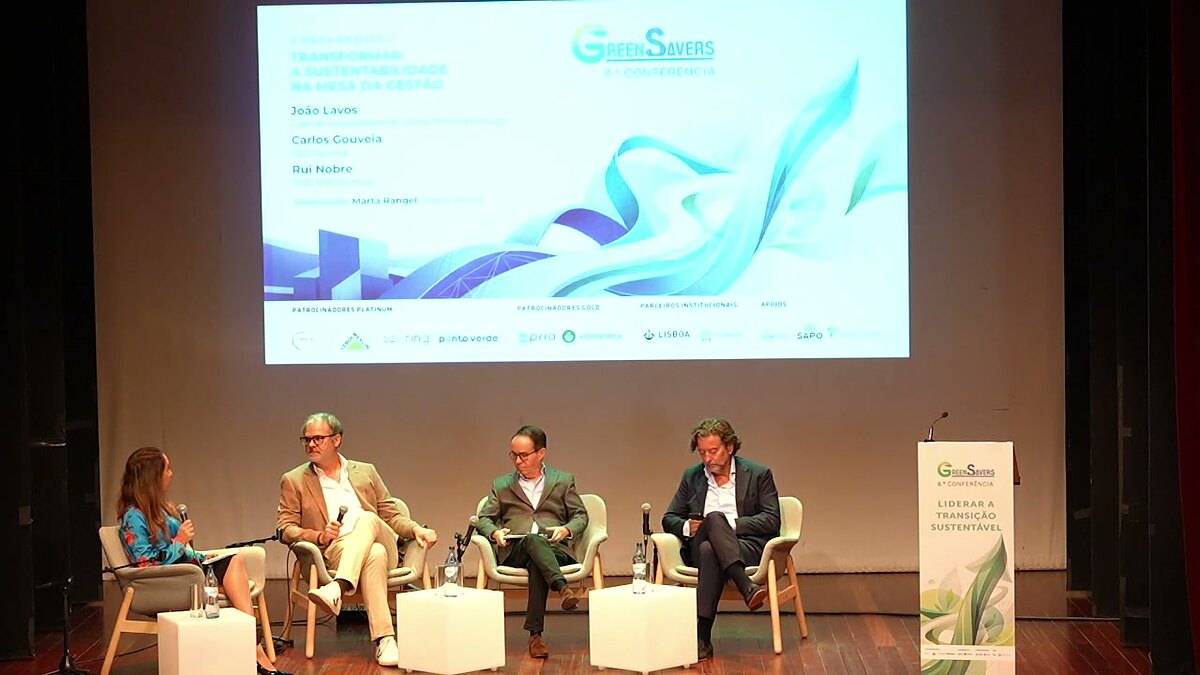
In the first panel, “Transforming: sustainability on the management agenda,” moderated by Marta Rangel, value creation was the idea repeated most often. João Lavos, Director of Positive Impact and Sustainability at LEROY MERLIN Portugal, explained that about 93% of the company’s carbon footprint comes from manufacturing, transport, and the use of the products it sells, and that the Home Index evaluates each of these in 31 criteria, an assessment shared with suppliers, who risk losing their place in the catalog if they do not keep up. Within the company, employee compensation is partly linked to 12 indicators, six human and six environmental, and therefore “they earn more if they are more sustainable.” Regarding circular businesses, such as repair and second life, they still struggle to scale up, but “they are profitable businesses,” he guaranteed.
Carlos Gouveia, CEO of Scoring, criticized targets that slid from 2030 to 2050 without technical basis: “It’s easy to announce. What is difficult is turning that into the reality of the company.” Reporting, he argued, “is the last thing in the line” and must arise from a materiality analysis and an action plan. Rui Nobre, COO of DPD Portugal, showed how the company’s network of about 2,300 collection points removes around 300 vans from the roads daily and eliminates failed deliveries, and he said that at DPD Portugal an electric vehicle already has a lower total cost of ownership than a combustion one. But he challenged the room: how many choose the electric option when they summon a car via an app if it costs 50 cents more?
Cooperating: no one closes the loop alone
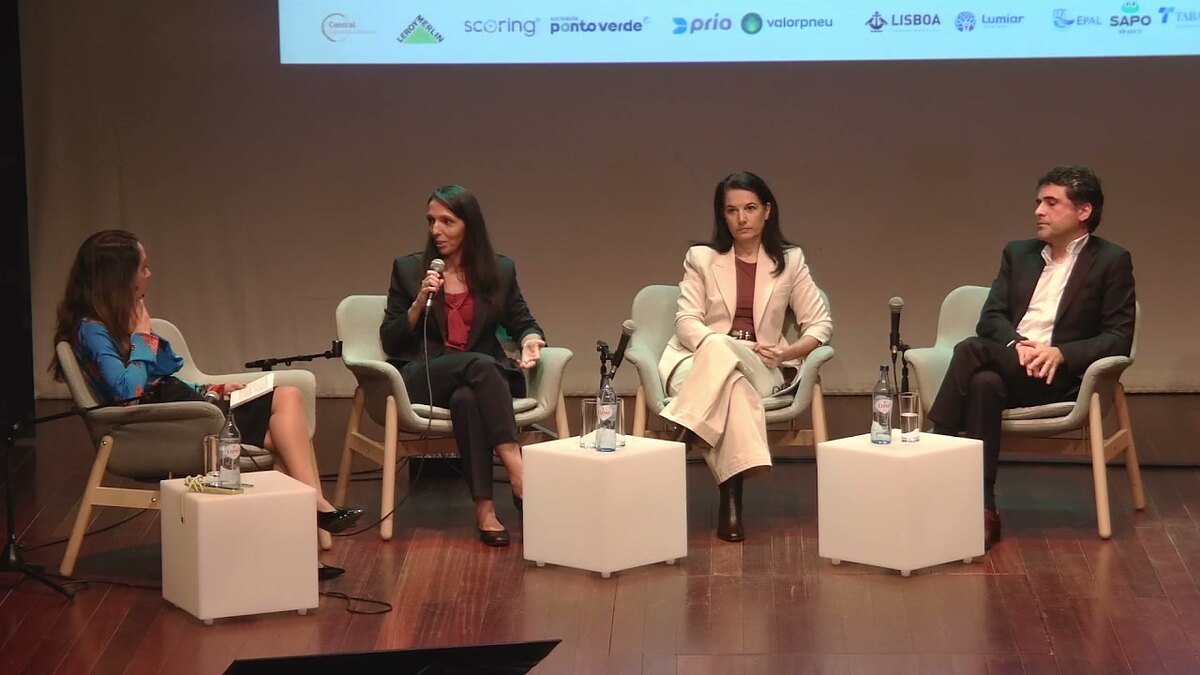
The second panel, “Cooperating: no one closes the cycle alone,” also moderated by Marta Rangel, followed the packaging value chain from one end to the other. Susana Almeida, Customer Services Director at Sociedade Ponto Verde, showed projects that are already delivering results, such as a pilot in sorting beverage packages, with Valorsul and Tetra Pak, which recovered between 7% and 11% of material that was being lost, or the “assisted bottling” of glass, designed for cafés and restaurants. The problem, she emphasized, is that the money companies put into the system grows much faster than the recovery rate, which stood at 60.5% last year, below the 65% target: “It’s not enough to simply pour money into the system.”
Sandra Peixoto, Sustainability Manager of the Central de Cervejas e Bebidas, explained that circularity requires thinking about packaging from its design, and that entering the deposit system required a cross-functional team, new labels, and changes in invoicing. It is the companies that pay the bill, increasingly higher, she noted, and therefore they must demand efficiency, since the country remains “the worst ranking in Europe” in recycling targets. João Cordeiro, Executive Director of SDR Portugal, revealed that the deposit and refund system has already collected 530 million packaging since April 10, a trend above the 40% target set for the first year, in a network of almost 3,500 machines that now seeks to expand beyond supermarkets. On the controversy surrounding urban cleanliness, he recalled the plan delivered to the Minister of Environment and left a note: “it is not normal” to find someone diving into an ecopoint to recover one or two euros.
The transition at the doorstep
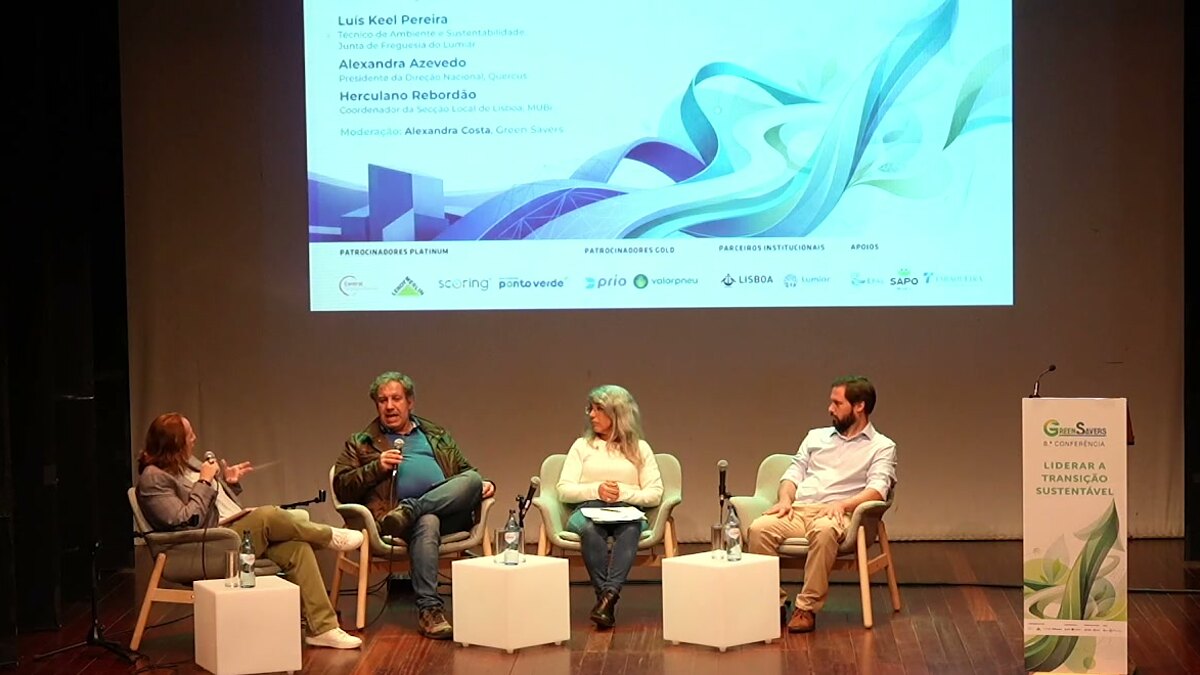
In the final panel, “Mobilizing: the transition at the doorstep,” moderated by journalist Alexandra Costa, the conversation moved to the neighbourhood. Luís Keel Pereira, Environment and Sustainability Technician at the Lumiar Parish Council, explained how a post-it left during a 2020 ideas collection, with the phrase “I would like to produce and share energy with my neighbors,” gave rise to the country’s first citizen-led renewable energy community, in Telheiras. Today there are 66 members, including families, companies, condominiums, and the council itself, and more than 150 are registered for the next phase. About 15% are families in vulnerable situations, who do not pay the entry because the others pay a little more. But none of this happens quickly, he warned: it took ten years of joint work among associations, because “community processes take time.”
Alexandra Azevedo, President of the National Board of Quercus, reminded that proximity is essential to creating community, whether in a Lisbon neighborhood or in a rural village, and that associations live on funding, increasingly scarce from the public side, and on the support of partner companies. To anyone wanting to move forward with an idea, she offered a piece of advice that echoed the day’s theme: “to lead really implies having courage, but a conscious, lucid, and committed courage.” Herculano Rebordão, Coordinator of the Lisbon Local Section of MUBi, swapped his car for a bicycle in 2009 and today makes in 17 minutes, during rush hour, a journey that by car takes half an hour. For more people to imitate him, the journey must be safe and convenient, and cities still have many bike lanes that are off, disconnected, or unfinished.
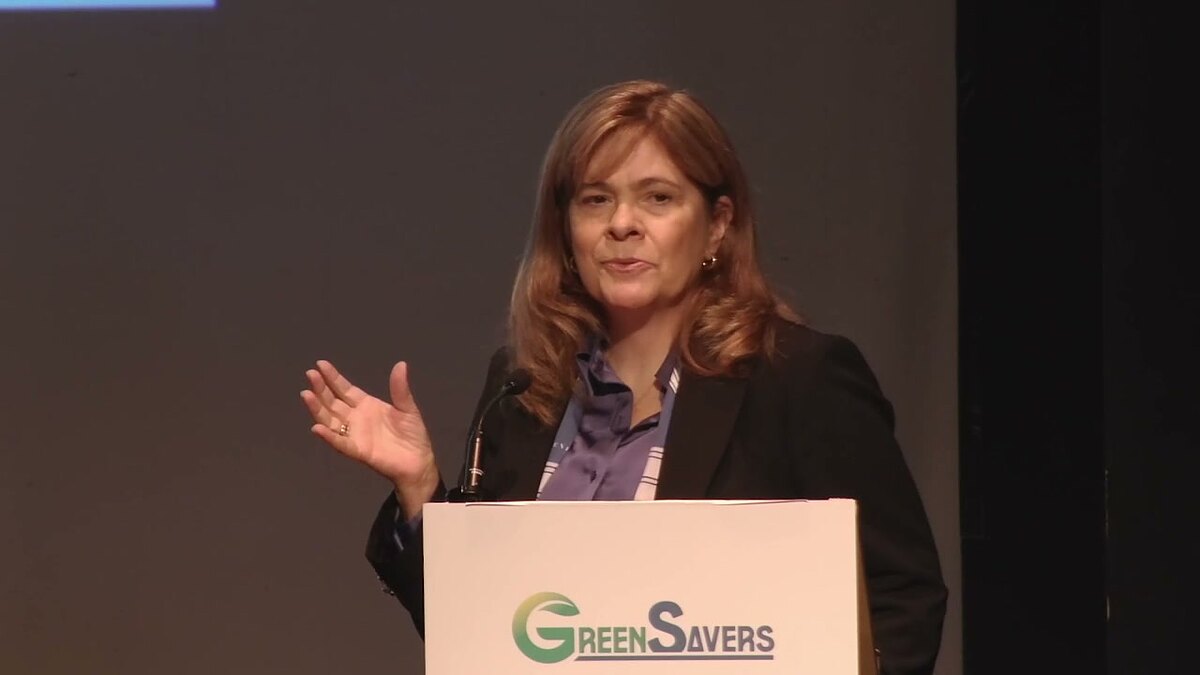
No encerramento, Maria Albertina Rodrigues, presidente do Conselho Científico da Associação Portuguesa de Ética Empresarial (APEE), que falou em representação do presidente da associação, Mário Parra da Silva, percorreu a evolução do relato de sustentabilidade na Europa, da diretiva CSRD à simplificação do pacote Omnibus e à nova diretiva contra o greenwashing, que trava alegações como “verde” ou “neutro em carbono” quando não correspondem à realidade. Lembrou que mesmo as empresas que não estão obrigadas a reportar continuam a ter de prestar informação a bancos, investidores e clientes, e que Portugal ainda está a transpor estas regras para a lei nacional. A fechar, recorreu a Fernando Pessoa para defender que a sustentabilidade vale a pena, porque beneficia sobretudo as gerações futuras.
Rogério Junior encerrou a manhã com a ideia que a atravessou: a transição “não se faz de um dia para o outro, nem se faz sozinha” e lidera-se “nas decisões de cada dia, por quem tem a coragem de as tomar e a transparência de responder pelos resultados”. E deixou um desejo para a próxima edição: que, quando voltarem a encontrar-se, já se possa falar de resultados.