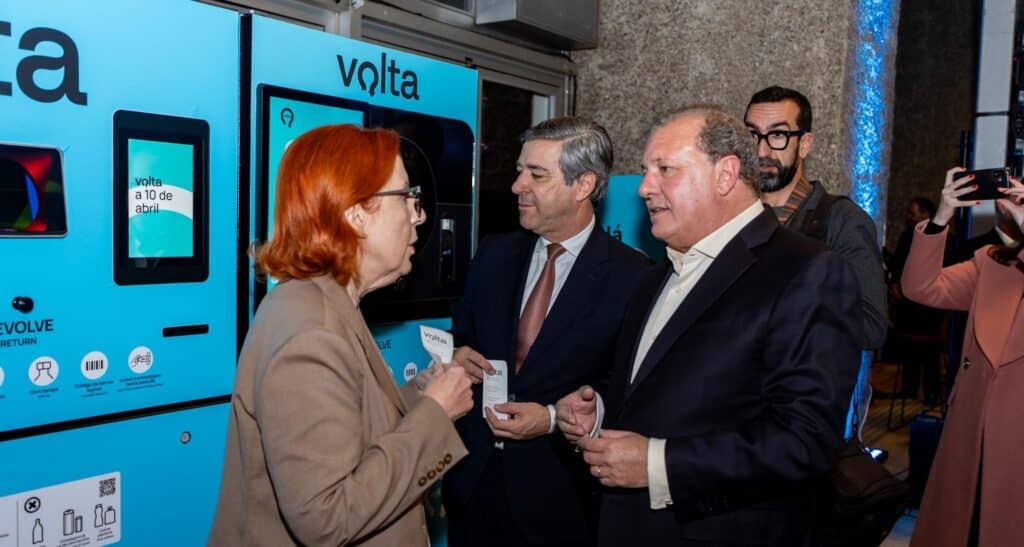
Five months after citizens began returning their packaging through the return system, SDR Portugal records more than 305 million beverage packaging units returned. The milestone is reached at a moment of strong growth in the use of the collection network, with the number of packaging units returned tripling in the last two months, after having reached 100 million in July, as disclosed in a press release.
According to the same source, with the launch of the Deposit and Return System (SDR) on April 10, an average of close to 5 million packaging units is being returned per day. This pace corresponds to more than 3,400 packaging units per minute, and, approximately, 57 packaging units per second.
In the first two months of operation, more than 10 million packaging units were returned. In July, a little more than three months after the start, the return reached 100 million. Now, five months after the system began, it reaches 305 million.
The collection network tracks the growth in use
The growth in packaging returns has been accompanied by the expansion of the return network, which now counts more than 3,000 automatic Return Points, available in supermarkets and hypermarkets, and manual Return Points, solutions for smaller establishments, such as small shops, minimarkets or local supermarkets, without an RVM (Reverse Vending Machine).
The network is also being reinforced through the Return Kiosks, designed to respond especially to situations of returning large quantities of packaging at once. Of the 12 kiosks already contracted, seven are currently in operation, in Albufeira, Barcelos, Cascais, Funchal, Ponta Delgada, Portimão and Vila Nova de Famalicão. The remaining five are in the implementation phase, in the municipalities of Almada, Aveiro, Mafra, Oeiras and Vila do Conde. The objective is to reach 50 units nationwide.
With the capacity to collect around 120 beverage packaging per minute, the Kiosks allow concentrating the return of large volumes at a single point, making them a particularly relevant solution for cafés, restaurants, hotels and other similar establishments.
For cafés, restaurants, hotels and other similar establishments that accumulate large quantities of packaging, SDR Portugal also provides the Direct Collection service, which allows collection directly at the establishment, by agreement with the Managing Entity.
Leonardo Mathias, President of SDR Portugal, states: “Reaching 305 million packaging units returned in just five months is an extraordinary milestone and demonstrates, in a very concrete way, the strong citizen adherence to the return. We are talking about millions of packaging units that were returned and that could become a new bottle or can. The participation dynamic has grown significantly since the start and the numbers show an evolution that deserves to be highlighted: we went from 100 million packaging units returned at the end of July to 300 million in September. In other words, the number of packaging units returned tripled in less than two months. It is a clear expression of citizens’ mobilization and of the return’s capacity to generate new habits and to contribute to a real change in how we view beverage packaging after consumption.”
In this sense, SDR Portugal thanks all citizens who have joined the return and, by returning their packaging, have been fundamental to achieving this result. It is also worth noting the commitment of SDR Portugal’s members — producers, distributors, packagers and retailers — whose joint effort was decisive to implement infrastructure of this dimension across the country, in terms of IT, technical, logistical, and staff training aspects, without which these numbers would not have been achievable.
“This result gives us confidence and, at the same time, increases our responsibility. The ambition is to continue growing, consolidate this participation and make packaging return an increasingly integrated behavior in everyone’s daily life. This is a very relevant milestone, but we want it to be only one more step in a journey whose objective is to continuously increase collection and ensure that more and more packaging returns to the circular economy,” concludes Leonardo Mathias.
The return covers single-use beverage packaging – plastic, aluminum and steel bottles and cans, with a capacity of up to three liters. For each package covered, a deposit of 0.10 euros is paid, which is fully refunded when the packaging is returned under the conditions provided.
Forms of returning packaging
Where can I return the packaging?
The packaging covered by the return can be returned at automatic Return Points, available in supermarkets and hypermarkets, at manual Return Points, and at Return Kiosks. HoReCa sector establishments that meet the necessary conditions can also use the Direct Collection service, by registration and agreement with SDR Portugal.
What is the difference between an automatic Return Point and a Return Kiosk?
Automatic Return Points allow the return of packaging through machines installed in supermarkets and hypermarkets. These are complemented by manual Return Points, usually smaller supermarkets, which allow citizens to return packaging when there are no automatic Return Points nearby, ensuring that citizens have return options even in the most remote areas.
Return Kiosks are prepared for the return of large quantities of packaging at once, with capacity to collect around 120 packaging per minute. They are installed in easily accessible locations and with adapted hours, presenting themselves as a convenient and quick solution.
Are Return Kiosks only for restaurants and cafés?
No. Return Kiosks can be used by citizens and by establishments, though they have particular relevance in contexts where it is necessary to return large quantities of packaging, especially by HoReCa establishments.
What is the Direct Collection service?
It is a solution aimed at HoReCa sector establishments that allows requesting packaging collection directly at the establishment. In this way, establishments that accumulate significant volumes of packaging can request its collection without needing to transport them to a Return Point or-Kiosk. Enrollment implies registration as a Return Collection Adherent and the signing of an agreement with the Managing Entity, SDR Portugal. The registration is subsequently validated, ensuring that the establishment meets the necessary conditions to benefit from this solution, namely a packaging volume that justifies it. This ensures the efficiency and sustainability of this service.
Direct Collection is free for establishments that have at least four full bags, each 240 liters, for collection. For collections of up to three bags, there is a charge of €13 + VAT.
How is the deposit refunded?
The deposit value is €0.10 per packaging and is refunded after return, provided the packaging meets the conditions set by the return.
At automatic Return Points, the amount can be recovered through different refund modalities, namely via a voucher that can always be converted into cash, a store discount voucher, a loyalty card or digital solutions, and it can also be donated to an institution, depending on the options available at each Return Point.
At Return Kiosks, the amount can be recovered through the Volta€ App, which allows transferring the accumulated amount to the associated bank account. It is also possible to opt for donating the deposit amount to the institutions available in this solution.
Refund via MBWay will be available soon.
What conditions must packaging meet to be accepted?
The packaging must be empty, not crushed, with the cap on and display the return symbol and a readable barcode. SDR covers single-use beverage packaging made of plastic, aluminum and steel, up to three liters.
Where can I check the return locations?
The locations of the Return Points and Kiosks can be found at https://volta.com.pt/onde-devolver/.