
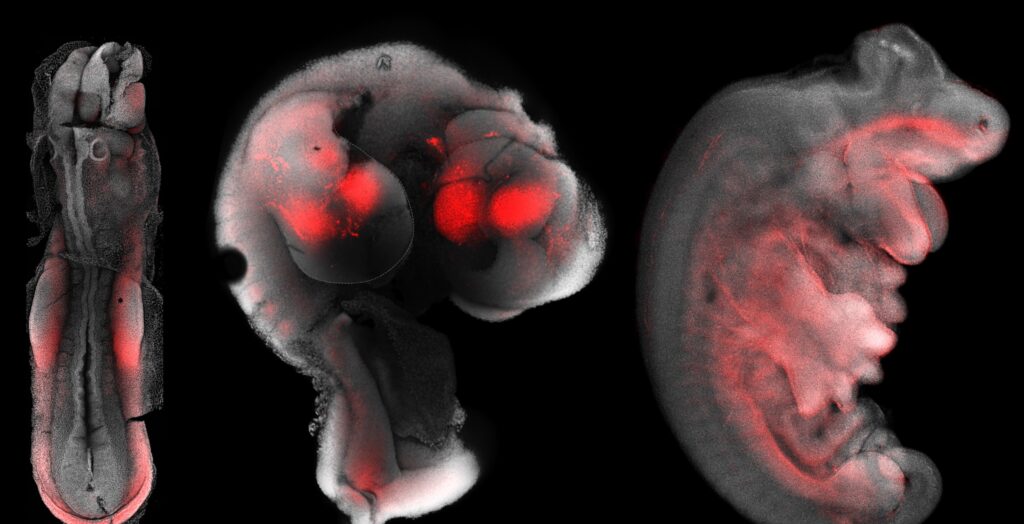
Scientists from the University of Melbourne have discovered that the forelimbs of marsupials begin to develop before birth much earlier than previously believed. The investigation, published in the scientific journal Science Advances, sheds new light on the evolution of these mammals and on the biological mechanisms responsible for limb formation.
Marsupials, a group that includes kangaroos, koalas, wombats, and the Tasmanian devil, are born in an extremely immature state. Despite this, the offspring depend on strong and functional forelimbs to move themselves to the maternal pouch and reach the teat shortly after birth.
According to the study’s lead author, Axel Newton, from the School of Biosciences at the University of Melbourne, the results reveal surprising aspects of the biology of these animals.
“We found that the forelimbs of marsupials develop rapidly over a period of only four days, going from a simple undifferentiated structure to fully functional arms with claws. This discovery profoundly challenges the current knowledge about limb development in vertebrates,” explained the researcher.
The team concluded that these structures arise at an extremely early stage of embryonic development, even before the formation of important bodily components, such as somites and the neural tube, considered essential elements for building the organism.
In collaboration with researchers from the University of California, Los Angeles (UCLA), the scientists analyzed two evolutionarily distant marsupial species: Sminthopsis crassicaudata and Monodelphis domestica. The aim was to study gene activity after fertilization and understand how limb formation begins.
The results challenge the traditional idea that limb growth follows a fixed and uniform sequence. In marsupials, some of the processes observed in other species seem to be reorganized or even overtaken, demonstrating unexpected flexibility in embryonic development.
“Much of what we know about limb growth results from studies conducted in chickens and mice, in which several tissues develop simultaneously. In marsupials, the isolated development of the limbs offers a unique opportunity to understand how these structures first arise,” says Newton.
The researchers believe that this discovery could also help to better understand the origin of certain congenital limb malformations in humans.
The research was conducted at the Pask Laboratory of the University of Melbourne, in partnership with the biotechnology company Colossal Biosciences.
For Andrew Pask, the director of the laboratory, understanding how evolution has shaped the development of marsupials is fundamental to their conservation.
“If we do not understand the biology of these animals, we will not be able to fully understand their vulnerabilities, their capacity to adapt, or the best way to intervene when a species is at risk,” says the researcher. “This study demonstrates how developmental biology can directly contribute to conservation efforts.”