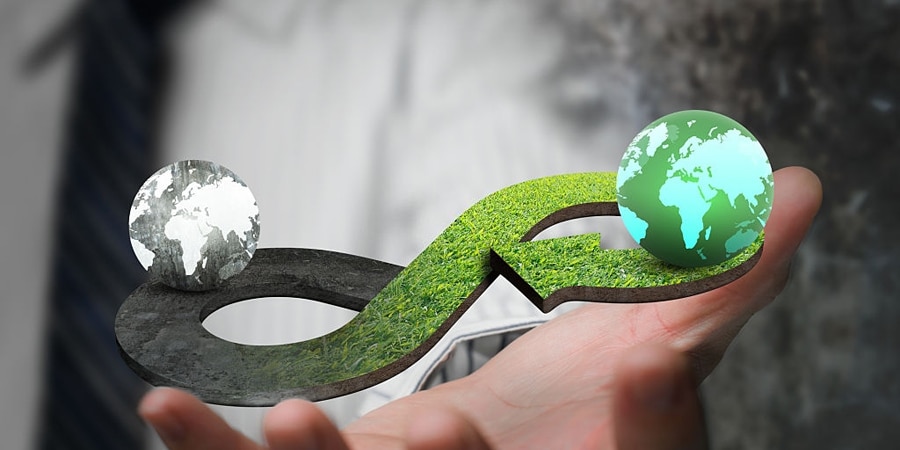
In a context marked by increasingly early heat waves and mounting pressure on natural resources, Smart Waste Portugal defends the circular economy as an environmental and economic response.
On July 30, humanity enters an “ecological debt” with the planet. The so-called Earth Overshoot Day marks the moment when the world population consumes the natural resources that the planet would be able to regenerate over the course of a year.
The date arrives at a moment when the effects of environmental pressure are increasingly visible in daily life. Europe has recorded episodes of intense heat that are arriving earlier and earlier, including unusual heat waves in May and June, felt in several European countries, among them Portugal. With the arrival of summer, these phenomena reinforce the urgency to rethink how we produce, consume and use the available resources.
From July 30, humanity begins to consume “environmental credit,” drawing on resources from future generations and exacerbating pressure on ecosystems, raw materials, energy and climate. In Portugal, this date came even earlier, on May 7, which shows that if all humanity lived like the Portuguese, the resources available for the year would have been exhausted in just over four months.
Faced with this scenario, the circular economy emerges as “one of the main responses to reduce waste, extend the life of resources and promote a more efficient, resilient and sustainable economic model,” notes Smart Waste Portugal in a press release.
According to the same source, unlike the traditional linear economy based on extract, produce, consume and discard, the circular economy proposes a logic of continuous resource use. In practice, this means reducing waste at the source, repairing and reusing products, promoting recycling and material recovery, rethinking consumption habits and regenerating natural systems.
Smart Waste Portugal “has been playing a relevant role in this transition, promoting collaboration among companies, public entities, academia and civil society to accelerate the implementation of circular solutions in Portugal. By bringing together different stakeholders around common goals, the association contributes to creating synergies, sharing knowledge, and turning environmental challenges into opportunities for innovation and competitiveness,” the note says.
This urgency also has an economic dimension. The Circularity Gap Report 2026, produced by Circle Economy in collaboration with Deloitte, introduces the concept of Value Gap, which translates the value lost from maintaining linear practices. According to the report, the global economy loses around €25.4 trillion (nearly 31% of world GDP) each year due to inefficiencies in material use, underutilized resources, and losses along the production, consumption, and end-of-life value chains. In practice, for every three euros of value generated, about one euro is lost along the way.
Closing this gap “requires a paradigm shift. Keeping products and materials in circulation for longer, reducing waste, recovering value and strengthening collaboration between companies, public entities, academia and citizens are essential steps to reduce pressure on natural resources while increasing the economy’s competitiveness.”
For Smart Waste Portugal’s Executive Director, “Earth Overshoot Day makes visible a reality that often seems distant: we are consuming faster than nature can replenish.” Luísa Magalhães notes that “the answer cannot lie solely in end-of-line recycling. It has to start earlier, in how we design products, choose materials, produce, buy, repair, reuse and avoid waste.”
The Executive Director adds that “the circular economy is a way to reduce dependencies and losses, protect resources and prepare companies and territories for a future in which efficiency will be increasingly decisive. It is also why Smart Waste Portugal works daily to bring organizations from different sectors closer together and to create conditions for circularity to happen in a collaborative way with real impact.”
“As environmental, climate and economic challenges become more evident, so too does the need to rethink how we produce and use resources. Adopting more circular models allows reducing waste, making better use of materials, lowering costs and making value chains more resilient, contributing to a stronger economy that is prepared for the future,” concludes the press release.