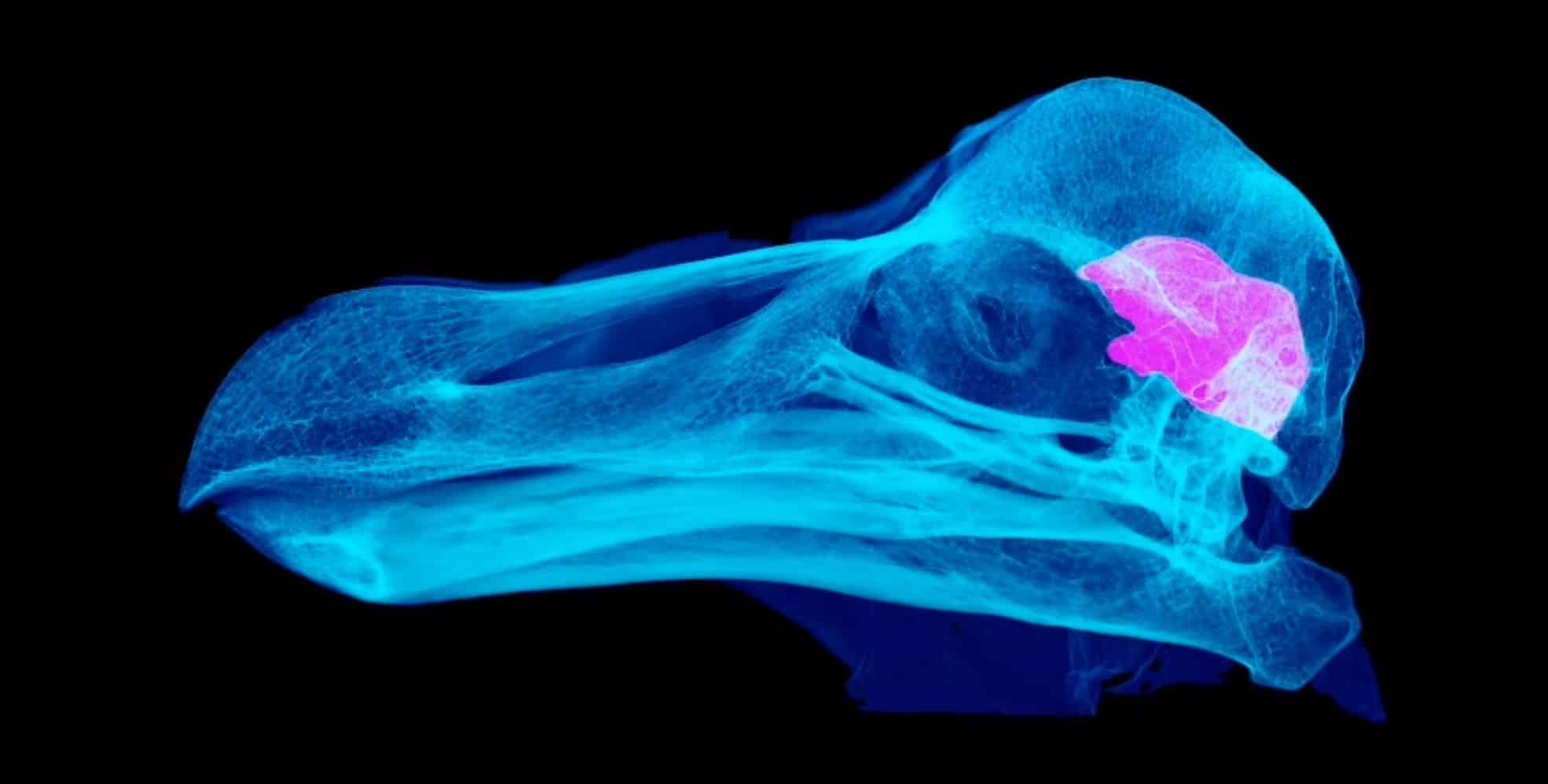
The dodo, an endemic bird of Mauritius and a worldwide symbol of human-caused extinctions, may have been far more intelligent than its reputation suggests. An international study concluded that the brain of this extinct bird was the size expected for an animal of its size and also points to the possibility that it was the only known pigeon with predominantly nocturnal habits.
The research, led by the University of Lethbridge in Canada, with the participation of researchers from Flinders University in Australia, was carried out using computed tomography scans of dodo skulls preserved in museums.
The researchers compared the skulls of three dodo specimens with those of other pigeon species, including its closest relative, the extinct Rodrigues solitaire, considered the largest pigeon known.
“The dodós have always been portrayed as foolish or confused birds, a reputation that probably resulted from their confident behavior, which led to the deaths of hundreds of animals in a very short period,” says Sara Citron, a PhD student at the University of Lethbridge and the study’s lead author.
“Apart from that, little was known about the dodo’s habits and behavior, so we wanted to change that,” she adds.
Brain was not smaller than that of other pigeons
The analysis revealed that the dodo did not exhibit a brain smaller than what would be expected for a bird of its size, contradicting the idea that it was less intelligent than its relatives.
“There is no evidence that the dodo was less intelligent than its relatives — and we know that pigeons are quite intelligent,” says Andrew Iwaniuk, professor at the University of Lethbridge and senior author of the study.
“The dodo had a very unusual skull, with a head strangely rounded, but the part of the brain responsible for cognition was exactly the size expected for a bird of that dimension,” he adds.
Nocturnal habits may have given an advantage
The study also identified several anatomical features commonly observed in birds active at dusk or at night.
According to Vera Weisbecker, professor of Evolutionary Biology at Flinders University, the dodo had slightly larger eyes, but unusually small optic lobes — the region of the brain responsible for processing visual information. “We suspected that the dodós were better adapted to see in low light conditions. They had slightly larger eyes, but unusually small optic lobes, an area of the brain that processes light,” she explains.
“This could mean that their vision was less detailed, because small optic lobes typically indicate that light reaches the brain through a smaller number of nerves,” she adds.
The researcher notes that this combination is similar to what is observed in several nocturnal birds, such as the New Zealand kakapo or the rare Australian night parrot, suggesting that the dodo depended less on vision and might have been active mainly at dawn, at dusk, or during the night.
The authors also acknowledge that smell could play an important role in the life of this species, since the brain region associated with this sense was relatively developed, although they consider that more studies are needed to confirm this hypothesis.
Naivety may have driven extinction
The researchers argue that the fame of the “stupid bird” may result from its lack of fear of unknown threats and not from a reduced cognitive capacity.
“These tame animals were possibly quite social. Like many island species, they were used to living without predators. They simply never needed to learn fear responses,” says Sara Citron.
“Calling them ‘stupid’ for being naive makes it seem like they deserved to go extinct, which is deeply unfair,” she concludes.
The team also considers that, if it is confirmed that the dodo was predominantly nocturnal, it could have avoided competition for food with other species on Mauritius, including the numerous tortoises that inhabited the archipelago.
The researchers now hope that the new data will encourage further studies on the species, using specimens preserved in museum collections around the world.