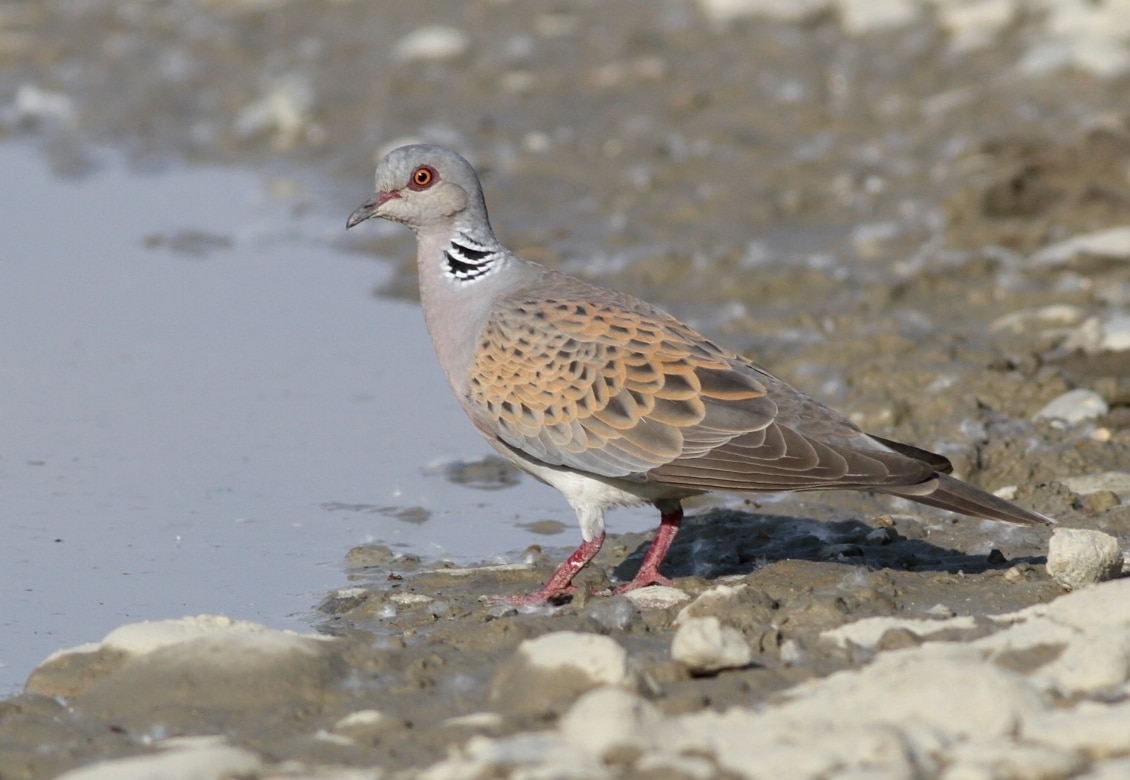
The hunting of the turtle dove (also known as the common turtle dove, Streptopelia turtur) has once again been authorised by the Institute for Nature Conservation and Forests (ICNF) for the 2026/2027 hunting season.
In a statement, the institute said that the decision results from the “scientific confirmation” that the species’ population trend “continues to be compatible with the sustainable conduct of hunting activity.”
The decision is based on conclusions, presented in May, by an international scientific consortium, the Task Force on the Recovery of Birds of the Expert Group on the Birds and Habitats Directives, whose mission is to monitor the recovery of bird species in the European Union. Based on data relating to the 2025/2026 hunting season, the specialists point to the continuation of the recovery of the turtle dove in the western migratory corridor, which includes Portugal, as well as the “reliability of the regulation, monitoring and control mechanisms of hunting implemented.”
After a four-year moratorium, the reopening of turtle dove hunting had as prerequisites an increase in turtle dove populations for two consecutive years, an increase in the survival rate and the existence of robust national systems of regulation, control and enforcement of the hunting activity aimed at that species.
In the 2025/2026 hunting season, the ICNF had set a maximum kill quota of 13,200 turtle doves, over two August mornings. For the 2026/2027 season, the quota was increased to 15,000 animals, with hunting limited to August 23 and 30, from sunrise to 11 a.m.
To ensure that the requirements are met, the ICNF stipulates as mandatory that each turtle dove killed be marked with a “unique and inviolable seal,” placed on the bird’s leg. In addition, hunting of the species will only be permitted “in hunting zones that cumulatively meet a set of conditions demonstrating the implementation of habitat management measures and monitoring action, essential for the continued recovery of this species and a sustainable hunting exploitation, framed in an adaptive management model,” reads a deliberation of the institute’s board of directors.
In light of the data from the European expert group, the ICNF, in a note, says that it can be concluded that “the conditions ensuring compatibility between the species’ population evolution and its hunting exploitation remain in place, thereby allowing the renewal of the authorization for hunting the common turtle dove in the 2026-2027 hunting season.”
A hasty decision?
Despite all assurances, not everyone is fully convinced that reopening turtle dove hunting is the right decision.
To Green Savers, Hany Alonso, Senior Science Technician of the Portuguese Society for the Study of Birds, says that “the moratorium should have been kept for longer,” to ensure “a more significant recovery of the species.”
Moreover, he argues that “the data from monitoring and enforcement of hunting should be made public, because if that is one of the conditions for the decision to open/reopen, it should be subject to scrutiny.”
Jorge Palmeirim, university professor and member of the board of the Liga para a Protecção da Natureza (LPN), also insists that it would have been “prudent” to extend the moratorium, since “the populations of the common turtle dove remain well below historical levels.” Yet, he acknowledges that the ICNF’s decision “despite involving some risk, is technically grounded.”
Recalling that “the status of the species remains worrying,” the LPN calls on hunters to respect the imposed limitations and to continue “habitat improvement actions.”
“It is crucial to improve the monitoring of the species and to be prepared to suspend hunting again if the recovery slows,” emphasizes Palmeirim, referring to the adaptive management model that the ICNF says is central to the hunting of the turtle dove and which, the agency assures, will safeguard the conservation of the species.
“The success of the moratorium demonstrates that hunting activity can exert a significant pressure that is important to avoid,” notes the LPN biologist.
The Moratorium
The hunting of the turtle dove had been suspended in 2021 in the western European migratory corridor of the species, which encompasses Portugal, Spain and France. The moratorium instituted aimed to relieve hunting pressure on the species, which is estimated to have suffered an 80% population loss in the last 40 years.
In Portugal, lifting the moratorium was only planned for the 2026/2027 hunting season, according to Portaria No. 67/2024, of 22 February, in which the Ministry of the Environment and Climate Action at the time stated that “the populations of the common turtle dove (Streptopelia turtur), although they have shown recent population stability following the hunting prohibition in the countries along the western migratory route, including Portugal, have not yet reached the conditions necessary to lift the prohibition, and it should be kept until the 2026-2027 hunting season.”
However, a year later, a group of specialists from the Habitats and Birds directives declared that the countries on the western route could resume hunting the turtle dove, as the species already showed conditions for hunting not to pose a threat to its survival.
Thus, in May 2025, a new portaria announced the turtle dove as a hunting species in Portugal already for the 2025/2026 season, earlier than initially defined. To Green Savers the ICNF, at the time, justified the decision to accelerate the end of the moratorium with a “positive evolution of the numbers of the common turtle dove in its western migratory route,” adding that Portugal follows “the same line of action” as Spain, France and Italy.
The decision, however, drew criticism, which remains from specialists and conservation organizations who argued that the moratorium on hunting should have been kept longer to ensure that gains in turtle dove populations were not eroded.
Additionally, they doubted that Portugal had implemented a credible national system of regulation, control and enforcement of hunting activity directed at the turtle dove, one of the criteria required for the resumption of hunting. The ICNF assured in 2025 that such a system would be in place in time for the species’ hunting reopening. Yet conservationists say that if these data are not made public it is impossible to know whether the requirements that determine turtle dove hunting are truly being met.