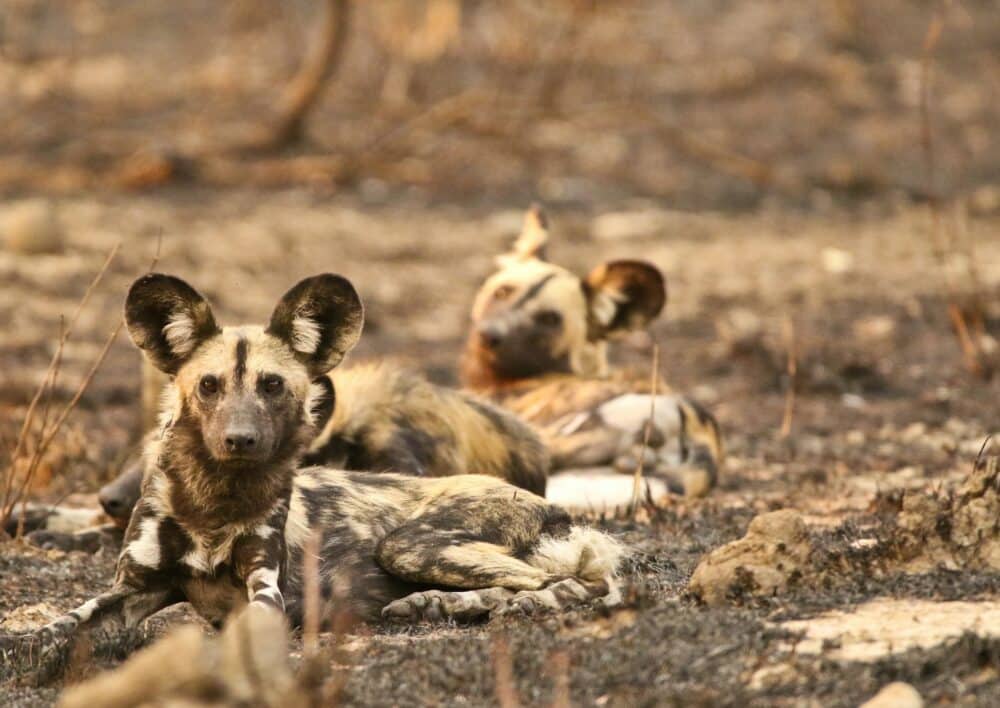
African wild dogs (Lycaon pictus) are considered ‘hypercarnivores’ because they feed exclusively on other animals and because they have a highly specialized dentition for this type of feeding.
That had been the idea, at least, until a pair of researchers from the organization Wild Entrust Africa uncovered something unexpected in northern Botswana.
During 27 days in 2022 (between July 29 and August 24), the team observed a pack of mabecos along the margins of the Okavango Delta feeding on fruits of Zanzibar ebony (Diospyros mespiliformis). In an article published in the journal Canid Biology & Conservation, the authors Megan Claase and John McNutt say that until that moment no other study had documented fruit consumption by mabecos.
The group consisted of six adults and five juveniles over a year old, and the researchers observed them not only consuming the fruits but actively seeking them. The mabecos, according to the descriptions, picked up the fruits, two to three centimeters in diameter, with their incisors, and swallowed them almost whole.
All members of the pack were seen consuming the fruits, and most observations, about 80%, occurred near the den of the mabecos and moments before the group headed out to hunt. This could suggest that it is a way of obtaining energy before going in search of prey.
The authors further argue that mabecos may be consuming the Zanzibar ebony fruits for their medicinal properties, long known and used by humans.
The fruit consumption also coincided with a period when the pack is helping to care for the young, so, the researchers suggest, by eating fruits they are obtaining additional food to provide for the younger members of the group.
Many hypotheses are still up in the air regarding the “why” of mabecos eating fruits, breaking the long-held idea that this is a species of ‘hypercarnivores’.
The same type of behavior had previously been observed the year before this study in a neighboring pack described in this article, as well as in 2013 in a pack about 23 kilometers east of the delta. However, those behaviors were not documented, and the authors learned of them through direct communications made by people who had witnessed these behaviors firsthand.
The researchers suggest that fruit consumption may be a learned behavior among mabecos rather than something innate, which, they say, would help explain why it has only now been documented and why it seems to be spatially limited.
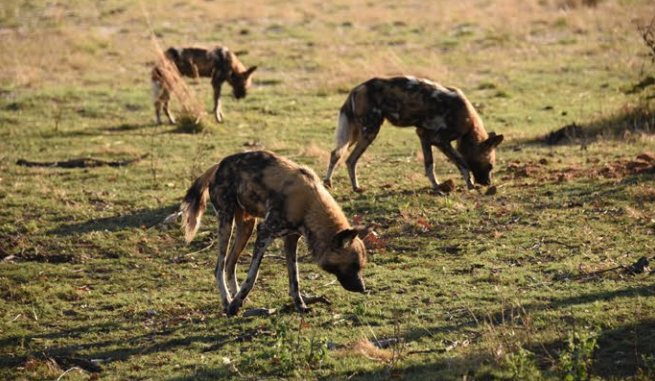
Claase and McNutt write that this study reveals the importance of studying animal behavior across various habitats and ecosystems, since only in this way is it possible to discover unexpected yet still relevant things about how animals cope with changes in food availability and also with the effects of climate change.
African wild dogs are classified as an Endangered species on the International Union for Conservation of Nature Red List. In times when they were abundant across much of sub-Saharan Africa, they now have their largest distribution range in Botswana and Namibia, but they are also present in Angola, Zambia, Mozambique, Tanzania, Kenya, and the Central African Republic.
Among the main threats are habitat loss, human-wildlife conflicts, and the loss of wild prey, so this dietary flexibility gives researchers some hope, since it could help mabecos better adapt to environmental and ecological changes that may further jeopardize their future.