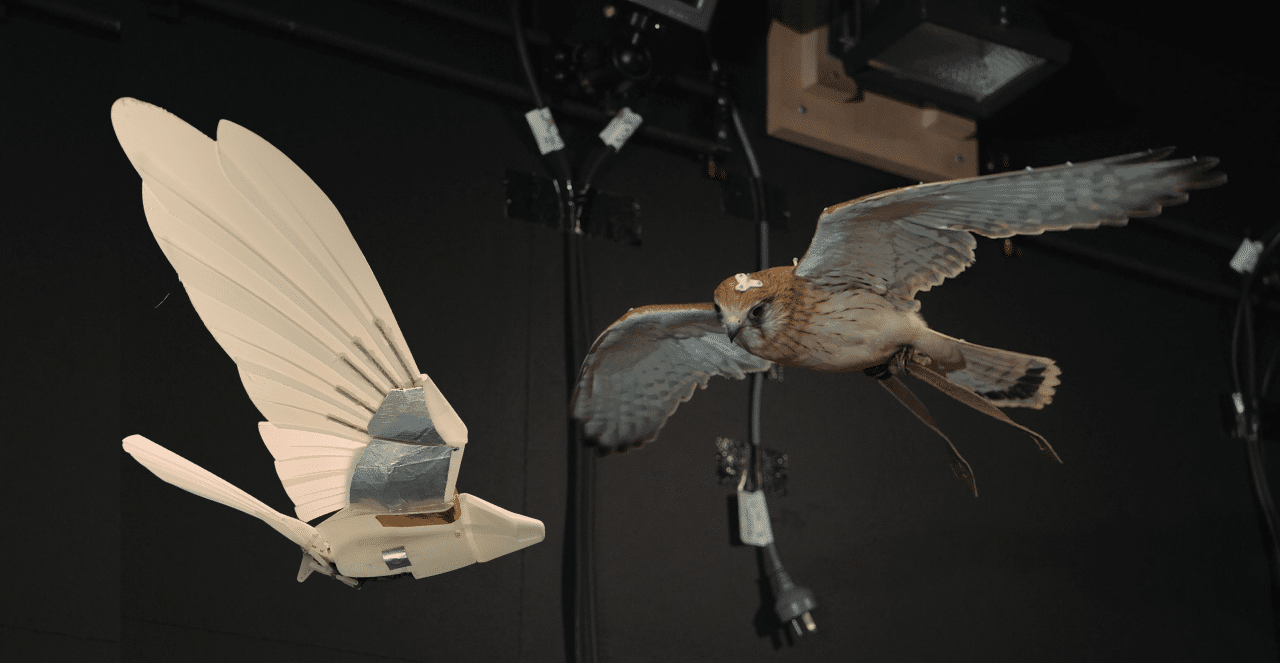
A robotic bird inspired by a species of Australian falcon is helping Australian and British researchers understand how some birds manage to maintain stability in flight even under strong turbulence, knowledge that could contribute to the development of safer and more efficient drones.
The research, conducted by teams from RMIT University and from University of Bristol, was published in two scientific articles in the Journal of the Royal Society Interface.
The researchers studied the behavior of a species of Australian falcon, a bird known for its ability to remain virtually motionless in the air while hunting. The movements of the species were recorded under wind and turbulence conditions using motion-capture technology installed in the Australian university’s industrial wind tunnel.
According to the authors, understanding how birds naturally cope with atmospheric disturbances could become increasingly important as climate change contributes to greater turbulence in certain regions.
Small unmanned aerial vehicles, used in activities such as aerial photography, search and rescue operations, agricultural monitoring, or deliveries, are particularly sensitive to adverse weather conditions.
According to RMIT researcher Matt Penn, the birds employ several simultaneous strategies to maintain stability during flight.
“They do not rely on a single response to gusts of wind. They continually adjust the wings and tail to maintain balance, while the natural flexibility of the feathers and joints helps absorb abrupt changes in airflow,” he explains.
To deepen the study, the team developed a robotic replica capable of reproducing the movements deemed most important for the bird’s stability.
According to Mario Martinez Groves-Raines, who participated in the research during his PhD conducted at the two universities, the robotic model allowed for more precise measurement of the forces involved in flight.
“We managed to identify several specific techniques that contribute to the kestrel’s stability. Many of them could be applied to improve the maneuverability of small aircraft, which face similar challenges,” he says.
The researchers believe that the results open new perspectives for the development of nature-inspired control systems capable of improving drone performance in turbulent environments.
The team now plans to study more deeply the birds’ ability to detect subtle changes in the atmospheric environment, with the aim of adapting that knowledge to the design of future aircraft, including larger models.