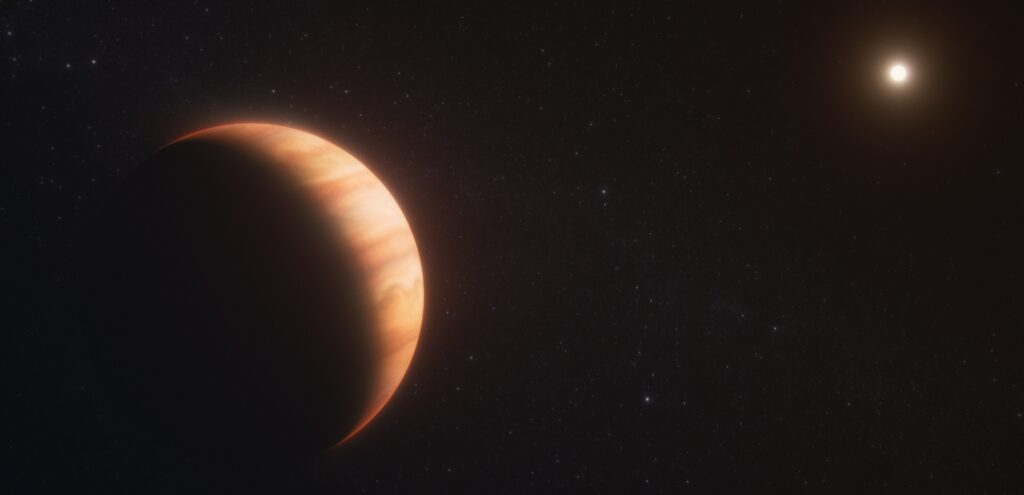
An international team of researchers used the James Webb Space Telescope (JWST) to study the atmosphere of a planet that orbits a white dwarf — the remnant of a Sun-like star after the end of its life. The discovery could help scientists understand what will happen to the Solar System when the Sun dies, in about five billion years.
The results, published in the scientific journal Nature, focus on the planet WD 1856 b, located about 82 light-years from Earth. The planet orbits a white dwarf approximately 10 billion years old, named WD 1856.
Methane-rich atmosphere
The observations revealed that the planet’s atmosphere contains large amounts of methane and aerosols, suspended particles that could give it a coloration similar to Titan’s moon.
The researchers estimate that the planet has between 4.3 and 10.9 times Jupiter’s mass, placing it in the category of gas giants.
Although it orbits a star that is already extinct, the temperature of its atmosphere sits between 117°C and 139°C, far above what would be expected for a planet of this type. According to the scientists, this warming occurred after the planet migrated to an extremely close orbit to the white dwarf, at only three million kilometers from the star.
A glimpse into the future of the Solar System
Most of the stars in the Universe, including the Sun, end their lives by becoming a white dwarf after passing through the red giant phase. During this process, the outer layers of the star expand dramatically, potentially engulfing or profoundly altering the closer planets.
The discovery of WD 1856 b demonstrates that some planets can survive this stellar transformation, though they may undergo significant changes in their orbits and atmospheres over billions of years.
A unique case
The authors of the study consider that WD 1856 b is the first transiting planet around a white dwarf whose atmosphere has been characterized in considerable detail.
By analyzing the chemical composition and temperature of its atmosphere, as well as its orbital evolution, the researchers hope to gain new clues about the fate of planetary systems after their stars die.
Although Earth is unlikely to survive the Sun’s expansion into a red giant, the existence of WD 1856 b suggests that some more distant worlds may continue to orbit the stellar remnants for billions of years, offering a rare window into the remote future of our own Solar System.