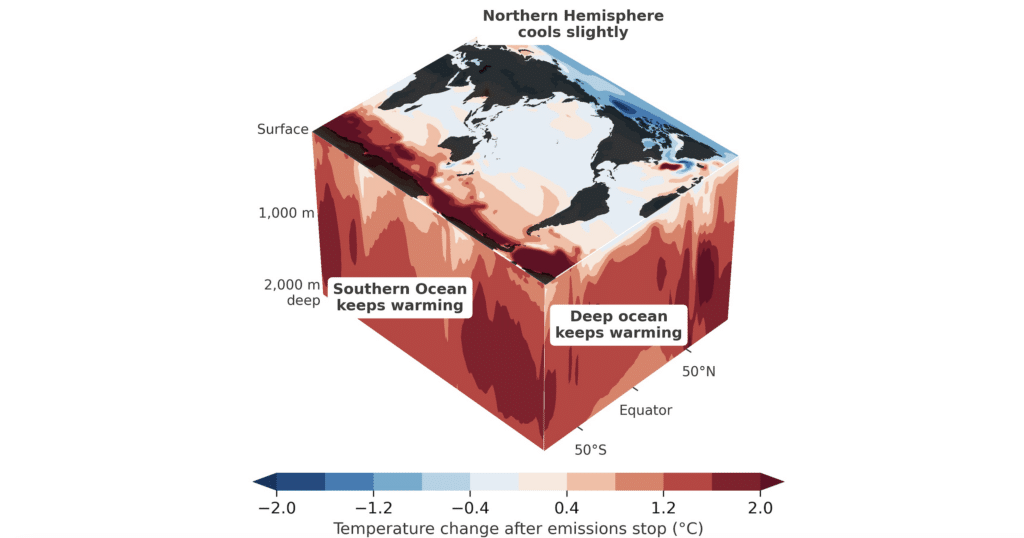
Rapid reduction of greenhouse gas emissions can limit long-term climate changes in the tropical Pacific and the El Niño phenomenon. However, the end of carbon dioxide emissions will not immediately return the ocean to pre-industrial conditions. A study published in the scientific journal Communications Earth & Environment concludes that some of these changes may persist for centuries.
The research, led by scientists from the University of Melbourne and the Centre of Excellence for 21st Century Meteorology, in Australia, analyzed climate simulations to understand how the tropical Pacific may evolve during global warming and after emissions are interrupted. The results show that warming is bringing the region’s average conditions closer to a pattern resembling El Niño. This does not mean the phenomenon will occur permanently, but that the usual temperature difference between the western Pacific, warmer, and the eastern, cooler, could diminish.
“The atmosphere and the ocean surface can adjust relatively quickly, while the deep ocean absorbs and releases heat over hundreds or even thousands of years. This gives the ocean a prolonged memory of previous greenhouse gas emissions,” explains Aditya Sengupta, the study’s lead author and a researcher at the University of Melbourne.
This capacity to store heat for long periods helps explain why ending emissions does not immediately eliminate the effects of global warming. According to the researcher, “some fundamental aspects of climate changes in the tropical Pacific could effectively be irreversible for centuries.” Therefore, he adds, “the longer emissions continue, the more heat accumulates in the climate system and the greater the risk of lasting changes.”
The tropical Pacific has a significant influence on global climate, particularly through the El Niño–Southern Oscillation (ENSO), which alternates between El Niño, La Niña and neutral phases. These phenomena affect rainfall patterns, droughts, floods, heat waves, and conditions favorable to wildfires in Australia and other regions of the world.
During an El Niño episode, the warmer surface waters extend further east along the tropical Pacific, the upwelling of cold deep waters weakens, and precipitation patterns change. The simulations suggest that characteristics of this pattern could become increasingly prevalent in the region’s mean climate conditions.
To reach these conclusions, the researchers analyzed simulations from nine Earth system models and then used the Australian ACCESS model to study climate evolution over a thousand years after emission interruptions, at different points in the 21st century.
Andrew King, co-author of the study and associate professor at the University of Melbourne, highlights the benefits of rapidly reducing emissions. “We found clear benefits in rapidly reducing emissions,” he says. “Achieving carbon neutrality sooner limits the changes occurring in the ocean and reduces the risk of leaving future generations a tropical Pacific that is substantially altered.”
The authors thus argue that rapid emission reductions should be accompanied by long-term climate adaptation planning, even after carbon neutrality is reached. Ending emissions remains essential, but it does not eliminate the heat already accumulated in the climate system nor does it guarantee the reversal of all ongoing changes.