
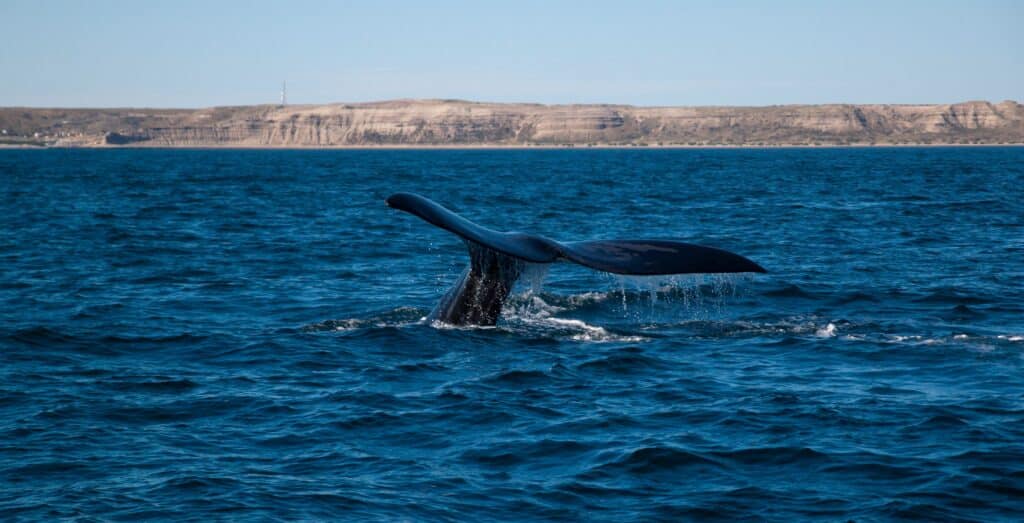
A study involving 21 southern right whales, known in New Zealand as tohorā, revealed that these cetaceans may follow very different migratory routes to reach the same feeding areas in the Southern Ocean, roughly at the same height.
The team, led by researchers from the University of Auckland in New Zealand, tracked the animals’ movements from the subantarctic Auckland Islands, also known as Maungahuka, to feeding areas south of Australia.
Satellite tracking data allowed the identification of two strategies. About half of the whales took a more direct westward route, while the others headed south before turning north again, drawing an L-shaped path and covering a greater distance.
Despite the differences, the two groups reached the feeding sites in similar timeframes. The whales that undertook the longer journey departed about a month earlier and took, on average, 64 days to arrive. Those following the shorter route took around 42 days, moving at a slightly higher speed.
According to the researchers, this difference may reflect a balance between conserving energy and reducing travel time. The animals that depart earlier may opt for a longer, more energy-intensive route, whereas those starting the migration later appear to compensate for the delay through faster travel.
Routes that change from year to year
The choice of route was not explained by the sex, age, or size of the animals, but primarily by the departure height. The investigation also indicates that some whales altered the route between years, suggesting that migratory behavior can adapt to circumstances.
A female that stays longer in a shelter area to allow the calf to grow may depart later and opt for the more direct path. In another year, when traveling without a calf, she may depart earlier and follow the longer route, potentially less energetically demanding.
The researchers acknowledge that this flexibility may result, at least in part, from learning and the transmission of knowledge among animals, rather than relying exclusively on instinctive behavior.
The study also examined possible cues used by whales to orient themselves across thousands of kilometres of open ocean. The observed routes coincided with patterns of ocean currents, seabed characteristics, and variations in the Earth’s magnetic field. On the return journey, the animals followed closely, in particular, the inclination of the magnetic field.
For Emma Carroll, associate professor at the University of Auckland and co-author of the study, the ability to vary routes and rely on different environmental references could give this recovering population more opportunities to respond to changes in ocean conditions.
Thus, the results point to the importance of behavioral flexibility in the adaptation of southern right whales to a transforming ocean.




