
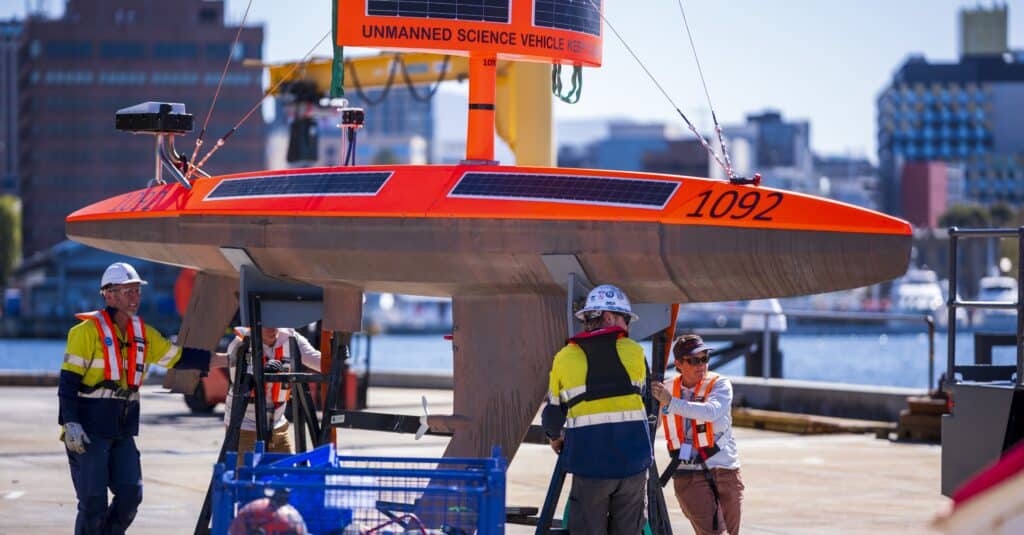
A fleet of autonomous maritime vehicles will traverse the Southern Ocean over the next five years to collect data that will help better understand how much carbon dioxide (CO₂) is absorbed and stored by this region of the planet.
The first of the vehicles departed this week from Hobart, Australia, on a mission coordinated by the Australian science agency CSIRO and involving institutions from several countries. The vehicles, developed by Saildrone, will be launched quarterly and are expected to complete circumnavigations of Antarctica, including during the austral winter.
The unmanned surface vessels (USVs) run on wind and solar power and can remain for months in remote waters, transmitting data in real time. Each mission is expected to cover about 22,000 kilometres.
The oceans absorb about one third of the CO₂ that is annually removed from the atmosphere. The Southern Ocean accounts for around 40% of the global CO₂ absorption by the oceans, but significant gaps remain in the available data, especially in remote regions and during periods when ship traffic is reduced.
“This mission is the first multi-year campaign with unmanned surface vessels in the Southern Ocean specifically to collect data across seasons and regions where ship traffic is limited,” explains Elizabeth Shadwick, a CSIRO researcher, quoted in a press release.
According to the scientist, the vessels should enable coverage of areas that are not easily reachable by research or commercial ships. “This will help fill critical gaps about the amount of carbon being absorbed by the Southern Ocean and about the factors that influence this process.”
The campaign will involve four Saildrone Explorer vehicles operating at different locations across the region. After completing a circuit around Antarctica, they will return to Hobart, where the sensors will be replaced before a new mission.
Rather than following a predefined route, researchers will be able to alter the trajectories over the five years to concentrate data collection in the regions deemed most relevant. The team also plans to use advanced models and AI-based observational tools to study the carbon cycle in the Southern Ocean.
The vessels will continuously collect atmospheric data, including wind speed and direction, atmospheric pressure, relative humidity, air temperature, and CO₂ concentration. In the ocean, variables such as sea surface temperature, salinity, dissolved oxygen, and CO₂ concentration in seawater will be monitored.
For Adrienne Sutton of the United States National Oceanic and Atmospheric Administration (NOAA), the Southern Ocean is “one of the most extreme environments on Earth and notoriously difficult to observe.” The use of autonomous vehicles will, according to the researcher, help overcome some of these limitations.
The mission is part of the COCO2 project, and the data collected are expected to contribute to the Global Carbon Budget, which annually accounts for CO₂ sources and sinks on a global scale.
A Saildrone Explorer had already completed, in 2019, a circumnavigation of Antarctica lasting 196 days. The new campaign, however, aims to establish systematic data collection over five years, including during winter, to reduce one of the persistent gaps in global observations of the carbon cycle.




