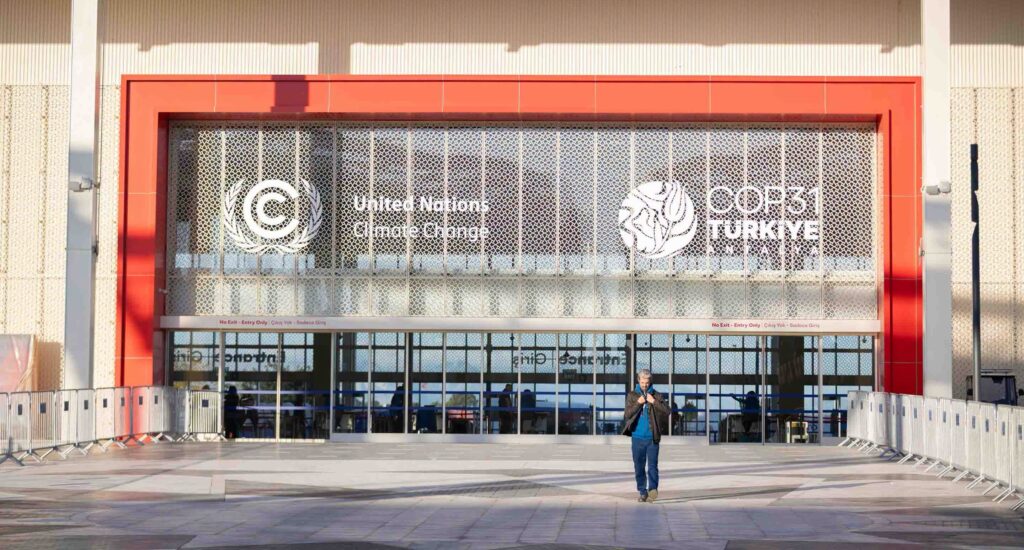
Germany and France rejected today the new COP31 draft agreement, denouncing setbacks in the text presented by the Turkish-Australian presidency, just minutes before a closing plenary session marked by uncertainty about a consensus.
The French Minister for Ecological Transition and Sustainable Development, Monique Barbut, classified the draft as an “unacceptable setback,” while Germany’s Environment Minister, Carsten Schneider, answered with a categorical “no” when asked if his country would approve the text.
“This text takes us back. It erases all references to phasing out fossil fuels, relegates science to the background, and makes it seem that technologies whose large-scale use remains uncertain will be enough to solve the problem,” Barbut said.
Barbut said that the European Union and other “more ambitious” partners had worked overnight on a compromise proposal that took into account the demands of oil-producing countries, but that proposal was discarded.
Schneider stated that the draft, released in the early hours, “indeed represents setbacks compared to progress or previous agreements” and denounced a “blocking stance” by some countries.
“We obviously still hope to reach a decision, but given what has occurred in the last hours, I am skeptical about the possibility of achieving it in this short time, especially considering that many colleagues have already left, since this COP was due to end two days ago,” said the German minister.
On Friday, the day when COP31 was reportedly to have ended, to journalists on the sidelines of negotiations, Energy and Environment Minister Maria da Graça Carvalho indicated that the European Union would block the agreement if the final text did not include the three demands relating to phasing out fossil fuels, carbon capture, and human rights and women’s rights.
Today, accompanying the negotiations in the Turkish city of Antalya, the president of the non-governmental organization Oikos issued a statement categorically rejecting this latest draft.
“We had become used to final decisions that go against the needs of developing countries, but this proposal helps no one. It only serves the interests of the fossil fuel industry,” José Luís Monteiro declared.
Also the president of ZERO, Francisco Ferreira, stressed that “in line with the International Climate Action Network of which he is part, he calls for rejection of the COP31 presidency’s draft decision.”
The closing plenary session, scheduled for 10:00 local time (07:00 in Lisbon), had not yet begun.
The conference was supposed to have ended on Friday, and the delay had already surpassed 30 hours, making Antalya’s summit one of the longest in 31 editions.
Funding for climate adaptation in developing countries remains one of the sticking points that could prevent a consensus.
The Turkish-Australian presidency’s draft seeks to reconcile the demand for public financing guarantees by developing countries with the reluctance of industrialized economies to take on new commitments with defined amounts.