
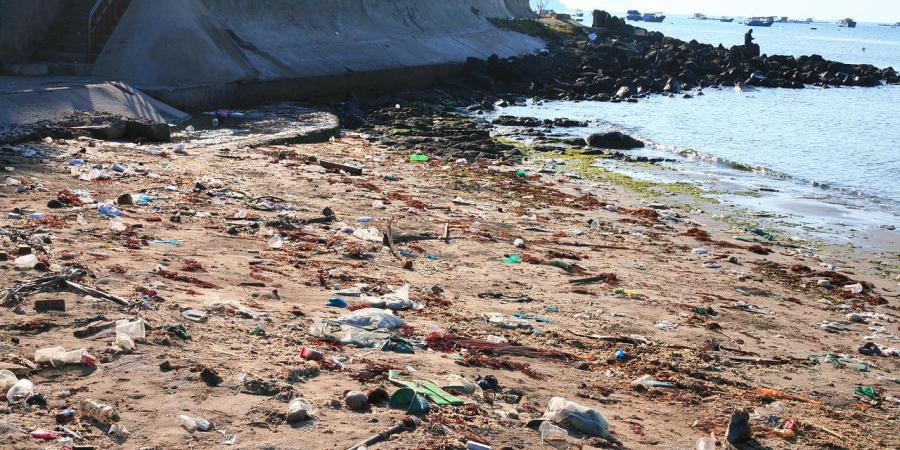
Thousands of people arrive at the beach to attend a music festival. But what happens when the last concert ends? The answer can be decisive for protecting coastal ecosystems. A study conducted by researchers from MARE – Centre for Marine and Environmental Sciences, coordinated by Zara Teixeira from the University of Évora and the ARNET Associated Laboratory, and published in the journal Environmental Monitoring and Assessment, shows that post-event cleanups remain insufficient to eliminate critical zones or prevent the dispersion of waste. Knowing precisely where the litter accumulates allows better planning of interventions and reducing the actual environmental impact of large events.
The investigation, which brought together researchers from MARE and ARNET of the University of Évora and the University of Coimbra, and a researcher from GeoBioTec of the University of Aveiro, followed three editions of RFM SOMNII to study waste accumulation at Praia do Relógio, in Figueira da Foz. Through this monitoring, the study identified the types of waste most common and the zones most vulnerable to accumulation. The results and recommendations can now help municipalities and organizers reduce the environmental impact of large events held by the sea.
With the return of RFM SOMNII to Figueira da Foz, MARE releases the results of this investigation, which tracked the festival editions (between 2019 and 2023) and demonstrates how science can support effective decision-making to reconcile large cultural events with conservation and the achievement of national and European environmental targets.
Understanding the Problem to Act Effectively
Over five years, the researchers monitored waste accumulation before and after the festival. Seventeen monitoring campaigns were carried out, allowing the collection of more than 26,000 items. More than 90% of the collected items were plastics, including single-use plastics and unidentified fragments difficult to trace, recording quantities above the European recommended limits.
The study’s main conclusion indicates that the deposition patterns stem directly from participant behavior and management limitations. Waste concentrates strongly in the areas of greatest activity and crowd presence, specifically on the stage and the VIP area. Knowing these spatiotemporal patterns allows anticipating problems, adjusting the location of collection points, guiding cleaning teams and implementing effective interim cleanups in these critical areas.
The years 2020 and 2021, when the festival was canceled due to the COVID-19 pandemic, recorded a sharp and very significant decrease in the count of waste and single-use plastics on the beach. In the editions when the festival took place, monitoring showed that the adoption of reusable materials, yet still easily discardable, such as plastic cups, is not sufficient to eliminate these wastes; that cleaning operations are decisive, but should be reinforced and adjusted to the festival’s reality; and that practices associated with the festival’s production, such as the use and disposal of wristbands, should be the subject of dedicated measures.
Science at the Service of the Sea
For MARE, protecting the sea requires upstream prevention. Improving the management of waste and intense flows on beaches means preventing the dispersion of litter and fragments into the sea, reducing the pollution that degrades and threatens coastal ecosystems.
The methodology used and the recommendations generated can now be applied to other festivals, sporting events and initiatives in coastal areas. The study provides guidelines for municipalities to make licensing more stringent, for organizers to replace disposables with return-and-control packaging incentive systems, and for regulatory bodies to create technical standards harmonized with European directives.
“Large festivals are part of the life of coastal areas and can coexist with environmental conservation. Scientific knowledge enables identifying where action is needed, optimizing resources, and developing solutions that benefit both people and ecosystems,” says Zara Teixeira of MARE.





