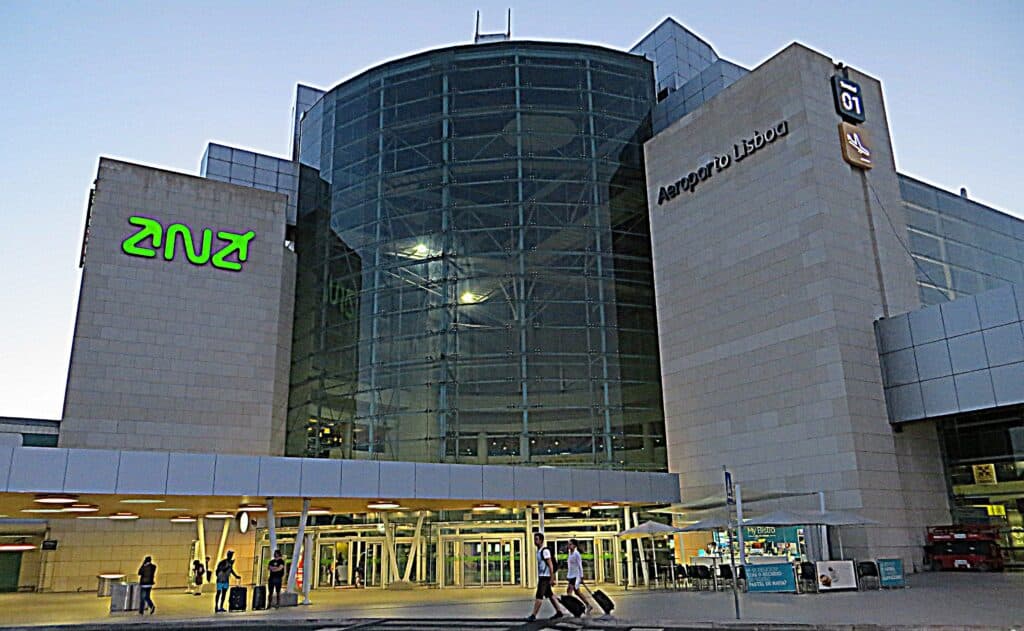
The Lisbon City Council today approved the regulation of the call for proposals to support interventions in homes affected by airport noise, amid opposition criticisms that the amounts are insufficient and access for more vulnerable families is hindered by the requirement of upfront financial effort.
The proposal was discussed at a private meeting of the Lisbon City Council, with the governing majority PSD/CDS-PP/IL and Chega voting in favor, and the abstention of PS, Livre, BE and PCP, according to council sources quoted by Lusa.
At issue is the Less Noise Program, created by the Government, with 10 million euros to improve the acoustic insulation of homes affected by noise from Humberto Delgado Airport, in the municipalities of Almada, Lisbon, Loures and Vila Franca de Xira.
The Lisbon City Council has a total allocation of €2,798,730 from the Environmental Fund to support “interventions in residential buildings located in areas identified as critical, namely through replacement or reinforcement of insulation in windows, frames and shutter boxes, when there is significant exposure to aircraft noise.”
The amount of the grant is determined according to the priority level of the case, with a maximum of €1,000 for very high priority, €800 for high priority, and €600 for moderate priority.
Although it has enabled the regulation, the opposition converged on criticisms of the “insufficient” amounts and the reimbursement model, which makes access difficult for those without the means to fund the interventions upfront, with the leadership noting that “this funding was not created by us nor did we define the total amount” and seeking to regulate its application “in a transparent, simple and equitable manner.”
“The maximum supports do not come close to financing a single window per home,” pointed out Livre, highlighting that for a two- or three-bedroom dwelling, “with five to seven windows, the total realistic cost of facade soundproofing, in a conservative estimate, lies between €6,000 and €12,000.”
Livre stressed that the proposal does not foresee condominium applications, making works such as facade and roof soundproofing unviable, “something that was requested in residents’ participations,” and proposed to the Lisbon City Council that it decide to recommend to the Government to reinforce the total funding and the municipality’s allocation, as well as additional financial support from ANA Airports.
BE emphasized that “the proposal saves ANA from non-compliance and penalizes Lisbon residents who suffer from the noise,” considering that the airport operator “had the obligation to install soundproof windows in the homes of affected families and now the responsibility passes to the State, which only pays a tiny part of the costs.”
For the PCP, the program “arrives late,” with an “insufficient” amount and makes that “those with greater means to carry out work are indeed partially reimbursed, to the detriment of others who may never be able to undertake any work, due to economic difficulties,” also pointing out that, being a fixed-fund system allocated by order of application, there may be cases of greater severity whose works take longer and may not be covered by the support, even if they meet the requirements.
Chega argued that the program “should be organized, implemented and financed” by ANA, noting that the Portuguese Environment Agency (APA) was “urged to produce a common regulation,” given that the noise covers several municipalities, but rejected.
PS had already lamented the “setback” in the program, because Lisbon residents would pay for the interventions and receive a “minimal” contribution, with ANA being the “only winner.”
In response to Lusa, the government of Carlos Moedas (PSD) said that it was “necessary to find a balance between the value of support per application and the number of households that could be supported,” noting that the proposal allows benefiting “a larger number of families.”
The leadership of PSD/CDS-PP/IL also stated that this is a measure to mitigate noise that “does not substitute” ANA’s responsibilities “nor the need to implement the remaining measures provided in the noise action plans” and should be seen as “a phased implementation, which will allow evaluating demand, the adequacy of the defined amounts and the effectiveness of the solutions adopted,” which will be “essential to underpin future revisions of the regulation and to reinforce, with the Government and ANA, the need to increase the financial resources available.”
It was planned to discuss today the Regulation on Establishment Operating Hours and the Municipal Noise Regulation, to submit for public consultation, but the proposals were postponed so that this process would not coincide with the August holidays.