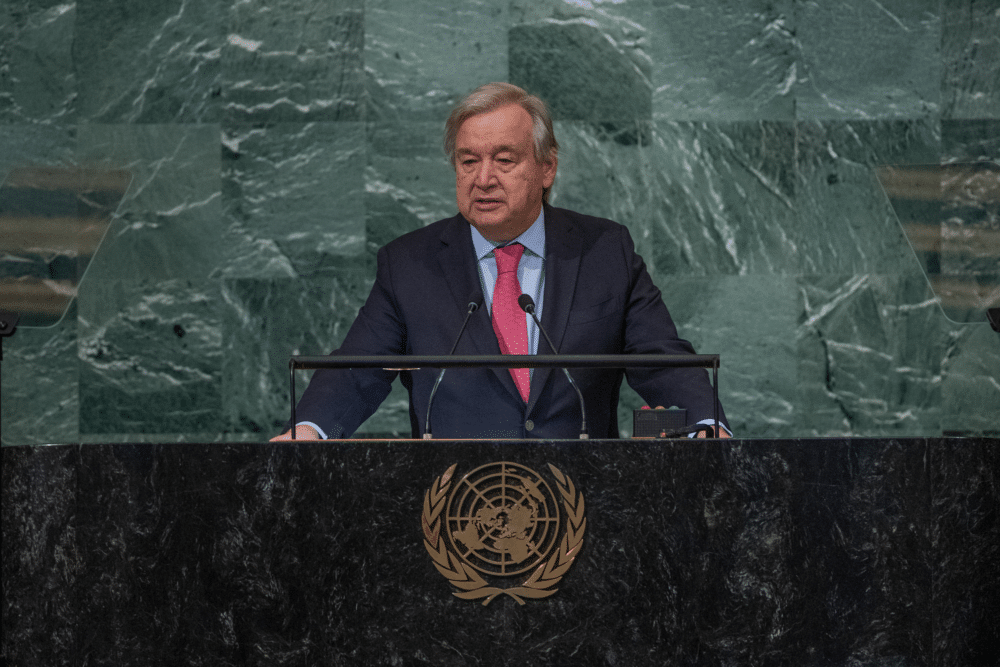
The UN Secretary-General, António Guterres, today called for an end to the “exploitation” and “plundering” of natural resources that do not generate added value for producing countries and affected communities.
In a high-level debate at the UN Security Council on the link between natural resources and conflicts, Guterres noted that, around the world, the control and exploitation of these resources are drastically changing the causes, dynamics, and outcomes of wars, stressing that critical minerals such as lithium, cobalt, nickel and rare earth elements are gaining increasing strategic importance.
The growing demand from global markets is creating vital opportunities to spur development in producer countries. But, according to Guterres, it is also driving intense geopolitical competition, increasing pressure on concentrated supply chains and fueling conflicts, which ultimately yields grave humanitarian consequences.
“Far too often, the proceeds of illicit exploitation of natural resources are making peace unattainable,” the UN leader explained, stressing that this exploitation strengthens armed actors and criminals, links local violence to regional and international networks, and weakens incentives for political commitment.
Guterres cited eastern Democratic Republic of Congo (DRC), where armed groups have benefited from illegal mining and mineral smuggling, but it has been civilians who paid the price of the ongoing conflict.
He also pointed to Sudan, where a fierce struggle for political and territorial dominance was fueled by the exploitation of natural resources—mainly gold and gum arabic—“leading to atrocities and the displacement of millions of people,” he said.
The UN Security Council has long recognized that illicit trade and the exploitation of natural resources play a significant role in financing armed groups.
Among the measures taken is the sanctions regime, notably against the DRC, Libya, and the terrorist group Al-Shabaab, in order to curb illicit trade in natural resources and prevent revenues from fueling violence.
Looking to the future, Guterres outlined four urgent priorities regarding this dossier, beginning with justice.
“We must ensure that mineral development yields fair and sustainable outcomes for resource-rich countries and communities. It is time to break with the long-standing pattern—where resources are extracted, value is captured elsewhere, and impoverished communities are left to bear environmental and socio-economic damage,” he urged.
The former Portuguese prime minister stressed that nowhere is this sovereignty deficit greater than in Africa, where the enduring consequences of colonialism, together with governance challenges, place states at a serious disadvantage as they seek to capture or reinvest the value residing in their natural resources.
Second, Guterres advocated for prevention, through capping illicit flows and strengthening transparency across all mineral supply chains.
Third, the peaceful resolution of disputes—especially regarding natural resource disputes that affect peace prospects—and fourth, climate, calling for assurances that preventive and policy efforts take climate analysis into account.
“Enough exploitation. Enough plunder,” he reiterated.
Today’s meeting was presided over by the Foreign Minister of the DRC, Thérèse Kayikwamba Wagner.
The DRC occupies a central position in the global energy transition, housing some of the world’s largest reserves of critical minerals, notably coltan, cobalt, copper, lithium, and rare earths.
The country holds approximately 60% of the world’s coltan reserves, consolidating its leadership as the largest single global producer. It supplies 50–70% of global cobalt, is the second-largest copper producer, and holds the largest lithium reserves in sub-Saharan Africa, according to the World Bank.
These raw materials are used in a variety of sectors—from electric vehicles and renewable energy systems to advanced electronics and defense technologies.
Despite generating billions of dollars in mineral wealth, the DRC remains one of the least developed countries in the world, ranking 171st out of 193 countries on the Human Development Index, with more than 70% of its population living in extreme poverty.
In this regard, the minister today asked the Security Council “to share an experience, convey a conviction and propose a way forward.”
The situation in her country reveals a “global imbalance for which only collective action based on equity and responsibility” can provide a lasting response, the official argued.