The so-called “eternal chemicals” are human-made substances that are toxic and highly resistant to natural degradation. As a result, they can persist in the environment, contaminating it for a long time.
These chemicals, also known by the scientific acronym PFAS (per- and polyfluoroalkyl substances), are used in a countless number of everyday objects, largely because of their resistance to water and grease. Today, thousands of PFAS are known, with the most widely used and studied being PFOA and PFOS.
With serious impacts on the health of humans, plants, and other animals, they have already been found in virtually every ecosystem on the planet, including in the most remote regions, such as the Arctic. Being difficult to detect and eradicate, the “eternal chemicals” are one of the greatest pollution problems of our time.
But a group of researchers made a discovery that could help strengthen our ability to combat PFAS.
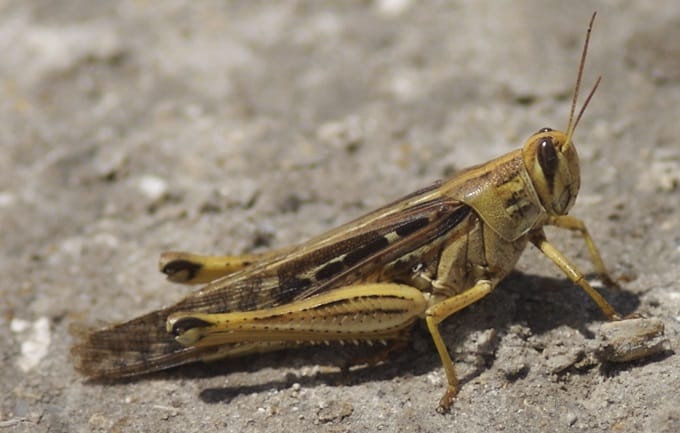
In a paper published in the journal “Journal of Hazardous Materials Advances,” scientists from Michigan State University and the University of California, San Diego (United States of America) reveal that grasshoppers (of the species Schistocerca americana) are capable of detecting PFAS, and even detecting several types of these synthetic substances.
In the laboratory, the team analyzed the brain activity of grasshoppers exposed to gases containing various types of “eternal chemicals,” including PFOS, and found that each one triggered a distinct neural response in the part of the brain associated with smell. In other words, each type of PFAS produced a unique odor “fingerprint.”
Moreover, the researchers say they confirmed that the grasshoppers can detect PFOS concentrations similar to those found in contaminated environmental samples.
The team admitted to being surprised by the discovery, because PFAS are entirely human-made chemicals. Unlike the natural odors that grasshoppers evolved to detect and recognize, the “eternal chemicals” have existed for less than a century, so the authors of the study are not sure why the insect’s sensory system reacts so strongly to them.
“For some reason, the insect’s sensory system is able to detect these human-made chemicals, even though they do not occur naturally in the environment,” says Debajit Saha, the study’s principal coauthor.
The scientists believe this discovery could inspire the creation of effective and cheaper PFAS detection systems. Currently, this detection is carried out with laboratory instruments, such as mass spectrometry, which, although highly precise, are expensive and require specialized facilities and cannot be taken into the field.
Furthermore, many existing detection systems can only detect specific types of PFAS, not permitting a more comprehensive analysis of contamination.
The team aims to convert the grasshopper’s detection system into a portable technology that can rapidly identify and analyze multiple PFAS outside the laboratory.
“Biology can provide a completely different way to detect PFAS,” says Saha. “If living sensory systems were able to recognize these chemicals, perhaps we can develop faster and more versatile tools to monitor contamination,” he adds.