Humans are the only extant primates that regularly hunt animals as large as themselves or larger. This behavior, known as the “human predatory pattern,” is considered central to the development of larger brains and the traits that make us what we are today.
However, this behavior did not arise out of nowhere, and understanding its origins and evolution helps deepen our knowledge about our own species. Often, the other primates with whom we share the planet are the best windows into our past.
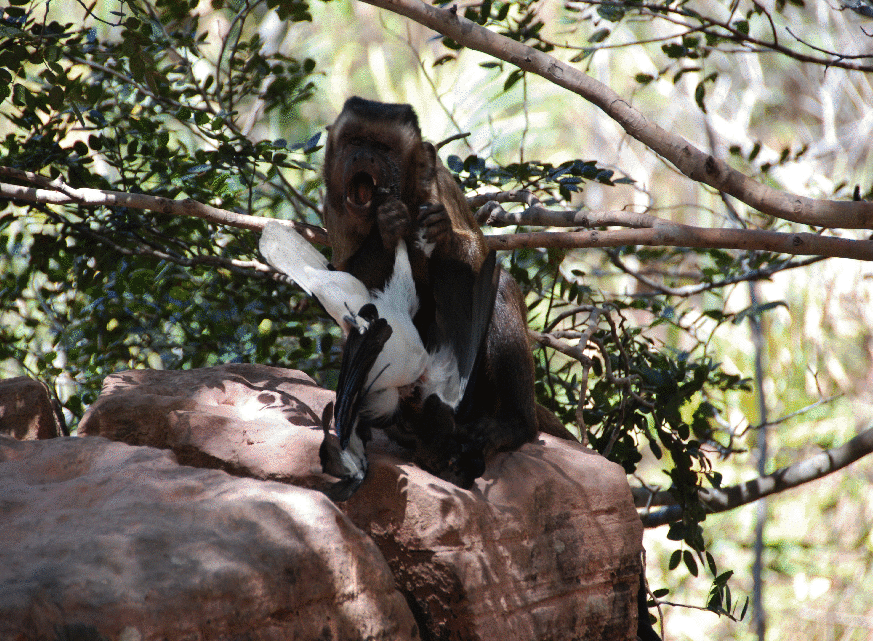
A team of researchers has discovered that capuchin monkeys of the species Sapajus libidinosus also hunt and feed on vertebrate flesh when fruits and plants become scarce in the areas where they live.
Led by Susana Carvalho, the scientific director of Gorongosa National Park (Mozambique), a researcher at CIBIO, the University of Porto, and a professor of Paleoanthropology at the University of Oxford, the work relied on the analysis of more than 5,000 hours of observations of these primates between 2006 and 2010 in the northeast of the state of Piauí, Brazil.
According to the article they recently published in the journal PLOS One, the scientists say they have obtained 446 records of capuchin monkeys eating small animals, mainly lizards (43%) and rodents (28%). However, among the records are also the first-ever observations of these monkeys eating opossums, iguanas and young birds.
Comparing males and females, the researchers found that they hunt more often than females and that they pursue prey that are more dangerous, such as snakes.
Hunting was more frequent when the availability of plant foods was lower, a behavior that the researchers say has already been suggested as also present in human ancestors during periods of climatic fluctuations. In addition, the results suggest that the capuchin monkeys’ hunting habits vary according to sex and the nutrients missing from their diets, and show a particular preference for the brains and viscera of the prey, fatty tissues.
The team believes that investigations of the fossil record should try to look for evidence of similar patterns in ancient humans, which would allow us to understand whether the non-human primates that exist today can help unveil the evolutionary origins of human predatory habits.
“This study shows the crucial need for long-term field observation to reliably understand the behavior of long-lived and highly flexible primate species,” say the authors of the study.
“Hunting small prey may have been an important source of nutrition for human ancestors during periods of food scarcity,” they explain, which may have paved the way for the exploitation of larger prey.