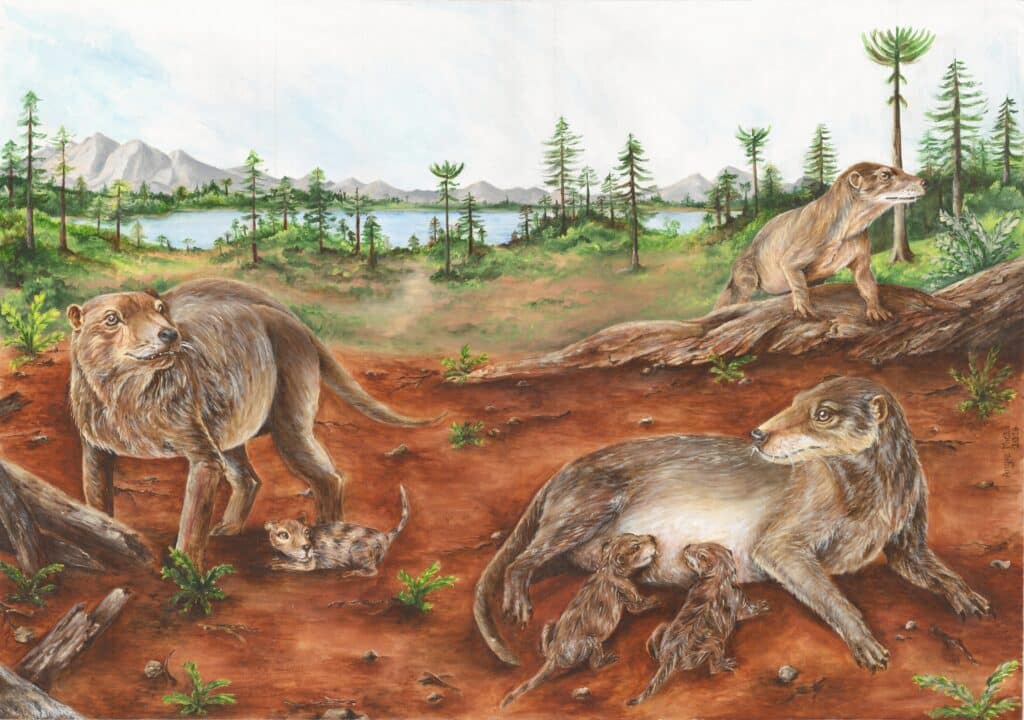
The ability to give birth to live offspring may have arisen in the evolutionary lineage of mammals much earlier than scientists thought. The conclusion results from a new study that found evidence of viviparity in a cynodont, a group of animals that lived long before the appearance of the first true mammals.
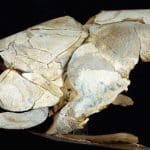
The investigation, published in the journal Frontiers in Mammal Science, analyzed fossil remains of Chiniquodon theotonicus, a species that lived about 236 million years ago, during the Triassic.
For a long time, cynodonts were considered egg-laying animals. However, microscopic analysis of the bone structure of an adult specimen of C. theotonicus revealed a growth mark that the investigators identified as a possible neonatal line.
This structure, which is rarely preserved in the fossil record, corresponds to a change in the growth rate that occurs immediately after birth and can be found in the bones or teeth of living animals.
To test this hypothesis, the team also compared the estimated body mass of C. theotonicus at birth and in adulthood with data from thousands of mammals, reptiles, and birds living today.
A Surprising Large Newborn
From the dimensions of the bones, the researchers estimated that the animal would weigh about 1.7 kilograms at birth and approximately 12 kilograms when it died. In other words, the offspring would have about 14% of the body mass it would reach later.
This ratio approaches what is observed in many living placental mammals and is far higher than what is recorded in most egg-laying reptiles and birds.
In reptiles of similar weight, offspring typically represent only a small fraction of the adult’s mass. In birds, the proportion is also quite low. Among mammals, by contrast, offspring can be born with a mass equivalent to a considerable portion of the mother’s or adult’s body weight.
“We were surprised to discover that C. theotonicus clustered with placental mammals, clearly distinguishing itself from other amniotes, such as reptiles or birds,” explains the lead author, Leandro Gaetano, a paleontologist at the National Scientific and Technical Research Council (CONICET) in Argentina.
The combination of the neonatal line identified in the bone and the ratio between birth mass and adult body mass constitutes, according to the researchers, strong evidence that this species gave birth to live offspring.
A Much Older Adaptation
The conclusion could push back by 90 to 95 million years the appearance of viviparity in the evolutionary lineage that led to mammals.
Cynodonts lived during the Triassic, a period marked by the recovery of ecosystems after one of the largest mass extinctions in life’s history. Competition for resources, predator pressure, and drier and more seasonal environmental conditions may have favored strategies capable of providing greater protection to embryos.
“We show, for the first time, that the birth of live young was present in at least one mammal ancestor, Chiniquodon theotonicus, which lived about 236 million years ago,” says Gaetano. “This means that viviparity among the earliest cynodonts arose in the mammal lineage at least 95 to 90 million years earlier than previously thought.”
The discovery may also force a reevaluation of the chronology of other features associated with modern mammals.
“In cynodonts, embryonic tissues had never been observed, much less a neonatal line,” explains María Miceli Baro of the University of Buenos Aires, also an author of the study. “Through its analysis, we found that a trait usually associated with evolutionary success was already present in animals long before the origin of true mammals.”
The researchers acknowledge, however, that more evidence is needed before concluding that viviparity was common among cynodonts.
“It is very possible that C. theotonicus does not represent an isolated case of viviparity among cynodonts. It could be evidence of a broad transition from egg-laying to the birth of live young at an early stage of the mammal lineage. But we need more evidence to test this hypothesis,” Gaetano concludes.
The discovery, thus, suggests that some of the oldest ancestors of mammals may already have employed a reproductive strategy that today we associate primarily with modern mammals.