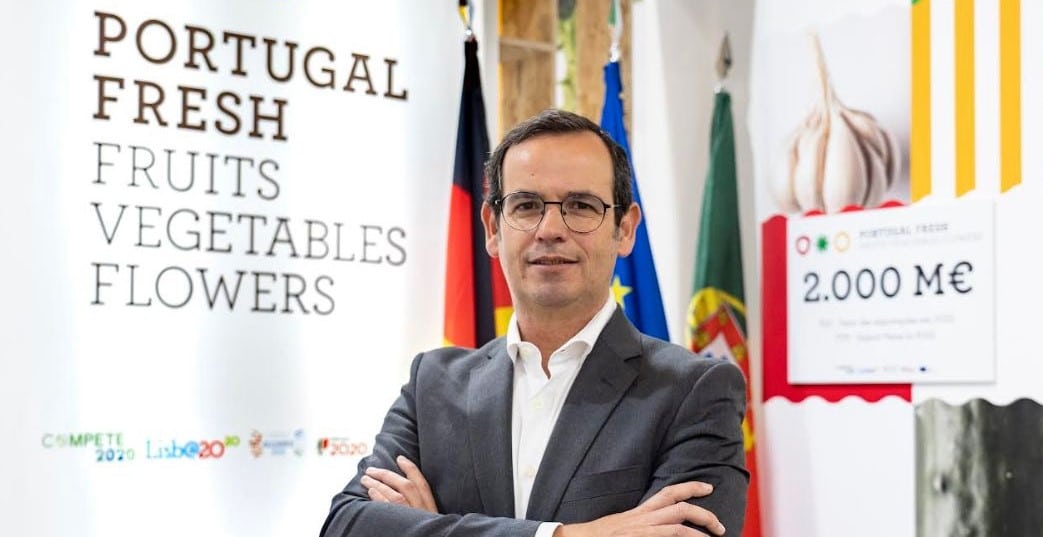
Portugal Fresh, the Association for the Promotion of Fruits, Vegetables and Flowers of Portugal, announced today that Portuguese exports of fruits, vegetables, ornamental plants and flowers fell by 3.5% in value and 5.9% in quantity in the first half of 2026, compared with the same period. Conversely, imports rose by 4.2% in value and 2.8% in quantity, worsening the sector’s trade deficit.
According to data from INE compiled by Portugal Fresh, external market sales totaled 1,226 million euros between January and June 2026. The export volume totaled 747,000 tonnes. The trade balance of the fruits, vegetables and flowers sector (FLF) deteriorated, surpassing 300 million euros in deficit — more than the 197 million euros recorded in the same period in 2025 and almost double the deficit of 2024 (178 million euros).
The reason for this decline is linked to the severe losses caused by the sequence of storms that battered the country (Ingrid, Joseph and Kristin) and resulted in destroyed crops, damaged greenhouses, and irrigation systems rendered unusable. Portugal Fresh had already warned about the predictable consequences of the storm train, which led to reduced product availability for international markets and, consequently, a drop in exports, visible in this first half.
“The figures for the first half were already expected, as they result, above all, from the impact of the storms that struck the country at the beginning of the year and, naturally, from substantial losses for producers considering the minimal aid from the European Union and the Government. Also worrying is the worsening of the trade balance, which surpassed 300 million euros. Nevertheless, we believe it is possible to reach again the 2.6 billion euros of exports recorded in 2025 by the end of the year,” says Gonçalo Santos Andrade, president of Portugal Fresh, in a statement.
According to the Association for the Promotion of Fruits, Vegetables and Flowers of Portugal, this is a very challenging year for producers and exporters in the national agri-food sector, also due to the lack of support, especially when compared with the main competing market — Spain — which received support for fertilizers and agricultural diesel to offset the impact of the Middle East war.
“Our main export destination is Spain, which, of the 1.2 billion euros exported in the first half, accounts for 37% of the total (446 million euros). Spain is also our main supplier of fruits, vegetables and flowers: we bought the equivalent of 870 million euros, which represents 57% of imports (totaling 1.5 billion euros). In accounting terms, the trade balance with our main international client is negative by more than 400 million euros. If competing on the global stage is already challenging, in the Iberian market it is becoming practically impossible. We compete with financial tools very different from those of Spanish producers and our costs have also risen sharply due to the Middle East war. The difference in sector support is astronomical,” concludes Gonçalo Santos Andrade.
Despite the decline recorded in these first six months, Portugal Fresh looks to the second half of the year with confidence. Having overcome the most critical period of the weather events, the association believes that domestic production has the conditions to resume its usual pace. Exports have room to recover by the end of the year, supported by the recognized quality of Portuguese products and by demand that remains in the main destination markets: Spain, France, the Netherlands, Germany and the United Kingdom. The association thus remains optimistic about the final balance for 2026 for the fruits, vegetables and flowers sector.