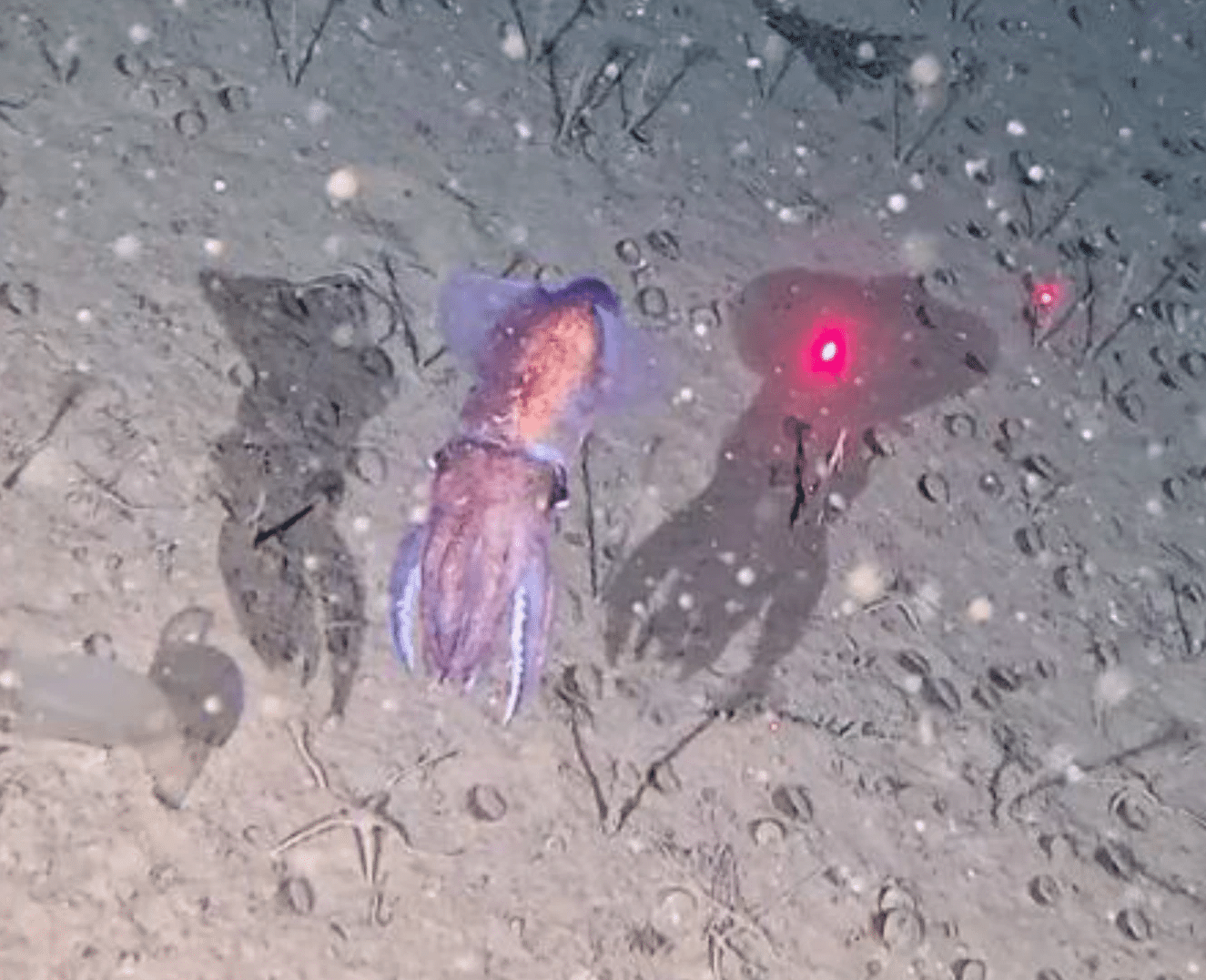
A group of researchers captured what they say are the first images of an Arctic squid of the species Rossia moelleri in its natural habitat in a remote region of the North Atlantic.
The records were obtained in Northeast Greenland National Park, considered the largest national park in the world, extending over the surrounding sea up to three nautical miles from the coast.
The discovery was led by biologist Paige Maroni, from the University of Western Australia, and published in the journal Polar Biology.
“Northeast Greenland National Park is the largest national park on Earth, but one of the Arctic marine regions least biologically documented,” describes the paper’s first author.
In addition to recording the presence of the squid R. moelleri, a compact, rounded animal that does not exceed 10 centimeters in length, with prominent eyes adapted to life in the dark and cold depths of the ocean, the scientists found that it was a female with several egg clutches nearby. Therefore, all indications point to active reproduction in that remote and icy region of the planet.
“The squid and the eggs were recorded at a depth of 50 meters in water at around -1.6 degrees Celsius, which underscores the resilience of marine life in one of Earth’s most extreme environments,” says Maroni.
The researcher considers that knowing and documenting the biodiversity in that region is “crucial” to understanding how the ecosystem works and assessing its resilience in the context of “accelerating climate change.”
In the article, the scientists write that, given the “rapid environmental transformation” of the eastern Greenland region, it is important to continue monitoring Rossia moelleri squids to understand how they cope with the warming of the seawater in which they live and with all the other ecological consequences caused by that warming.
“Such findings show how even isolated and verified records, drawn from poorly studied polar ecosystems, can provide a disproportionately deep understanding of the resilience and adaptability of marine life at the edge of habitability,” they state.