
The natural world is becoming increasingly small. The expansion of humans into spaces historically occupied more by wild animals than by our Homo sapiens, alongside the destruction of natural habitats, is bringing beings that have little history of coexistence, or whose history is brief, ever closer.
When humans and wild animals live in the same spaces and depend on the same resources, it is likely that conflicts will arise, with risks for both sides. It was precisely on this topic that João Paulino focused.
Within the scope of his doctoral work at the Center for Ecology, Evolution and Environmental Change (CE3C), of the Faculty of Sciences of the University of Lisbon, the researcher analyzed the perception of rice producers regarding the waterfowl with whom they coexist, in Lezíria Grande, in the Vila Franca de Xira area.
The study, recently published in the journal European Journal of Wildlife Research, focused on a theme the authors describe as “increasingly relevant in Mediterranean agricultural ecosystems”: the coexistence between agricultural activity and Nature conservation.
The investigation also included Pedro Granadeiro and Teresa Catry, both from CE3C, and Ana Nuno, from the Interdisciplinary Center for Social Sciences (CICS.NOVA) at NOVA University Lisbon, specialized in the social dimensions of conservation.
As natural wetlands disappear, rice paddies assume an increasingly important role as habitat for waterbirds, the team says. However, despite the widely recognized value of these agricultural ecosystems for the conservation of these species, conservation strategies rarely consider the perceptions of rice producers, the researchers emphasize, a gap in knowledge that, with this work, they aim to fill.
“The success or failure of many conservation measures in rice paddies depends, to a large extent, on the actions, decisions and collaboration of these farmers,” says João Paulino.
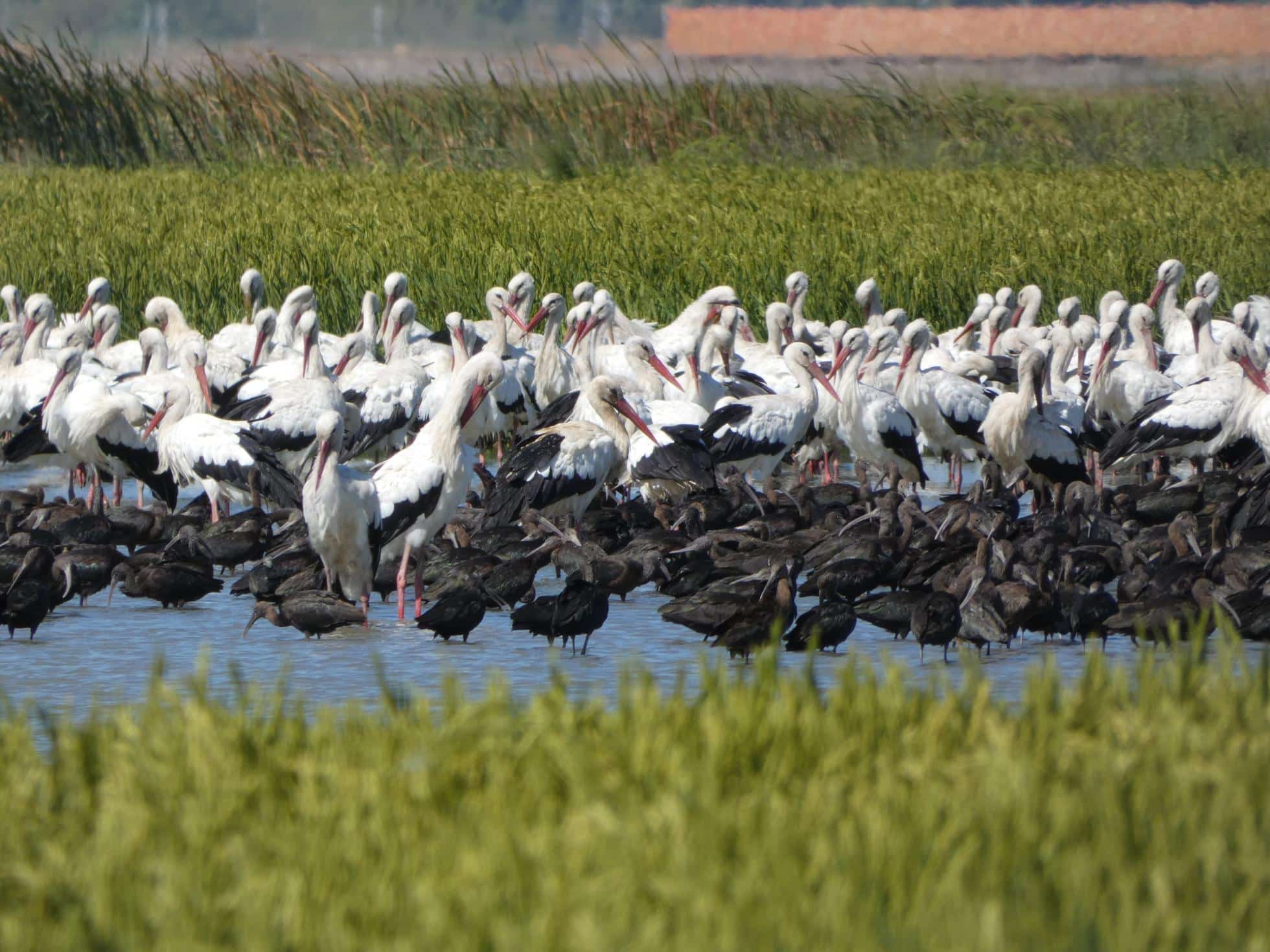
Water birds are often seen by farmers as potential pests, due to the damage they can cause to crops. Flamingos, storks and ibises were identified by rice producers as the species they consider responsible for the greatest losses, especially during sowing and harvesting periods.
In response, farmers adopt various techniques to scare the birds, such as propane gas cannons, to keep them away from the fields.
This situation creates a conflict between humans and wildlife, the researchers say, something that could jeopardize the conservation of some species and hinder the relationship between producers and the bodies linked to nature preservation.
Younger farmers with ‘particularly negative’ perceptions
According to the results of the study, it was found that older farmers have a less negative perception of waterfowl, but, at the same time, they are the ones who show less willingness to consider conflict mitigation strategies. On the other hand, younger farmers showed ‘particularly negative’ perceptions.
In addition, the scientists found that farmers with higher levels of education demonstrated more positive perceptions and greater receptivity to solutions, considering deterrence measures economically effective.
Based on the information gathered, the team presents several recommendations to promote “a more sustainable coexistence between agriculture and nature conservation,” as stated in a note.
Among these, the involvement of producers in collecting scientific data that allow quantifying the real impact of birds on rice production and rigorously identifying the species responsible for the greatest losses stands out.
In this way, it would be possible not only to make farmers part of conservation efforts, but also to design targeted deterrence measures for the species that are indeed having negative impacts on crops, rather than non-selective techniques that drive away all birds, as well as other animals that may be beneficial to agricultural production.
The researchers say that these solutions may involve not only systematic data collection but also the implementation of environmental education actions and the creation of agro-environmental schemes that recognize and compensate the conservation value provided by the rice paddies, as well as the potential losses caused by birds.





