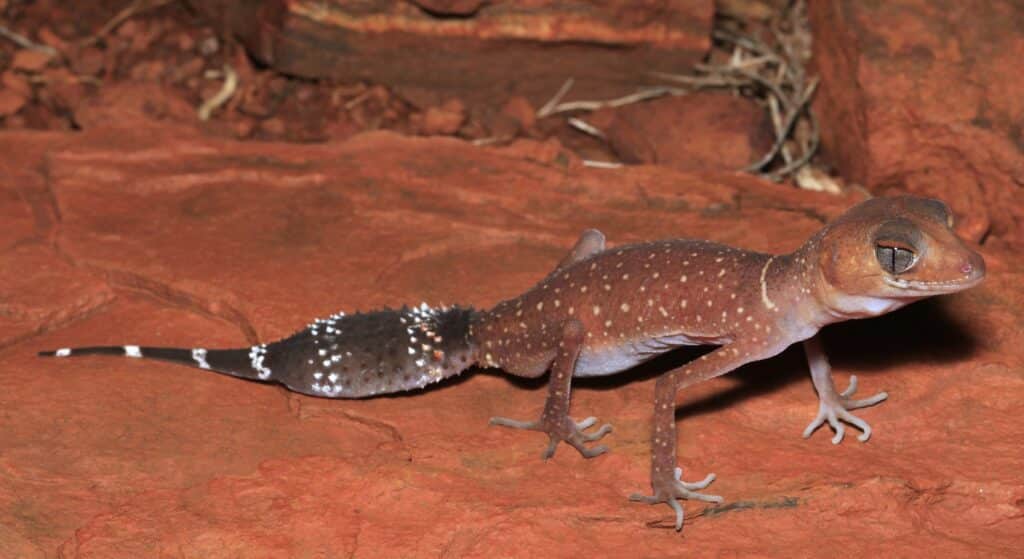
An investigation by Monash University in Australia has concluded that the Underwoodisaurus seorsus, one of the country’s least-known reptile species, faces an increasing risk of extinction due to climate change.
The study, published in the scientific journal Pacific Conservation Biology, presents the first comprehensive assessment of this species endemic to the Hamersley Ranges in the Pilbara region of Western Australia. The investigation combined five months of fieldwork, habitat analyses, study of the species’ biology and climate modeling to evaluate its conservation status.
Known for its distinctive sound resembling a dog’s bark when threatened or surprised, the Pilbara barking skink also stands out for its preference for mountainous and cooler areas, unlike most reptiles that thrive in hotter environments.
Until the start of this investigation, there were only 55 confirmed records of the species.
Habitat could disappear in the coming decades
According to Robert Audcent, who graduated with distinction in Science from Monash University and is the project coordinator, the species’ preference for elevated areas proved to be a key clue in understanding its vulnerability.
“The Pilbara region is expected to experience a significant rise in temperatures over the coming decades. Climate models forecast a grave and imminent threat to the species’ survival,” says Robert Audcent.
“The cool refuge habitat these skinks depend on is disappearing, and our models suggest that almost all suitable habitat could disappear in the coming decades,” he adds.
Over the past year, Audcent has traversed remote mountains and gorges in the Pilbara region, conducting nocturnal expeditions to locate specimens of this rare species.
The work has identified ten new populations and 87 individuals, significantly expanding knowledge about the species’ geographic distribution and its ecological preferences.
Proposed classification as a threatened species
Following the new discoveries, the researchers proposed including the skink in the endangered species category under Western Australia’s biodiversity conservation legislation.
If the proposal is accepted, the species will be considered in environmental impact assessments and will benefit from more rigorous monitoring and conservation programs.
Jules Farquhar, a senior researcher at the Chapple Lab of Monash University, warns that many species classified as ‘data-deficient’ may face similar threats without these being properly identified.
“Reptile species with insufficient information often have conservation needs equivalent to those of threatened species, and many may be experiencing rapid population declines,” he says.
“Australia hosts about 10% of the world’s reptile species, with more than 90% not occurring anywhere else. Leaving little-studied species unprotected can result in silent extinctions and severe ecological imbalances,” he adds.
The researcher also emphasizes that many of these species receive little scientific attention and are often deemed safe due to a lack of information.
“This investigation demonstrates that even a species previously classified as ‘least concern’ by the International Union for Conservation of Nature can face significant threats that only become evident through targeted investigation,” he notes.
The study reinforces the scientific community’s warnings about the impact of climate change on biodiversity, particularly for rare and little-studied species, whose threats may remain invisible until their decline becomes difficult to halt.