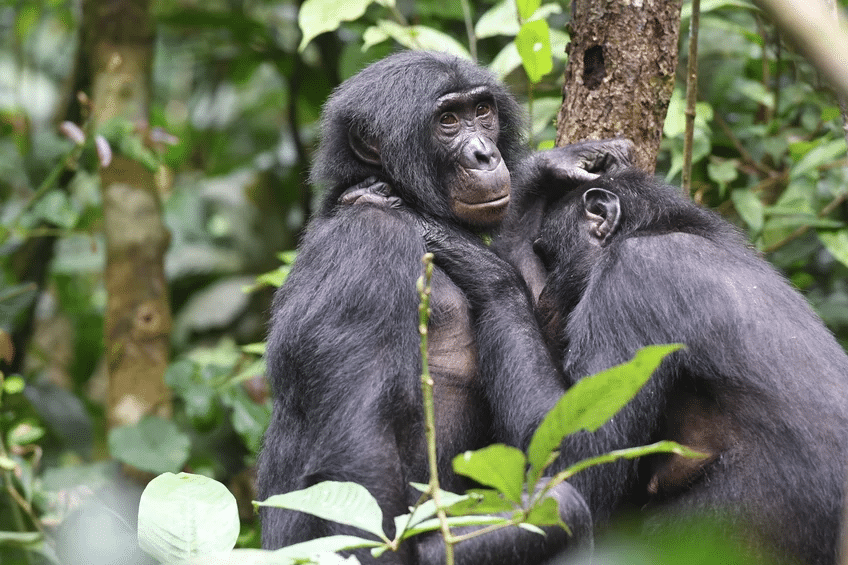
In bonobo societies, or pygmy chimpanzees (Pan paniscus), the group’s social life is largely dictated by the females. They are the ones who decide whom to mate with and they are the ones who control who eats when.
Although matriarchal societies are not exceptionally rare among non-human animals, the power dynamics of bonobos are especially curious, since the males are larger and stronger than the females, so one would expect them to rule. However, that is not what happens, with the females holding higher social status than some males.
A group of researchers in evolution and animal behavior believes they have discovered the reason why bonobo societies are female-dominated. The secret? “Coalitions” among females that embody the adage “unity is strength.”
In a study that compiled 30 years of demographic and behavioral data from six groups of wild bonobos in the Democratic Republic of Congo, the only country where these primates still live in the wild, the researchers reveal that females form alliances with one another to force the males to submit to their dominance. In this way, the female coalitions shape the groups’ hierarchy.
Martin Surbeck, from Harvard University and the Max Planck Institute for Evolutionary Anthropology, explains in a press release that “as far as we know, this is the first evidence that female solidarity can reverse the typically male-dominated power structure that is characteristic of many mammal societies.”
The paper’s first author, published in the journal the journal Communications Biology, adds that “it is exciting to realize that females can actively raise their social status by supporting each other.”
The dataset analyzed contained observations of 1,786 conflicts between males and females, of which 1,099 were won by females, thanks to the coalitions formed among them.
Thus, Surbeck notes, “it is possible to win a conflict by being stronger, by having friends who support you or by having something that someone wants and cannot be taken by force.”
Something that also surprised scientists was the fact that coalitions were formed between females who do not have blood-related ties, that is, the females of one group are typically individuals born in other groups and who, when they reached adulthood, left their families to integrate into others. Therefore, for these researchers, these female alliances are “unexpected.”
Still, there are many mysteries yet to be solved. Specifically, what leads to a coalition being formed. Scientists say that alliances can be formed in mere seconds, moments after the females have detected a male threatening one of the group’s offspring.
The offending male is chased by the allied females to the tops of the trees, in a frenzy of cries and movement, and, in some cases, the females may even seriously injure the males.
“It is a fierce way of asserting power,” says Barbara Furth, of the Royal Zoological Society of Antwerp and one of the study’s principal authors, who suggests that these aggressive demonstrations by the females are a way of showing other males that they must stay in line and submit to the governance of the females.
Nevertheless, the study notes that one cannot claim with total certainty that the females enjoy undisputed dominance, since even forming coalitions they do not always reach the top of the hierarchy. Therefore, Furth argues that “it is more correct to say that, in bonobo societies, the females enjoy a high status, rather than absolute dominance.”