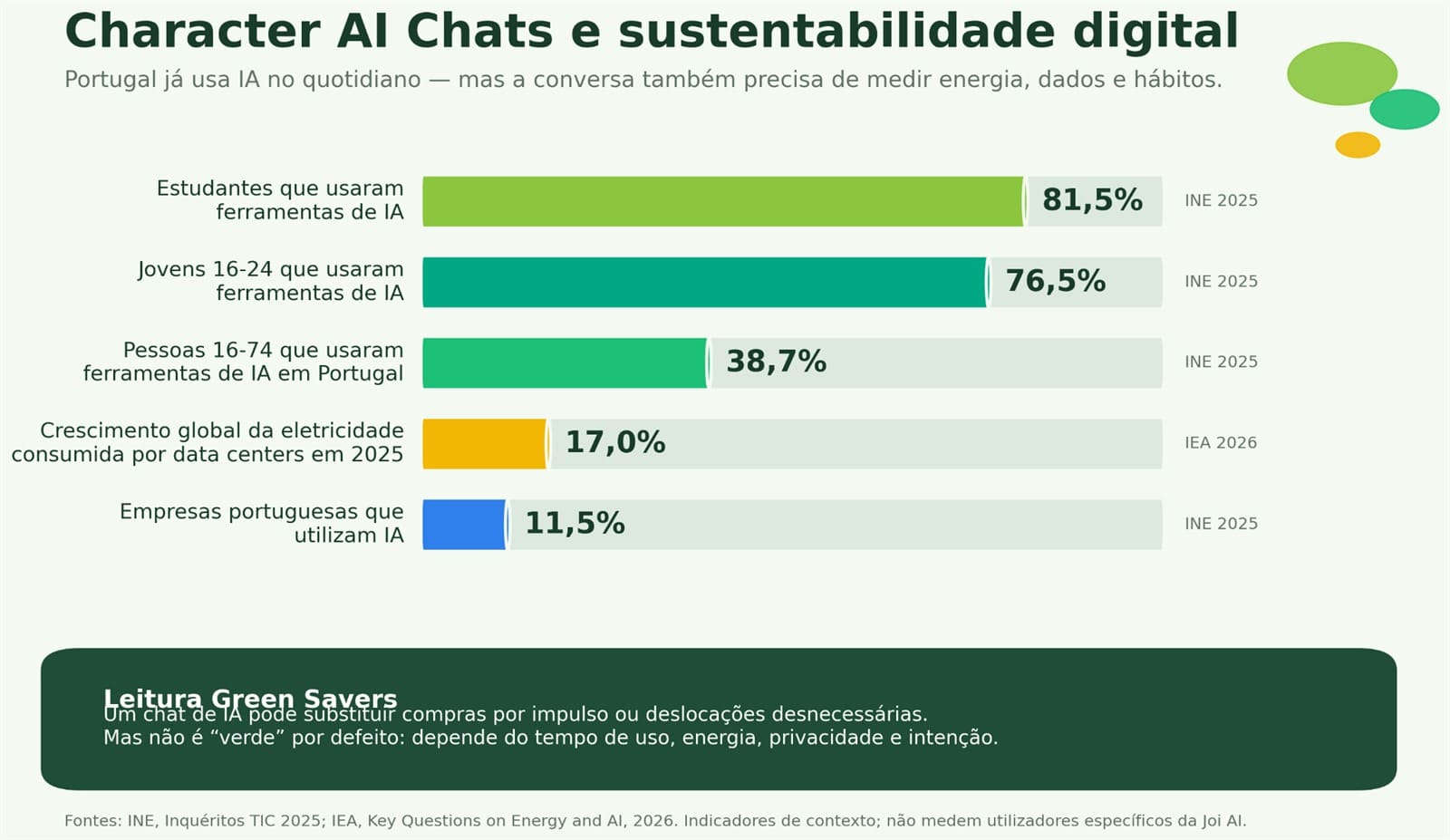
Between virtual companionship, the energy impact of artificial intelligence, and the need for more conscious digital habits, Character AI Chats open a conversation that no longer belongs only to the world of technology. It is also a conversation about sustainability.
For a long time, talking about digital sustainability meant talking about equipment recycling, energy efficiency, teleworking, or cloud storage. Today, the conversation begins to enter a more intimate territory: the way we use the internet to fill time, deal with loneliness, consume content, buy products, or seek companionship.
This is where the so-called Character AI Chats come in, platforms where the user chats with characters created by artificial intelligence. In services like Joi AI, for example, the experience is not limited to asking questions of an assistant. The proposal is to converse with virtual characters, each with their own style, personality, and context. It can be a light conversation, an interactive story, a creative simulation, language practice, or simply a way to pass a few minutes without falling into infinite scrolling.
At first glance, this may seem like digital entertainment only. But there is a more interesting question for a Green Savers perspective: can this kind of interaction help create more sustainable digital habits?
The short answer is: maybe. But it depends a lot on how it is used.
The first point is loneliness. In Portugal, as in other European countries, loneliness has ceased to be just a private issue. It is also a public health topic, aging, urban life, mobility, and social organization. There are people who live alone, young people who spend hours online but feel isolated, workers in hybrid arrangements with less daily contact, the elderly with family far away, and users who, at the end of the day, seek a conversation without pressure.
An AI companion does not replace friends, family, neighbors, therapists, or real communities. This distinction is essential. However, it can function as a light layer of companionship: someone opens their phone, chats, vents about a difficult day, asks for ideas to cook with what they have at home, practices a language, or invents a short story. It does not solve structural loneliness, but it can reduce moments of emptiness that often end up filled by worse digital habits.
The second point is impulsive consumption. Much of online time today is designed to push the user to buy, compare, click, accumulate, desire. Social networks, marketplaces, personalized advertising, and notifications create a kind of permanent storefront. When we are bored, tired, or lonely, shopping can become a quick emotional response.
In that context, a Character AI Chat can offer a less material alternative to impulse. Instead of opening a shopping app with no objective, the user can chat, play with a narrative, ask for suggestions to reuse objects, plan a waste-free meal, or organize ideas for a project. The exchange is not perfect, because it still consumes energy and data. But it shifts part of digital leisure from “buy to feel something” to “interact to think, imagine, or converse.”
The third point is unnecessary travel. There are essential trips, of course: work, school, health, family, culture, social contact. Sustainability is not about staying at home forever. But there are also small outings driven by boredom, automatic consumption, or lack of alternatives: going to the shopping mall without needing anything, driving to “see stores,” shopping impulsively because another way to occupy the night wasn’t found.
An AI conversation does not replace a walk, a trip to the theater, a stroll in a garden, or a coffee with friends. But it can substitute some trips without real purpose. It can help plan a purchase before leaving, compare needs, make a list, avoid a useless trip, or transform a night of boredom into a moment of writing, learning, or narrative game. On a small scale, this is also sustainable behavior.
But there is a side that cannot be hidden: artificial intelligence has an environmental footprint. Each interaction depends on servers, networks, data centers, electricity, cooling water in some infrastructures, and physical equipment. The International Energy Agency has warned about the growth of electricity consumption of data centers, especially with the expansion of AI. Therefore, saying that an AI Chat is automatically “green” would be wrong.
The more honest question is another: in which situations does the use of AI prevent larger impacts and in which situations does it only add more digital consumption?
If a ten-minute conversation helps someone avoid an unnecessary purchase, better plan a trip, or reduce a night of anxious scrolling, there may be an indirect benefit. If, on the contrary, the person spends hours generating conversations with no intention, with no rest and with no data awareness, the environmental and social balance becomes more doubtful.
Where Character AI Chats Can Fit Into a More Sustainable Lifestyle
| Day-to-day situation | Possible use of Character AI Chat | Potential sustainable benefit | Necessary caution |
|---|---|---|---|
| Evening boredom | Conversation, interactive story, or creative game | Less endless scrolling and fewer impulse purchases | Set usage time |
| Unnecessary desire to buy | Ask for help evaluating whether the purchase makes sense | More conscious consumption | Do not turn AI into a new commercial trigger |
| Small domestic doubts | Ideas for cooking, reusing, or organizing | Less waste and better planning | Confirm practical information |
| Occasional loneliness | Light companionship and low-pressure conversation | Complementary emotional support | Not substitute human relationships |
| Aimless outings | Plan before going out or find an alternative at home | Fewer useless trips | Maintain real and active social life |
| Learning and creativity | Practice languages, write, imagine scenarios | Digital leisure with less material | Protect personal data |
Portugal is already at a stage where AI is no longer a distant novelty. INE data indicate that a significant portion of the population aged 16 to 74 has already used artificial intelligence tools, with particularly high uptake among young people and students. This means the question is no longer “if” these habits will reach daily life. They have already arrived. The question is how they will be integrated.
For a user, the rule may be simple: use less, but better. Talking with an AI companion for a few minutes to unlock ideas, train a conversation, find an alternative to a purchase, or occupy a difficult moment can make sense. Allowing the app to replace sleep, human contact, physical activity, or conscious decisions is another matter.
For technology companies, the responsibility is greater. Character AI Chat platforms must be transparent about privacy, user age, safety, moderation, data management, and environmental impact. They should also create experiences that do not depend solely on keeping attention for as long as possible. A sustainable digital product is not only one that uses renewable energy; it is also one that respects people’s time and vulnerability.
For users, there is a small ethics of possible use: do not share sensitive data, avoid emotional dependency, take breaks, prefer conversations with a purpose, turn off aggressive notifications, and choose tools that better explain their policies. Digital sustainability often starts with discreet gestures.
Character AI Chats will not save the planet. They are not the automatic villain of the new internet either. They are more a piece in the puzzle of contemporary digital habits. They can help reduce impulse consumption, avoidable travel, and poorly resolved moments of loneliness. But only if used with awareness, restraint, and critical thinking.
Perhaps the future of sustainable leisure is not only about buying less, traveling better, or recycling more. Perhaps it also involves asking what kind of company we seek on screens, how much time we devote to algorithms, and what impact each seemingly small gesture has.
Technology is not neutral. But habits are not either. And between an impulse purchase, an unnecessary trip, and a well-used digital conversation, there may be room for lighter choices — for the wallet, for the mind, and for the planet.