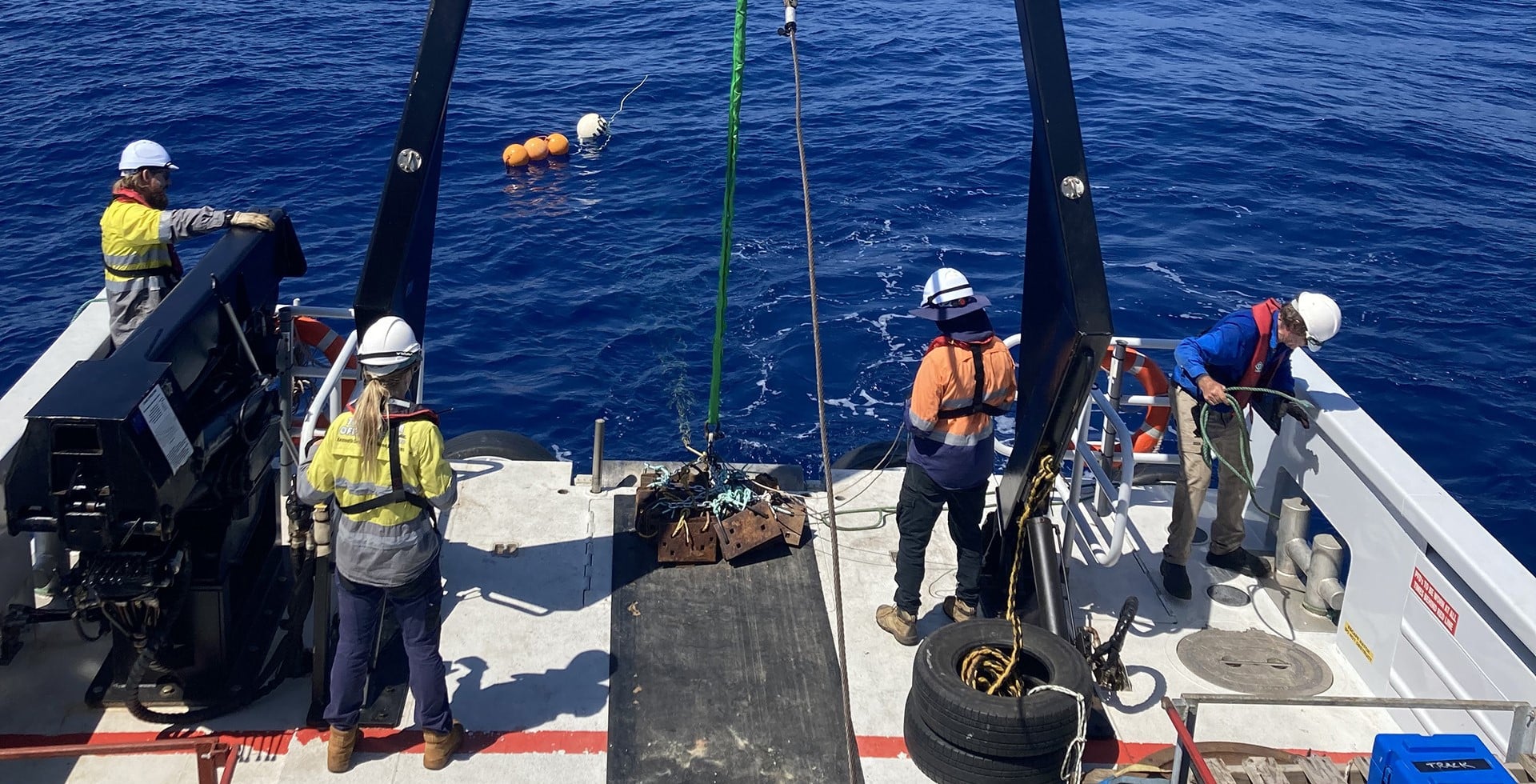
A study analyzing more than 18 years of underwater acoustic recordings identified some environmental conditions associated with the presence of the Omura’s whale Balaenoptera omurai, a cetacean species still little known to science. Researchers from Curtin University, in Australia, studied records collected between 2005 and 2023 at 35 sites off the country’s northwest, along about 1800 kilometres of ocean. The vocalizations were detected year-round, but the likelihood of presence was greater from September to May, when the waters are warmer.
The study, published in the journal Marine Mammal Science, concluded that the presence of this species was associated with sea surface temperatures above 27.5 °C, stronger winds, and higher concentrations of chlorophyll-a. This pigment, present in photosynthetic microscopic organisms, is used as an indicator of phytoplankton presence, which forms the base of the marine food chain.
The researchers also observed that the presence of the whales increased about a month after periods with higher levels of chlorophyll-a, suggesting a possible link to increased marine productivity and prey availability.
As Omura’s whale is rarely seen in the wild, it is difficult to study through direct observations. Therefore, analysis of the sounds it makes allows monitoring its presence over broad areas and long periods. Ciara Browne, a PhD researcher at Curtin University and the first author of the study, explains that acoustic recordings are an important tool for understanding where the species occurs and under which environmental conditions it is most likely to be found.
This whale was only recognized as a distinct species in 2003 and is listed as “Data Deficient” on the IUCN Red List. This classification does not mean that the species is out of danger, but that the available data do not allow a rigorous assessment of its extinction risk. For Christine Erbe, director of Curtin University’s Centre of Marine Science and Technology, identifying the habitats and oceanic conditions on which it depends is an essential step in guiding future conservation measures.
The results could also contribute to planning and management of the marine environment, helping to assess the potential effects of human activities, such as ship traffic, offshore industry, and other sources of underwater noise. The researchers also emphasize that long-term monitoring will be important to understand how this species may respond to environmental changes and future climate shifts.
The work was conducted with the support of the Western Australian Marine Science Institution. By revealing patterns that would be difficult to identify through single-point observations, the recordings accumulated over nearly two decades provide a knowledge base to improve understanding of this species and support future decisions regarding the conservation of Australian waters.