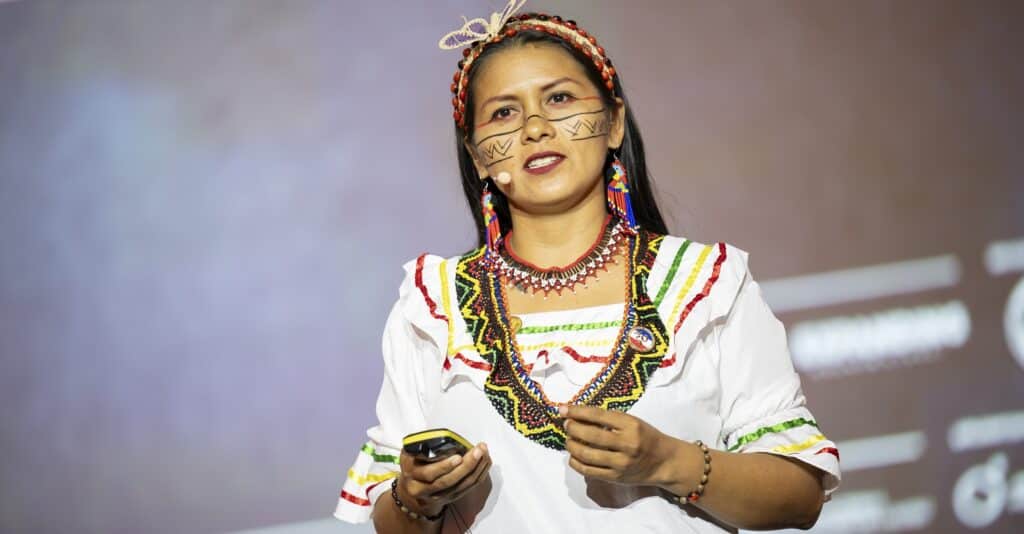
Microorganisms found in a river in the Amazon could help identify new solutions to one of the planet’s greatest environmental problems: plastic pollution. The research was presented by Peruvian biologist Avita Taricuarima, representative of the Kukama Indigenous people, during GLEX Ignition, an international conference dedicated to scientific exploration, which took place on October 29 and 30 in Coimbra, as stated in a press release.
According to the same source, the researcher revealed that she has already managed to isolate more than ten colonies of microorganisms collected from the Fervilhante River in the Peruvian Amazon, and is studying in the laboratory their capacity to degrade different types of plastic.
“My results are still preliminary, but I have already isolated more than ten colonies of microorganisms collected from the River Fervilhante. We are testing their capacity to degrade different types of plastic in the laboratory and the results are promising. I believe these microorganisms could help us find new solutions to an environmental problem that affects the entire planet,” Avita Taricuarima said.
Being the first Kukama woman from her community to enter university, the biologist also conducts research on parasites present in fish consumed by local populations, seeking to bridge scientific knowledge with the needs of Amazonian communities.
In her speech at GLEX Ignition, Avita Taricuarima argued that contemporary science has much to gain from the knowledge transmitted across generations by Indigenous peoples, particularly with regard to biodiversity and the preservation of ecosystems.
“Science and ancestral knowledge do not need to be separated. Biology gives me tools to study nature and to find new solutions, but the knowledge of my ancestors teaches me to respect it and to understand the relationship we have with it. I believe that when these two forms of knowledge work together, we can build a stronger future,” she noted.
For the researcher, protecting the Amazon also demands a change in how society relates to nature.
“For Indigenous peoples, the forest, the animals and the rivers are not just resources that we use when we need them. They are our identity, our family, our mother. When the river is sick, I am sick too. If we begin to look at nature as part of our family, we will protect it with much more respect and dedication,” she concluded.
Organized by Expanding World Portugal, in partnership with The Explorers Club, of New York, GLEX Ignition brought together in Coimbra astronauts, scientists, researchers and leaders of some of the most ambitious scientific exploration missions, promoting debate about the new frontiers of knowledge and the challenges of the future.