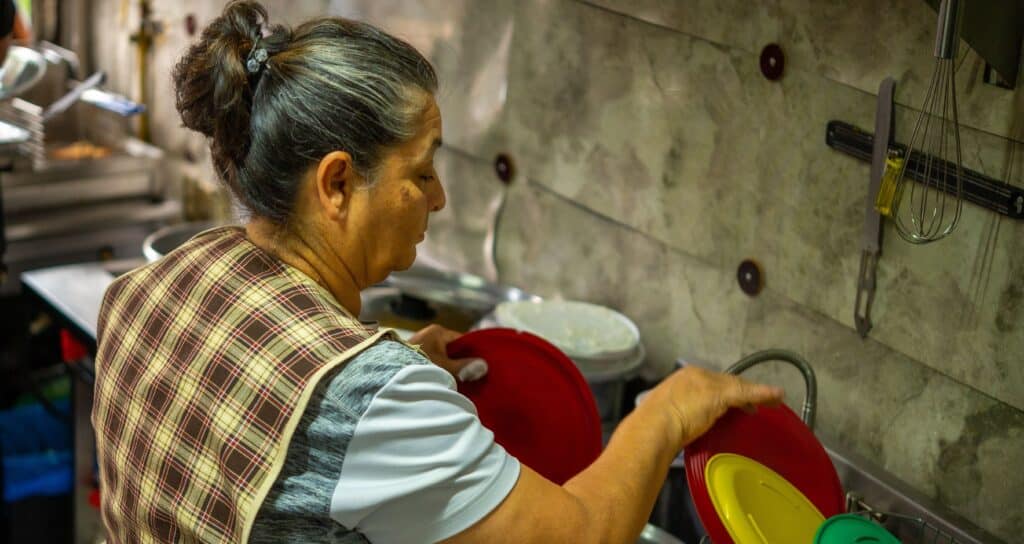
Thirty years after the adoption of the Beijing Declaration, considered a milestone in promoting gender equality, the unpaid work carried out by women remains widely ignored in economic statistics and public policies. The conclusion comes from a collection of international studies published in the scientific journal The Economic and Labour Relations Review.
The nine studies, coordinated by researchers at the University of New South Wales (UNSW) in Australia, show that, despite more and more women participating in the labor market, no country has achieved true economic equality between men and women.
According to the researchers, one of the main reasons is that essential tasks such as caring for children, providing assistance to elderly relatives, preparing meals, cleaning the house, or supporting dependent family members remain largely outside traditional economic metrics, including Gross Domestic Product (GDP).
The research estimates that more than half of women’s total contribution to work comes from unpaid activities, while for men this proportion hovers around one third.
For Yuvisthi Naidoo, a researcher at the Social Policy Research Centre of UNSW, this invisibility helps explain why progress toward gender equality has been slower than expected. “At the heart of the problem is the fact that a large portion of the work performed by women simply is not accounted for,” she says, quoted in a press release.
Having a job does not mean economic autonomy
The researchers also warn that access to paid employment, in itself, does not guarantee financial independence or decision-making power.
In many countries, women remain concentrated in underpaid or precarious professions, while simultaneously accumulating the majority of caregiving and domestic responsibilities. In some contexts, they even have limited control over how the income they earn is used.
For Diana Kelly, editor-in-chief of the scientific journal, the concept of economic empowerment goes far beyond employment rates. “Economic empowerment cannot be measured solely through employment statistics,” she emphasizes.
Gender equality remains far from being achieved
The findings come at a time when the United Nations acknowledges that the Sustainable Development Goal related to gender equality by 2030 is far from being achieved.
The studies also reveal that occupational segregation remains deeply rooted. In Australia, for example, only 20% of professions showed an even distribution between men and women in 2025, while around one hundred occupations recorded wage gaps greater than 25% to the detriment of women.
Disparities are even more pronounced among Australian Indigenous women, whose pay gap with men reaches 38.1%.
Change requires recognizing the value of caregiving work
Although challenges are common across different regions of the world, the researchers identify some positive signs, especially in Latin America, where several countries have been recognizing the care provided to children, the elderly and dependent people as essential social infrastructure.
Among the measures highlighted are the strengthening of public services supporting children and the elderly, as well as policies aimed at distributing caregiving responsibilities more evenly among families, employers and the State.
The authors argue that achieving true economic equality requires more than increasing women’s participation in the labor market. It will also be necessary to recognize the economic and social value of caregiving and domestic work, which remains largely invisible in national accounts and in policy decisions.