
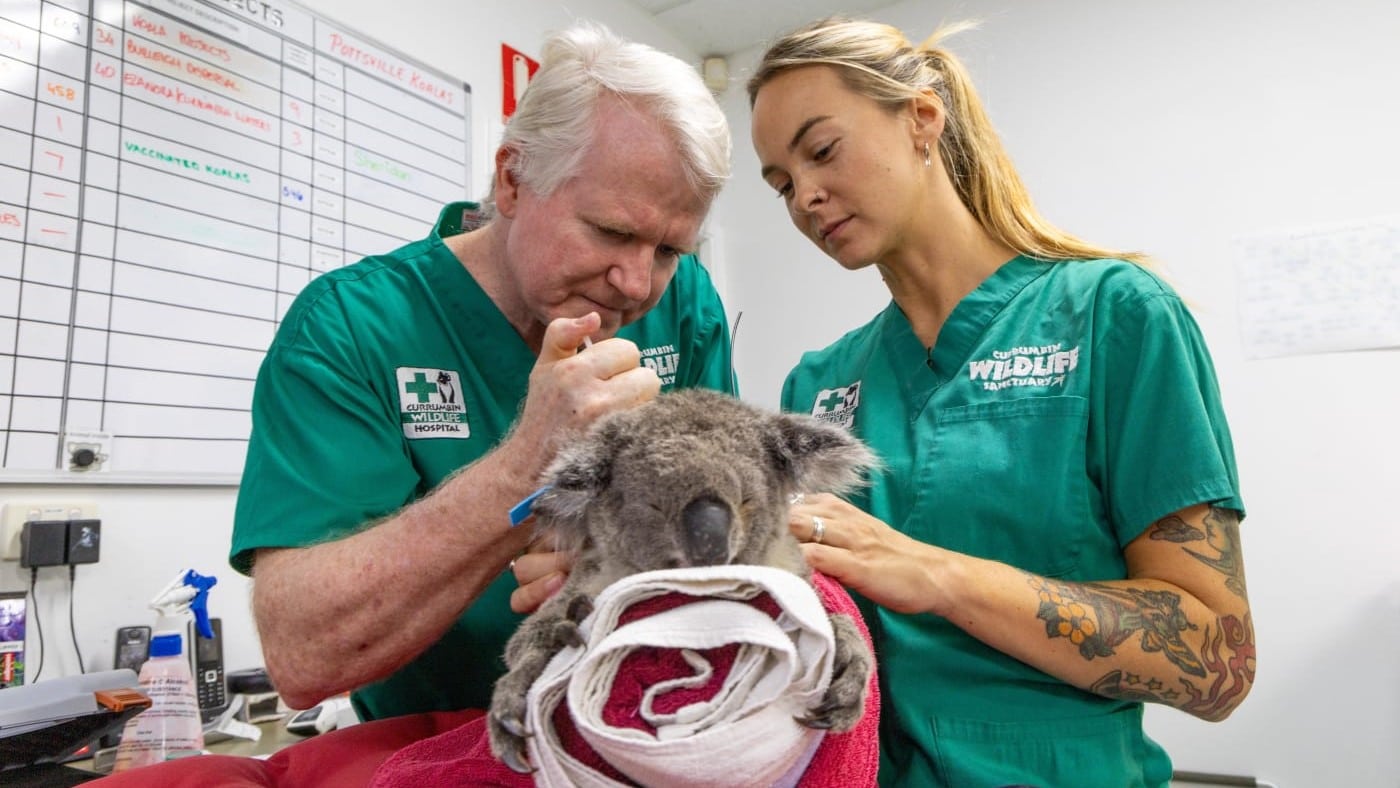
A young koala has become the first wild member of the species to receive a biodegradable implant capable of automatically administering the second dose of a vaccine against chlamydia, one of the diseases that threatens koala populations in Australia.
The procedure, regarded by the researchers as a “huge advance,” was carried out on an 18‑month‑old female named Bamse, captured in the Burleigh region of Queensland. After being observed and sedated at the Currumbin Wildlife Hospital, she received the first dose of the vaccine and an implant designed to release the second dose about 30 days later.
On the day of the intervention itself, the koala was returned to her natural habitat, where she is now being monitored via a GPS collar. The monitoring is expected to extend for at least six months, allowing an assessment of the new technology’s effectiveness.
The project is led by Queensland University of Technology (QUT) and Currumbin Wildlife Hospital, with support from the environmental organization WWF Australia.
Less stress for the animals, greater reach of vaccination
Until now, the chlamydia vaccine used in koalas required two captures: one to administer the first dose and another, about four weeks later, for the booster dose.
The new biodegradable implant eliminates this need, significantly reducing stress for the animals and making large-scale vaccination campaigns simpler and more feasible.
According to the researchers, five wild koalas from the Burleigh region have already received the implant. Bamse and another animal have since been recaptured for routine assessments after a month, showing no signs of chlamydia infection.
“We have been working with vaccines against chlamydial disease in koalas for more than five years, and this is a huge advance, because we are turning a two-injection vaccine into a combination of injection and implant that can be administered in a single visit. It is truly a remarkable moment,” says Michael Pyne, senior veterinarian at the Currumbin Wildlife Hospital, quoted in a press release.
Encouraging results in population recovery
The vaccine has already been administered to more than 500 koalas in wildlife rehabilitation centers in Queensland.
One of the most promising examples emerged in the Elanora region on the Gold Coast, where more than 70% of koalas admitted to the hospital in 2020 had chlamydia infection.
According to the project leaders, disease-related admissions in that area fell by 75% since then. Concurrently, there were 41 joey births and 13 births of grand-offspring among these animals, in a site previously considered one of the most affected by the disease in the state.
Chlamydia is one of the major threats to koala survival, capable of causing blindness, infertility, and severe infections that frequently lead to death.
Report recommends large-scale vaccination
The announcement comes at a time when an independent report prepared for the Queensland Government concluded that the vaccine developed by QUT demonstrated “substantial reductions in chlamydial disease and mortality in vaccinated wild koalas” and that vaccination is “operationally viable on a large scale.”
The study, conducted by Lyndal Hulse of the University of Queensland, analyzed more than 1,100 koalas and identified several regions in southeastern Queensland as priorities for future vaccination campaigns due to the high prevalence of the disease.
The city of Logan recorded the highest infection levels, with 58% of animals affected by ocular chlamydia and 56% by infections of the urogenital tract.
According to the researcher, the results obtained so far clearly demonstrate the vaccine’s potential. “When we analyze the vaccine’s efficacy using data collected by the Currumbin Wildlife Hospital, the reduction in infection burden and disease caused by chlamydia is quite evident at the population level.”
T echnology could benefit other species
In addition to its application in koalas, the researchers believe the implant could be adapted for other vaccines and veterinary medicines that require multiple doses.
Freya Russell, a QUT researcher involved in the project, believes the technology could have impact far beyond the conservation of Australian marsupials.
“What makes this implant so exciting is its versatility. It can be adapted to a wide range of vaccines or medicines for animals that would normally require multiple doses,” she explains.
The researcher adds that discussions are already under way with groups connected to wildlife and livestock research, with several agricultural producers expressing interest in the technology for the possibility of simplifying cattle vaccination.
For WWF Australia, the innovation represents a new hope for a species that continues to face multiple threats, from disease to habitat loss.
“We need to combat chlamydia and, at the same time, restore and protect koala habitats if we want to prevent the species from moving closer to extinction,” argues Tanya Pritchard, head of koala recovery at the environmental organization.





