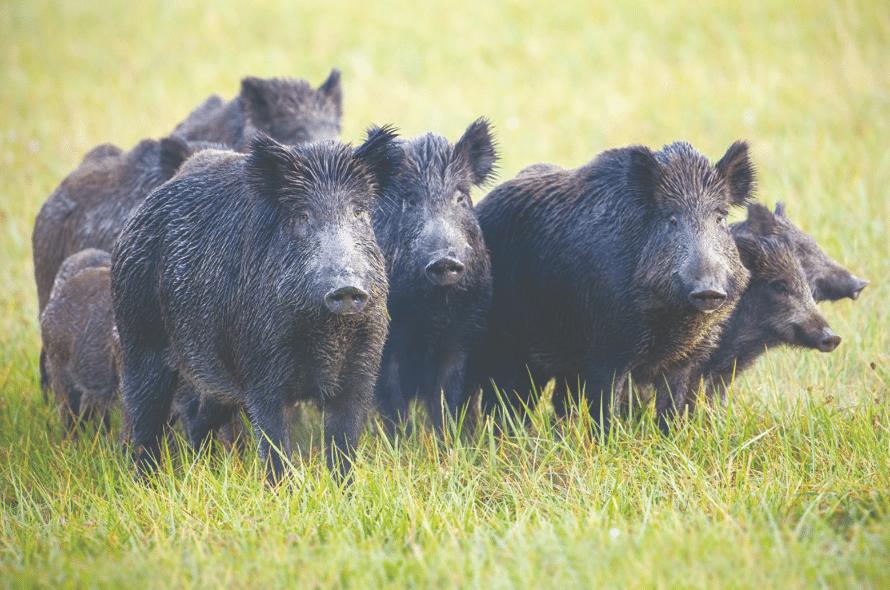
The Institute for Nature Conservation and Forests (ICNF) will reinforce the plan to contain the wild boar population in Arrábida, in Setúbal, focusing on the entry points into the urban space and beaches, a spokesman told Lusa yesterday.
In statements to Lusa, the ICNF’s regional director for Lisbon and the Tagus Valley, Carlos Albuquerque, explained that the control of the wild boar population has been carried out in a zone farther from the city, and the strategy is now to be strengthened to allow containment to be conducted at the entry channels into the urban space and at the beaches.
“For now, we will identify the crossing zones and try to extract some of the animals with traps or hunting,” said Carlos Albuquerque, who was speaking at the end of a meeting with the vice-president of the Setúbal City Hall, Maria do Carmo Tiago.
Also according to the official, the ICNF is giving priority to requests for correction of excessive densities of wild boar in the Arrábida Natural Park area (ANP).
However, he added, the ANP has few state-owned lands, with most being private, so the control of the density of the wild boar population is carried out by the owners, with requests directed to the ICNF and implemented by certified individuals.
The vice-president of the Setúbal City Council, Maria do Carmo Tiago, said that the ICNF “will have the support of the City to carry out this measure, particularly in identifying these access points.”
“The Setúbal City Council has been following this issue and will always be available to collaborate,” she added.
According to the ICNF, there are no absolute data on the size of wild animal populations, although in the Arrábida Natural Park, in the last hunting year (June 1, 2025 to May 31, 2026) around 700 animals were culled per year, with the population remaining numerous but stable.
The sighting of wild boars in the city of Setúbal and on Arrábida’s beaches has been reported on social media.
In a statement, the ICNF also notes that “the increase in wild boar sightings in urban areas is not a new phenomenon at this time of year and does not necessarily result from uncontrolled population growth or from a shortage of water and food in the species’ usual presence areas.”
The increase, according to the ICNF, is often associated with the post-birth period, a phase in which the animals explore new territories, becoming more visible to human populations.
“The ICNF is aware of the constraints associated with wild boar sightings in urban areas and has been working in close collaboration with local authorities, aiming to adopt the most appropriate measures in each situation,” the institute indicates, adding that it does not have the authority to authorize the culling of wild boars in urban areas “as they involve public safety concerns.”
The ICNF also emphasizes that the beach area is not considered a hunting area, “so the responsibility for ensuring the safety of people and property lies with civil authorities.”
On the other hand, the ICNF adds that its Nature Wardens teams have been monitoring the situation on the ground, with information to the public reinforced by placing informational posters on Arrábida’s beaches, as well as appeals to Setúbal’s Municipal Services to strengthen the regularity of waste collection.
Carlos Albuquerque also reinforced the warnings, reminding that wild boars are wild animals whose behavior is unpredictable and calling on people to always contact the authorities, notably the National Republican Guard (GNR) and the Maritime Police, in cases of sightings in the urban area or on the beaches, not to feed them, to avoid approaching children and dogs, and to place trash in the containers.
The wild boar is a game species that has virtually no natural predators, so its presence in the territory must be controlled.
“Aware of this reality,” the ICNF notes, the institute “has sought to respond as quickly as possible to requests for correction of population densities, also promoting actions with hunting zones, farmers, or other entities, whenever justified.”
Portugal’s Strategic Plan and Action Plan for the Wild Boar, prepared by the Environment and Sea Studies Center of the University of Aveiro, recommends, over a 5 to 10-year horizon, strengthening efforts to increase the extraction rate of the species by 20 to 30%, taking into account risks to the safety of people and property, implications for public health, and the negative impacts on habitats, species, and the balance of ecosystems.
In 2025, the regulatory decree governing hunting was amended, allowing wild boar hunting to take place throughout the year.
Thus, the existing legislation enables the execution of actions to correct wild boar densities whenever there is considered to be an excess population of this or other game species, subject to authorization by the ICNF, at the request of the competent entities.