Some insects, such as ants, bees and termites, form complex and large-scale societies, usually governed by queens, who are the only individuals that reproduce.
Several studies also indicate that queens secrete pheromones that help control the other members of the colony, all their descendants, and keep the group stable and prosperous.
A new investigation now reveals that the queens of the bees of the species Megalopta genalis emit chemical signals that serve for their daughters to make one of the most important decisions of their lives: to remain in the colony to help the queen as non-reproductive females or to leave the “nest” to create their own colony.
In an article published in the journal ‘Proceedings of the Royal Society B – Biological Sciences, the research team, led by the Smithsonian Tropical Research Institute, discovered that the queen bees of this species use pheromones to try to convince their daughters to stay in the colony in which they were born.
The scientists suggest that the decision depends on the health of the queen herself and on whether the daughters leaving the colony is the best way to disseminate the family’s genes.
“We are interested in the evolution of cooperation and, in this case, in how [the Megalopta genalis bees] decide whether cooperation is worth it or not,” says Callum Kingwell, the study’s first author. He adds: “our observations offer a rare view of how insect societies may have initially evolved.”
The investigation took place on Barro Colorado Island, in Panama, where for years scientists studied the lives of these bees to understand whether the queen’s daughters stayed in the birth colony and became non-reproductive workers, usurped the ruler and took the throne, or ventured out to seek their own fortunes in the outside world.
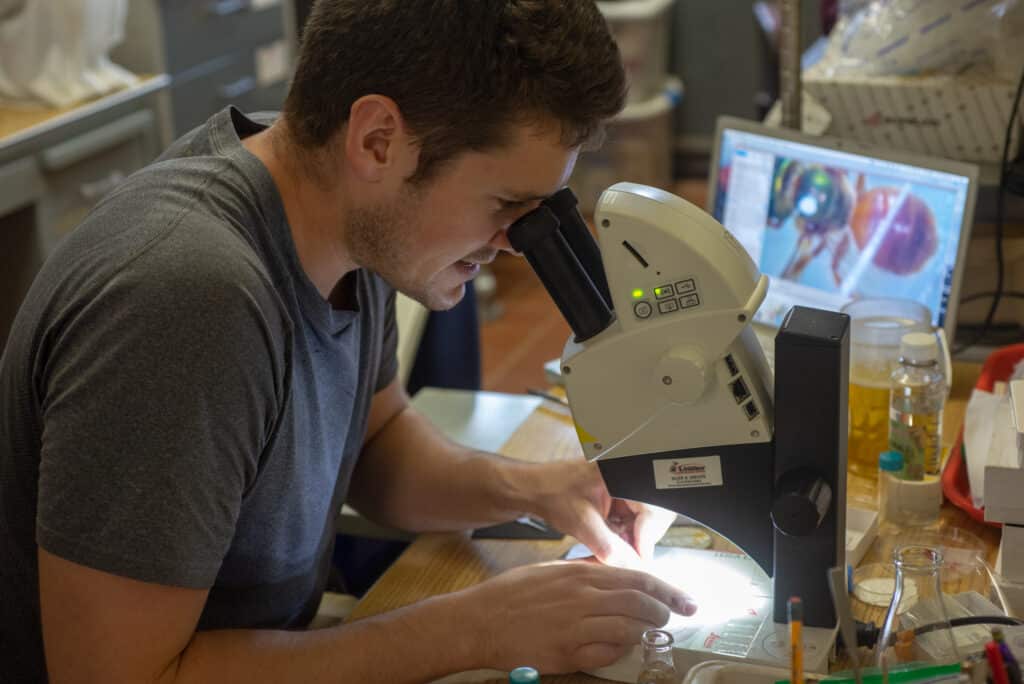
Moreover, they used advanced techniques, such as gas chromatography and mass spectrometry, to identify and quantify the pheromones emitted by the queens.
Based on the results, the researchers suggest that the queen’s pheromones influence the daughters in two ways. On one hand, high levels of real pheromones, associated with the queen’s good health, inhibit the development of the daughters’ reproductive apparatus. On the other, these same chemical signals reveal the health status of the ruler, and the better it is, the greater the queen bee’s capacity to continue propagating the family’s genes.
The higher the pheromone levels, the scientists say, the greater the likelihood that the daughters will stay in the colony, probably because they know that the one responsible for disseminating the genes remains able to carry out her mission.
“The evolution of cooperation is a fundamental issue that goes far beyond insects,” notes Kingwell. “Our work shows how chemical communication can help individuals decide when cooperation is worth it, providing perspectives relevant to evolutionary biology, animal behavior, and social systems more generally.”