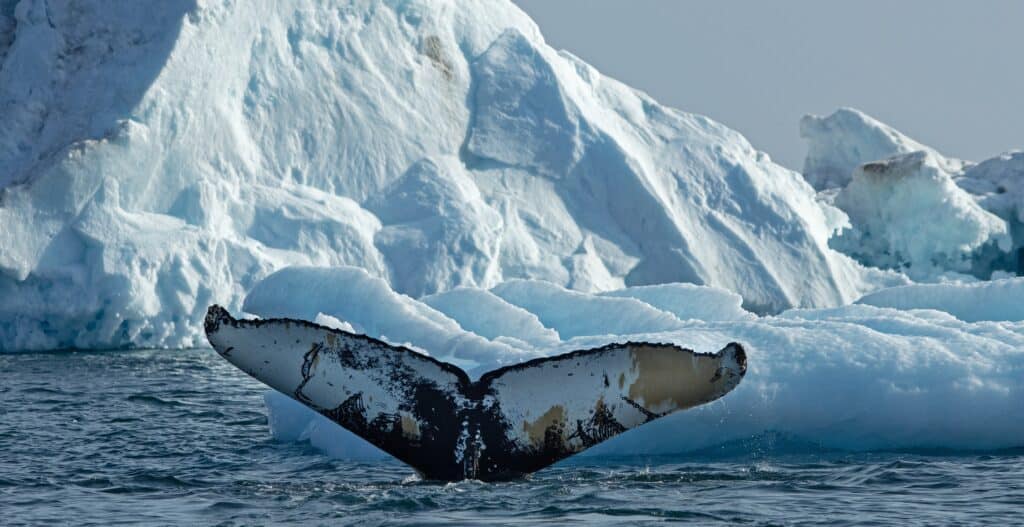
The warming of the waters and the reduction of sea ice are transforming the eastern Greenland marine ecosystem, attracting exceptionally high concentrations of three species of baleen whales. A study published in the journal Frontiers in Marine Science estimates that about 16,000 common minke whales, humpback whales and pygmy right whales may spend the summer in this region, where they congregate to feed on krill.
“We show here that the increase in ocean temperatures and the reduction of sea ice coverage have facilitated the widespread presence of baleen whales along the east coast of Greenland, up to 70° north latitude,” says Mads Peter Heide-Jørgensen of the Greenland Institute of Natural Resources. According to the researcher, this change has given rise to regular concentrations of common minke whales, humpback whales and pygmy right whales feeding together, species that historically were observed only rarely in the coastal waters of eastern Greenland.
The Arctic and the North Atlantic are among the regions warming the fastest on the planet. The sea-surface temperature east of Greenland has risen by about 2 °C since the 1990s and, from the mid-2000s, the summer sea-ice boundary retreated significantly to the north, reducing the extent of ice along the island’s eastern coast.
A Change Observed Over Decades
To track this transformation, the researchers conducted the first systematic aerial surveys of baleen whales up to 50 kilometres from the east coast of Greenland, in August 2015 and 2024. To these data they added aerial observations conducted in 2022, reports from Inuit hunters collected between 2023 and 2025, records of ships that participated in North Atlantic observation campaigns since 1987, and data from 15 whales equipped with satellite tracking devices between 2019 and 2025.
The researchers also used a mathematical model to analyze the data and relate the presence of whales to factors such as sea-surface temperature, salinity, and the concentration of sea ice.
The results show a clear shift between 1987 and 2024 in the presence of the three species along the east coast of Greenland, north of 60° north latitude. Observations of humpback whales conducted from ships, for example, only began to be recorded in 2006. In 2007, seven animals were observed; in 2015 there were 26 and, in 2024, the number exceeded 150.
Observations of pygmy right whales were also low until the mid-1990s, but began recording between ten and 20 individuals per year after 2001. The presence of common minke whales also increased sharply since the start of the observation series.
In August 2025, a ship’s crew reported exceptionally large concentrations, with up to 50 whales observed simultaneously along the east coast near 69° north latitude, already north of the Arctic Circle. The aerial surveys conducted in 2015 and 2024 showed, in turn, a nearly continuous distribution of the three species between 60° and 70° north latitude.
The Krill Is Changing Territory
The researchers estimate that, in the summer of 2024, at least 4,000 humpback whales, 6,000 common minke whales, and 6,000 pygmy right whales passed through the Greenland Sea.
“There is little doubt that the three species of baleen whales that spend the summer in the coastal waters of eastern Greenland do so primarily to feed,” the authors conclude.
The main reason appears to lie in a small prey, krill, a species adapted to cold waters and one of the main prey of these whales in other regions. Recent studies indicate that, since the mid-2000s, krill shifted its feeding zones from relatively warmer waters north of Iceland to the Greenland Sea.
The whales would have followed this shift, following the new food availability in waters that are warming rapidly. So far, there are no commercial krill fisheries in this region, so direct competition with human activity does not appear to pose an immediate threat.
“In eastern Greenland there is a major ecological regime shift underway. Ice-associated species, such as narwhals, are increasingly sharing their habitat with baleen whales from temperate waters, or being displaced by them, as they generally avoid ice-covered waters,” says Heide-Jørgensen.
For the researcher, this shift in species composition demonstrates how climate-driven changes are reorganizing the eastern Greenland marine ecosystem and could have lasting consequences.