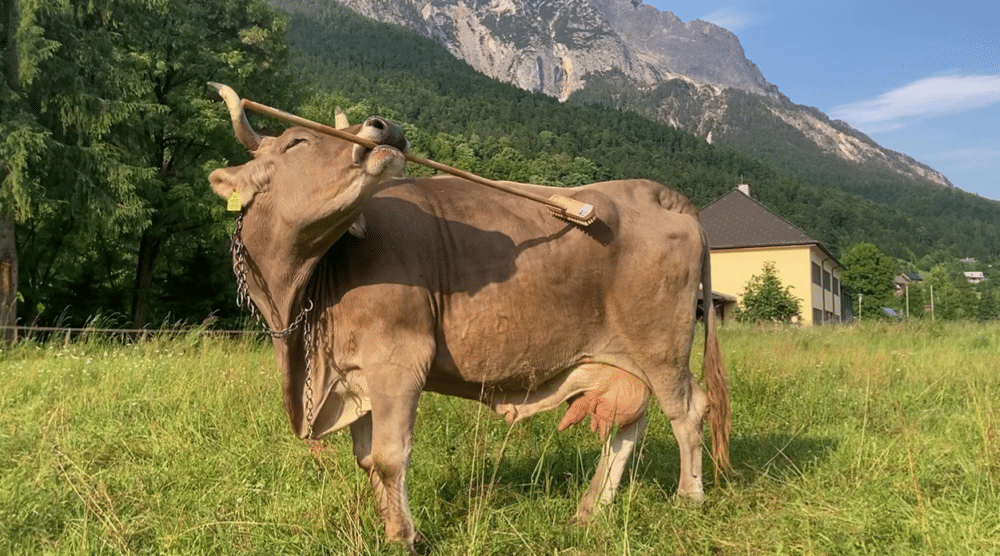
In the small mountain village of Nötsch, in southern Austria, an unusual phenomenon is changing the way we have hitherto thought about how non-human animals use tools.
This ability has already been documented in primates, birds, otters, and cetaceans, for example, but until now it had not yet been properly considered in cattle. The precursor of the discovery was Veronika, a pet cow who is not raised for her milk nor her meat, aged 13, belonging to farmer Witgar Wiegele.
Over a decade, Witgar noticed that Veronika, from time to time, would pick up sticks and use them to scratch herself. One day, a friend of the farmer recorded a video of the peculiar behavior on his cellphone and sent it to animal cognition specialist Alice Auersperg.
Upon seeing the images, the scientist from the Messerli Institute for Human-Animal Interactions, at the Vienna University of Veterinary Medicine, immediately realized that she was looking at something unusual.
“This is not just a curious behavior; it is a scientifically valuable example of a tool being used by a species that is traditionally overlooked when it comes to its cognitive abilities,” recalls the researcher.
To better understand what was happening, Auersperg and colleague Antonio Osuna-Mascaró, both authors of the article that reports the discovery, travelled to picturesque Nötsch to meet Veronika the cow in person.
When they arrived, the duo expected they would have to spend several hours in the pasture to glimpse the behavior they wished to study, but, to both of their surprise, Veronika began using a stick to scratch herself as soon as it was placed in front of her.
“She picked up [the stick] with her tongue as if it were a hand, placed it in her mouth with precision, aligned it with her body, and rubbed it on parts of her back that she clearly could not reach in any other way,” explains Osuna-Mascaró.
After that first visit, the scientists designed an experiment to test whether Veronika really had the capacity to use an object to extend the reach of her own body by applying mechanical force to a target, which in scientific jargon is described as flexible tool use. This behavior, according to the study’s authors, had up to now not been experimentally verified in animals considered cattle, such as cows.
During several sessions, the scientists placed a broom horizontally on the ground in front of Veronika. The side to which the bristles faced varied to observe the cow’s choices.
The team concluded that Veronika preferred to use the end with the bristles to scratch parts of the body with firmer and broader skin, such as her back. Conversely, the choice fell on the other end—the tip of the broom’s handle—to scratch more sensitive areas with skin that is more flexible, such as the belly or the udder.
Moreover, the way Veronika moved the broom depended on how she used it. To scratch the back, she made broad movements like a human sweeping the floor. To scratch more sensitive parts, the movements with the broom’s handle were more careful, controlled, and concentrated on a specific area.
“What most captured my attention was the fact that she did not simply choose the end that was closest,” says Osuna-Mascaró.
“Instead, she adapted the end and the technique according to the area she wanted to scratch. It was then that I realized she seemed to be using the broom as a true multifunctional tool,” the researcher details, adding that the only solid examples of this kind of capability in non-human animals had previously been found only in chimpanzees.
Auersperg emphasizes that flexible tool use, as seems to be displayed by Veronika, “is often associated with complex cognition,” requiring good motor control and “some level of action planning.”
“The fact that a cow managed to do this challenges what we know, especially about animals we tend to view through a purely utilitarian lens,” says Auersperg, who notes that this work is not about showing that cows are, after all, more intelligent than we thought, but about recognizing that what we know about animal intelligence is “shaped by how we treat them and by what we take the trouble to look for.”