In a fossil quarry, near a small locality called Seadouro, in the municipality of Vagos, Mário Miguel Mendes discovered something unexpected, a secret well kept at the heart of the rock that is rewriting the history of flowering plants that lived millions of years ago in what is now Portugal.
What the lecturer at Fernando Pessoa University, and researcher at the Center for Earth and Space Research of the University of Coimbra (CITEUC), found were fossilized remnants of fruits of a new species of angiosperm, still unnamed, which had not yet been identified in the country.
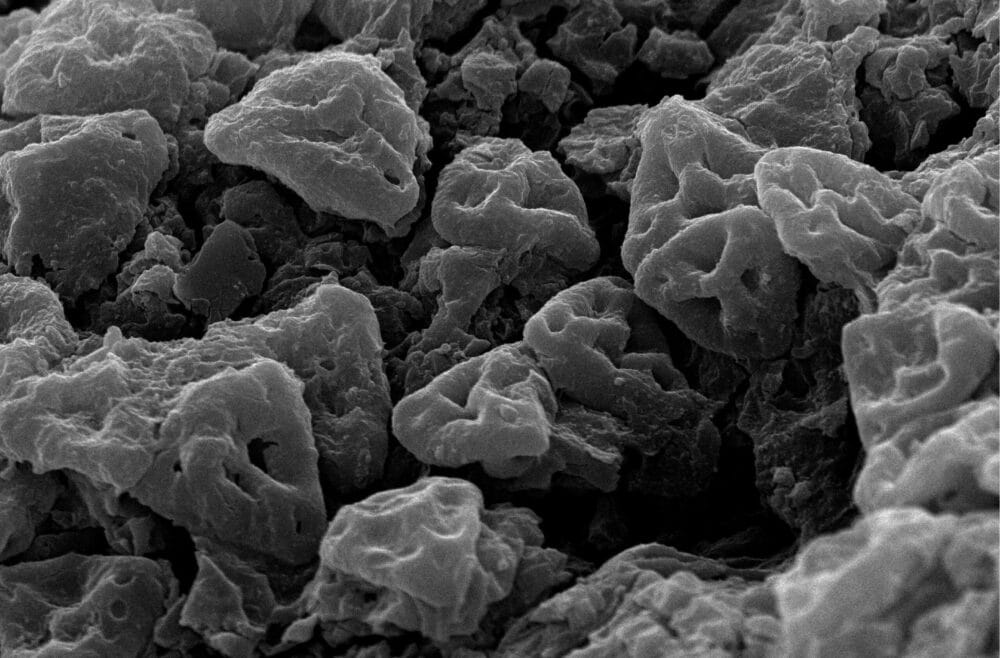
Through observations made with a scanning electron microscope, Mário Miguel Mendes has no doubt that the fruits belong to the genus Endressianthus, in the order Fagales.
Scale: A – 500 µm; B – 20 µm. Photo: Mário Miguel Mendes.
In the region of the fruit where the stigma was located (the region where pollen grains fall, which then extend tubes through the style to carry the sex cells to the ovary), pollen grains of a group called Normapolles were observed, which is frequently associated with plants of the order Fagales, therefore, says the scientist, there is no doubt about the taxonomic classification.
However, questions remain regarding the family (the taxonomic rung between genus and order) to which the newly discovered species belongs. Still, similarities are noted with the Betulaceae family, to which species such as the common hazel or European hazel (Corylus avellana) and the Turkish hazel (Corylus colurna) belong.
To determine exactly which family the newly found species in Vagos, in the Aveiro district, belongs to, Mário Miguel Mendes will go to the Paul Scherrer Institute in Switzerland to use an advanced imaging technique, known as synchrotron radiation X-ray microtomography, to unveil the mysteries that the new species has yet to reveal.
But the fact that it is a new species is not the only surprise. The researcher tells us that flowering plants of the genus Endressianthus had already been found in Portugal in the fossil record dating from the Late Cretaceous Period, more specifically between the Campanian and Maastrichtian, i.e., between 83 million and 66 million years ago. These fossils were unearthed in the localities of Esgueira, in Aveiro, and Mira, in Coimbra.
However, the fruit specimens that are now being described by Mário Miguel Mendes, in collaboration with researchers from the National Museum in Prague (Czech Republic), are about 87 million years old, placing them also in the Late Cretaceous, but this time in the Coniacian, or in other words, before the Campanian and Maastrichtian.
With all these indications, the Portuguese researcher is convinced that the angiosperms Endressianthus were already well established in the Portuguese flora of the Late Cretaceous millions of years earlier than previously thought.
Not only fruits, but also flowers
In addition to the fruits, at the Seadouro site some flowers were also identified. Although they did not display pollen of the Normapolles group at the site where they were found, the researcher believes that, by their morphological characteristics, they clearly belong to the order Fagales. However, it is not yet known which lineage within that order they fit into.
Looking through the scanning electron microscope, Mário Miguel Mendes says that the ovary of the flower of the collected specimen lies below the perianth. It is as if the part of the flower where pollen grains will germinate is protected by the corolla, the set formed by the petals, and by the calyx, a kind of outer covering of the flower that is made up of modified leaves called sepals and that serves as the “base” of the flower.
But in this 87-million-year-old flower, also from the upper Coniacian of Portugal, petals and sepals do not distinguish from one another, so the scientist explains that it is a perianth “clearly undifferentiated.”
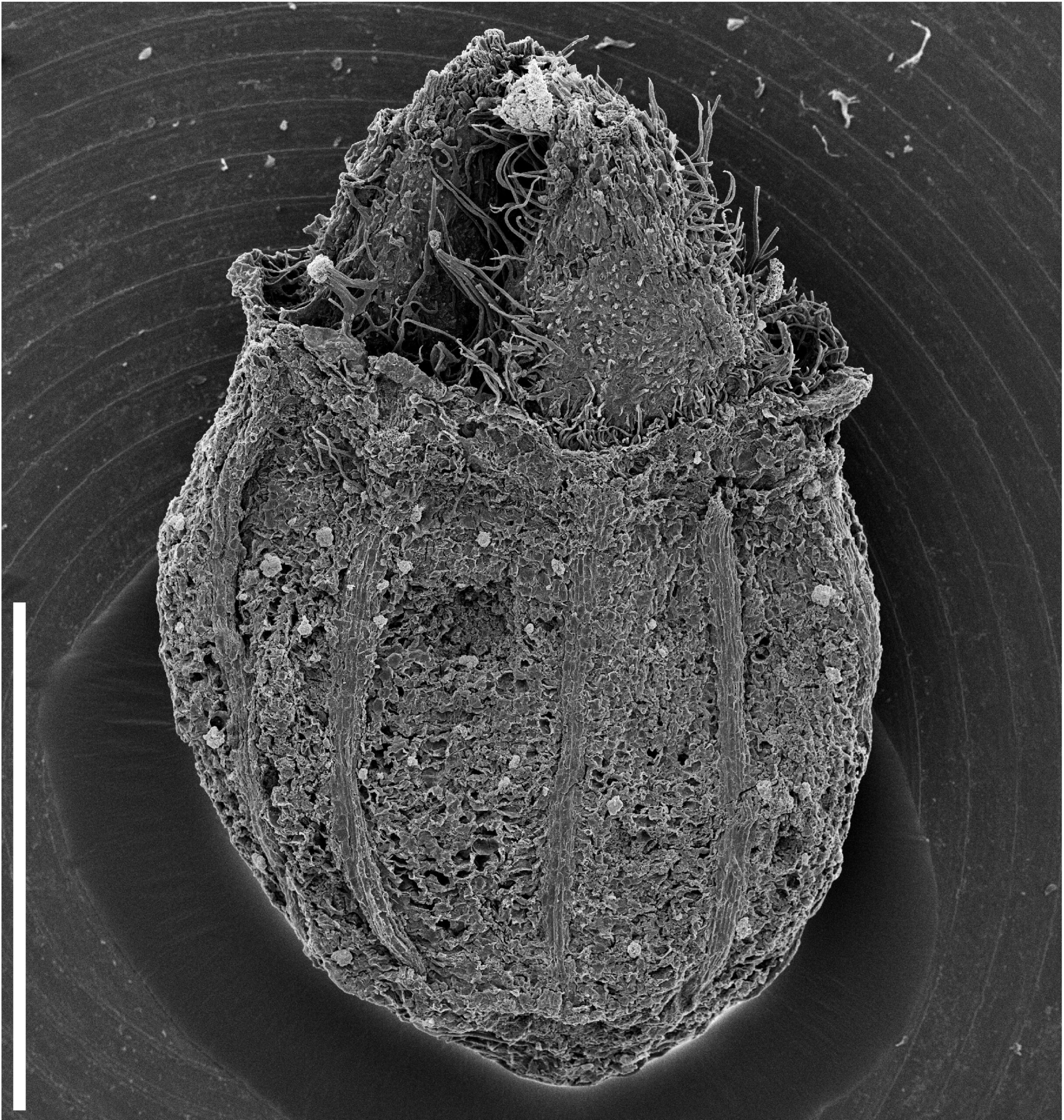
From what he has managed to observe so far, Mário Miguel Mendes is almost certain that this flower, whose family is not yet known, has two carpels that are fused at the base. Carpels are the female reproductive organs of a flower, composed of the ovary, the style, and the stigma. The collection of more than one carpel is called the gynoecium or pistil.
The region of the stigma of this flower, where pollen grains fall, is also surrounded by long trichomes, hair-like microscopic structures that help to trap the grains, which will later extend “arms” to the ovaries through the style. All these traits are typical of Fagales angiosperms and point to this flower indeed being part of that plant order.
Earlier investigations had already shown that Fagales were common in arid or semi-arid ecosystems of the Late Cretaceous, and the discovery now made in Aveiro points in the same direction, as the traces were found in the same strata where numerous fragments of frenelopsids, plants from the Cretaceous and now extinct that are associated with dry environments, were found.
Thus, the study of ancient plants, even after many millions of years, helps us not only to better understand what life was like in those distant times, but also the environmental conditions that existed in places that today are radically different.