
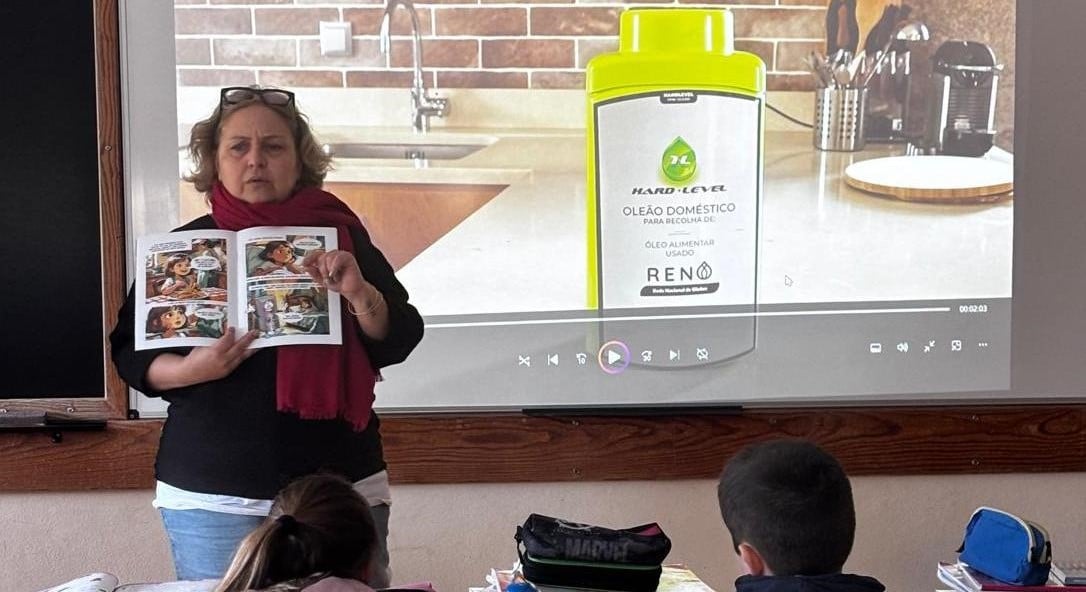
More than 12,000 students, 45 schools and eight municipalities joined, in the last school year, the program “Educate to Recycle – Heroes of the Environment,” an initiative by Hardlevel – Renewable Energies, which aims to transform children into true agents of environmental change within their families and communities, according to a press release.
According to the same source, a year after the project’s launch, the balance reported by school administrations and partner municipalities is “unanimously positive,” with several Portuguese municipalities and dozens of educational establishments already expressing interest in joining the program and making it grow exponentially in the next school year.
Developed by the HardLevel Environmental School and supported by the Carbon Foote technology platform, the “Environment Heroes” program is much more than a set of awareness-raising actions. It is a pedagogical, operational and digital ecosystem that accompanies children from the 1st to the 8th year of schooling along their educational path, promoting the adoption of environmentally responsible behaviours and encouraging their replication within the family and community.
“Children are not only the future. They are today one of the most powerful engines of change within families. If we want to alter environmental behaviours, we have to start where it all begins: in education,” says Karim Karmali, founder and CEO of HardLevel.
Portugal continues to record a significant deficit in the domestic collection of used cooking oils, despite the targets set by Decree-Law No. 102-D/2020. And many municipalities continue to face difficulties in implementing effective solutions that allow increasing the collection and recycling rates of these residues.
It was precisely to respond to this challenge that HardLevel decided, a year ago, to go beyond the simple collection and valorization of waste, betting on a long-term environmental education strategy. “Because, like seeds, ideas need time to germinate and bear fruit. We believe that educating children is the most effective way to build a lasting culture of sustainability,” adds the executive.
After the launch in the municipalities of Guimarães, Ovar, Murtosa, Sever do Vouga, Albergaria-a-Velha, Oliveira do Bairro, Almada and, likewise, in the territory served by Resialentejo – Treatment and Valorization of Waste, the objectives of the initiative — an innovative solution that combines structured environmental education in schools, technology Internet of Things (IoT), selective collection of used cooking oils (UCO) and community mobilization — are now more ambitious.
According to Karim Karmali, the aim is now to reach a total of 25 municipalities, 120 schools and over 35,000 students and their respective family units. A growth (of more than 213% in the number of municipalities, 167% in educational establishments and 192% in students) that will be supported by the updated cloud version of the HardLevel Environmental School platform and by new pedagogical contents, also for the 5th and 6th years of schooling.
“There are still many municipalities that lack the means and effective methodologies to meet legislative aims, which impose growing targets for the recycling of used household cooking oils,” recalls the entrepreneur, who has led the pioneering company in smart management of UCO in Portugal and Spain for twenty years.
Hardlevel Network Reaches More Than 100 Municipalities and 10,000 Restaurants
In the field in which Hardlevel operates, giving it their all has a literal and highly impactful meaning. Because every liter of used cooking oils poured down the drain has the power to contaminate one million liters of water, overburdening wastewater treatment plants (WWTPs) with fats that are difficult to treat.
Hardlevel is approaching the milestone of nearly one million kilograms of used cooking oils collected per year, this being only from the domestic component; the goal is to surpass it by 2027, sustained by the expansion of the Smart S+ oil containers (sensorized and with IoT technology) and by the growing impact of the Environmental School program.
The network of this operator currently reaches more than 100 municipalities, served by approximately 4,000 oil containers, and also processes used cooking oils from around 10,000 restaurants. The waste enters an industrial valorization circuit that avoids the emission of around 3,900 tonnes of CO₂ per year — equivalent to planting 195,000 trees.
“We are recording double-digit growth in our operation compared to the previous year, a trend that remains in line with the targets defined in our 2025-2030 strategic roadmap,” reveals the HardLevel CEO.





