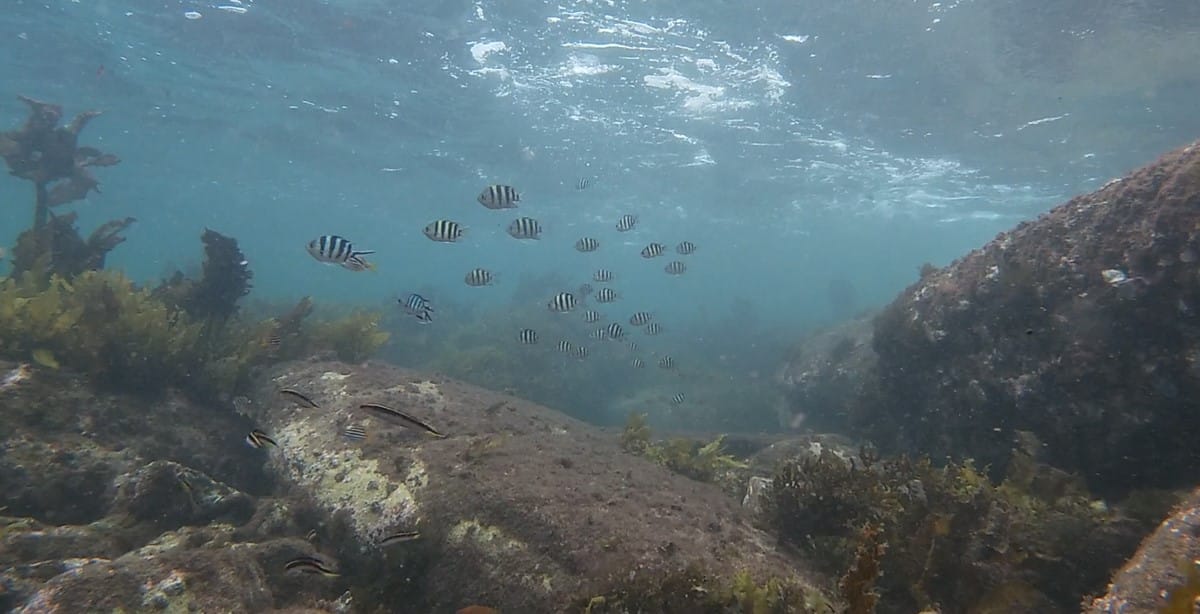
As tropical fish colonize new habitats in temperate oceans, made available to them due to global warming, researchers have discovered that those swimming in schools alongside native neighbors of the area learn behaviors that help them thrive.
According to the study, conducted jointly by researchers from the University of Adelaide and the University of Technology Sydney, tropical fish species living in mixed shoals — and not only among other tropical fish — have become bolder and have fed more, which may help them survive longer and grow more on temperate reefs.
“This result suggests that new interactions between species, which are often considered stressful or competitive, may benefit some species that are expanding their range,” says the lead author, Angus Mitchell, from the University of Adelaide’s School of Biological Sciences.
“Living in shoals with locals can help tropical fish learn about new predators, food sources and environmental cues. This reduces uncertainty and increases survival in unfamiliar ecosystems,” he adds.
This work builds on previous research from the University of Adelaide that found tropical fish exhibit reduced physiological performance in milder-climate ecosystems.
“Our new work demonstrates that new shoal interactions can dampen poorly adapted physiological responses,” says co-author Chloe Hayes, from the University of Adelaide’s School of Biological Sciences.
The new study, published in the Journal of Animal Ecology, found that while tropical fish may thrive in these new environments, the fish whose habitat is being invaded do not enjoy a similar benefit.
“In subtropical regions, we found that fish species suffered. They were more prone to flee and fed less when tropical species were present,” notes co-author Professor David Booth of the University of Technology Sydney.
These interactions may force temperate-climate fish species to permanently leave their warmer native areas.
“Subtropical reefs are already at the thermal limits for many fish. The additional stress from tropical competitors may push them to the limit,” says the project leader Professor Ivan Nagelkerken of the University of Adelaide.
Understanding the interspecific dynamics that occur due to climate-driven range shifts will be important in designing conservation strategies.
“Our investigation shows that climate-driven species redistributions are not only about temperature. They are also about the new relationships formed in recipient ecosystems,” says Professor Nagelkerken.
“As the world’s oceans continue to warm, understanding the outcomes of these new interactions, whether friendly or hostile, will be essential to predicting how reef communities will be reshaped in a rapidly warming ocean,” he concludes.