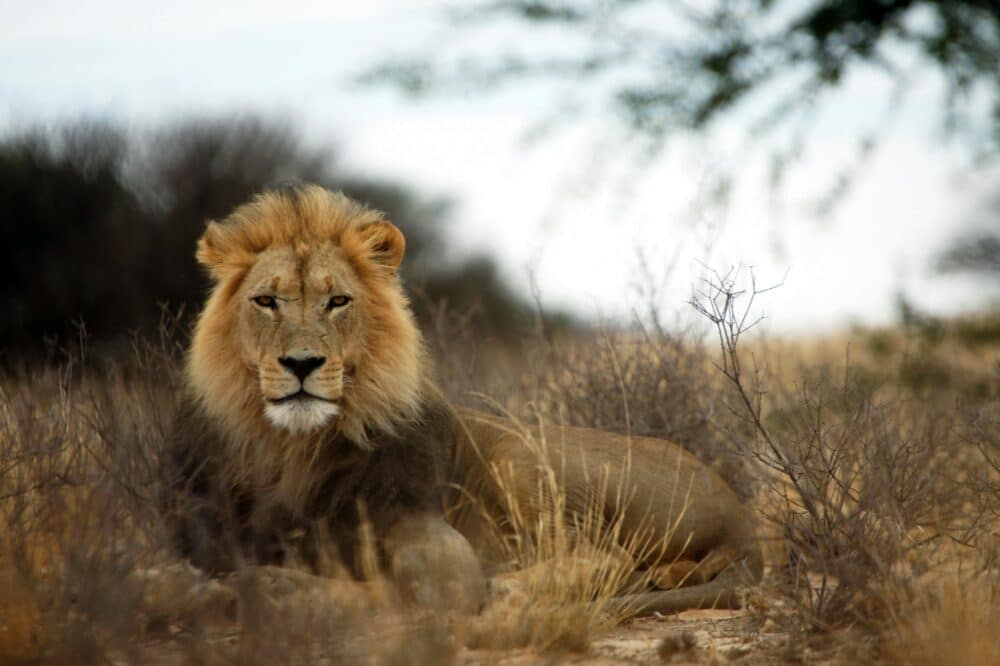
Organized criminal networks are increasingly targeting lions in Africa to sell their bones, claws, skins, and teeth on the black market. Scientists say that the intensification of poaching could be an existential threat to the species if nothing is done to combat it.
In a paper published in the journal Conservation Letters, an international team of researchers reveals that the rising trade in parts of African lions is being fed by demand in markets in Africa and Asia.
At one time, hundreds of thousands of lions roamed Africa, but today they occupy only about 6% of their historical distribution range, with roughly 23,000 individuals estimated to be in the wild.
Although habitat loss, prey depletion, and human-wildlife conflict have long been key drivers of the species’ decline, scientists warn that targeted poaching aimed at obtaining body parts — “a more recent and poorly understood threat” — is aggravating these pressures that already existed.
“We are witnessing both the organized and increasingly widespread and deliberate slaughter of lions for commercial purposes, and the opportunistic collection of lion body parts from lions that died from other causes,” details, in a statement, Peter Lindsey, of the Wildlife Conservation Network, the University of Pretoria (South Africa) and the study’s first author.
“Poachers are increasingly using poisoned baits and traps that can wipe out entire groups at once, driving an already vulnerable population closer to collapse,” the researcher warns. And he adds that, beyond these impacts, the use of poisons threatens an even larger number of other carnivores and scavengers, such as vultures.
In this work, the scientists reveal that recent seizures of lion parts include 17 skulls in Zambia, more than 300 kilograms of various body parts intercepted in Mozambique and also other records in Botswana, Zimbabwe, Uganda and South Africa.
“In Uganda, and across East Africa, lions are fundamental both to ecosystems and to the livelihoods of communities, but they are now being drawn into sophisticated illicit trade networks,” says Simon Nampindo of the Wildlife Conservation Society and coauthor of the article.
“If we do not strengthen on-the-ground protection and work in genuine partnership with communities, this crisis will continue to accelerate beyond our capacity to contain it,” he warns.
Scientists explain that lion parts are sought for cultural, spiritual and commercial purposes, being used in traditional belief systems present in at least 37 African countries, and also trafficked to Southeast Asia, where they often serve as substitutes for tiger parts used in medicinal products.
Trade in lion parts is increasingly linked to ivory trafficking, rhino horn trafficking, and pangolin scales, the study shows.
To prevent further losses, the study’s authors recommend strengthening protection and on-the-ground monitoring of lions and involving local communities as partners in conservation efforts. They also consider it important to improve knowledge about trafficking networks and dismantle routes, strengthen laws and the judicial system, and reduce demand on the consumer side through what the researchers describe as “behavior-change campaigns” grounded in the culture of the groups or social segments that feed this black market.