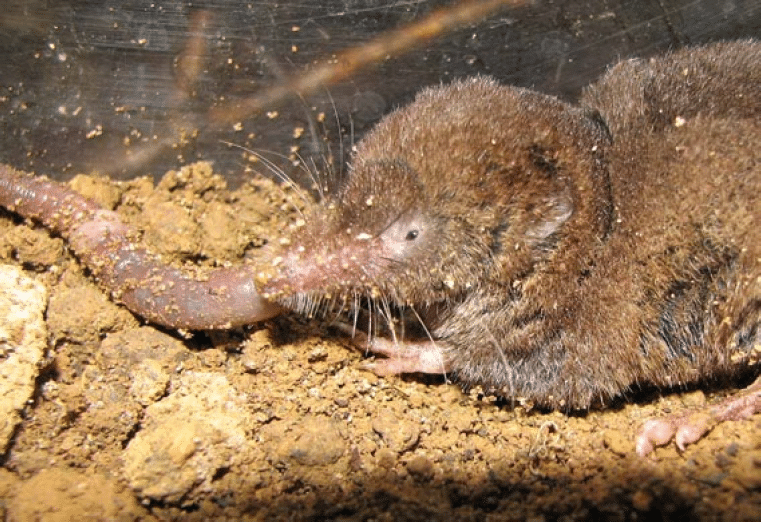
During the coldest months of the year, a small rodent on the Japanese island of Hokkaido found a way to face winter by reducing energy expenditure when food sources are scarcer.
In 1949, the Polish zoologist August Dehnel discovered that shrews had a peculiar capacity: to shrink and enlarge the volume of their brain. Named after the “Dehnel phenomenon,” it is considered a way for these rodents to limit calories spent during the coldest part of the year. And they manage to do so without risking death of brain cells.
This reversible ability was first described in the shrews Sorex araneus, but has already been found in Sorex cinereus. Now, a new investigation reveals not only that the shrews Sorex unguiculatus are capable of this feat of the natural world, but also adds a unique and hitherto unprecedented twist among this group of animals.
In a paper published in the journal ‘Proceedings of the Royal Society B, researchers from Toyo University and Hokkaido University (both in Japan) reveal that during winter the cranial box of S. unguiculatus decreases and returns to its normal size in spring. What is novel is that the snout of this species, conversely, increases during winter and returns to decrease in spring.
The authors of the study say that it is the first time worldwide that the “inverse Dehnel phenomenon,” as they named it, has been documented. Until now, they explain, it was thought that the skull of some shrews decreased uniformly during winter, but this investigation shows that it can increase and decrease in different directions.
The work involved analyzing the dimensions of 136 skulls of S. unguiculatus preserved in the Botanic Garden of Hokkaido University, collected between 1948 and 1988 in that same Japanese region. By comparing the shape of the skulls with the time of year the shrews were collected, the team was able to identify seasonal changes.
The exact reason for the snout’s increase when the cranium and brain shrink is not yet known, but scientists have some theories. One suggests that a larger snout may contain more blood vessels that help warm the cold air inhaled by the rodent before it reaches the “shrivelled” brain, allowing the animal to stay alert.
Another hypothesis points out that a larger nose could correspond to a greater ability to detect odors, such as food, at a time when food sources are scarce and may be buried under thick layers of snow.
Or, the researchers say, the increase in the shrews’ noses could be a combination of both.
Unlike other small mammals, shrews do not hibernate, so to survive the colder months of the year, they had to develop unique adaptations, such as altering the shape of their bodies.