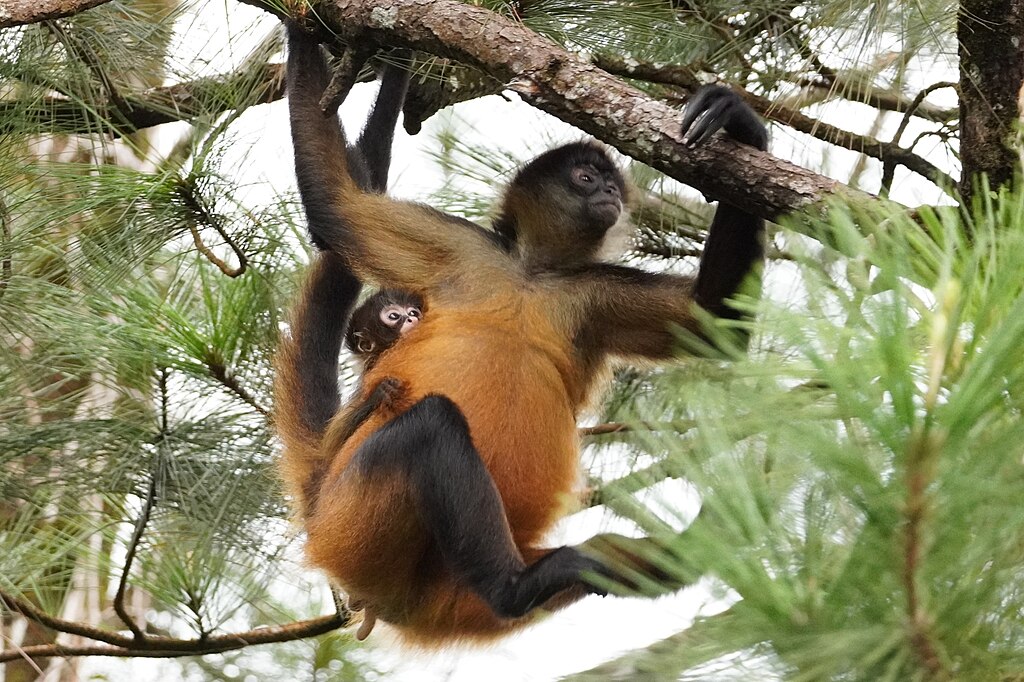
Spider monkeys, primates of the genus Ateles, known for using their flexible and prehensile tails as if they were a fifth limb to move through the trees, are capable of combining what they know with the knowledge of others to improve their hypotheses about finding the best fruits.
The conclusion comes from a study published in the journal ‘npj Complexity’, in which scientists from Mexico and the United Kingdom write that spider monkeys “combine their information in a way that produces new knowledge”.
Between 2012 and 2017, field observations were made of groups of spider monkeys of the species Ateles geoffroyi living in a protected area on the Yucatán Peninsula, in Mexico. The team noted that the animals frequently changed subgroups, with three or more individuals, in order to share what they know about the location of fruit-bearing trees and the best time to harvest and eat them, but also to obtain information that others have.
For example, this behavior could translate into something like a subset of monkeys going to another to share what it knows about the location of a food source and the other subgroup sharing what it knows about when will be the best time to pick the fruits at that tree or location.
It is as if each subgroup had a piece of the puzzle: by combining them all they can benefit from a clearer picture of where the best fruits are. This knowledge results from the animals’ experience of the places where they live, the visits they make to the trees and linking what they find to the time of year they are in.
In this way, they can minimize wasted time and energy in the search for food or in visiting places where the most nutritious food sources are not present.
The team of scientists regards this as “a convincing example of collective intelligence in natural conditions”.
By constantly changing subgroups, spider monkeys who know different things and who know different parts of the forest in which they live can share that information and increase the group’s overall knowledge.
The spider monkeys Ateles geoffroyi are a native species of the forests of Central America and are classified as “Endangered” on the Red List of Threatened Species. The intense loss of habitat caused by deforestation and the trafficking for exotic pet markets are the main threats.
These risks are amplified by the fact that these primates tend to reproduce late, give birth to only one offspring per reproductive season, and have long intervals between births.