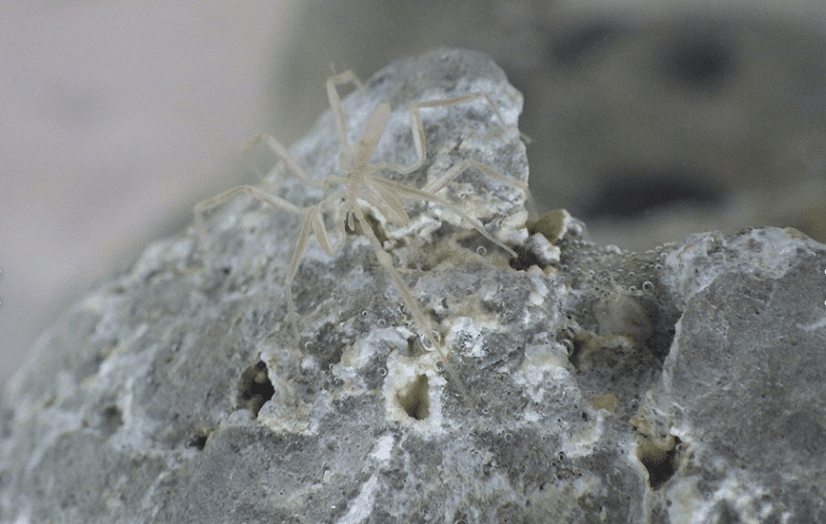
About 50 kilometers off the coast of Del Mar, California, and at a depth of one thousand meters, a methane seep was discovered in 2012, released from the Earth’s interior through a fracture in the crust.
It was in that same location that, a decade later, another group of researchers discovered that sea spiders of the genus Sericosura and a type of bacteria thriving in these harsh environments share a life history, in apparent symbiosis.
In an article published in the journal PNAS, the scientists say that these sea spiders cultivate the bacteria on their own exoskeletons, a hard outer layer that coats the bodies of many invertebrates, and then feed on them, something like a “walking garden” in the form of a coat.
Similar communities of bacteria were also found in the egg sacs that the males of these arthropods carry, which suggests, the researchers say, that the bacteria are transmitted from parents to offspring.
Other groups of sea spiders – which are not arachnids but physically resemble them – typically feed on other invertebrates, but these Sericosura obtain their energy through the bacteria, which metabolize methane, an energy source that sea spiders, by themselves, could not exploit.
Through the collection of specimens and their meticulous analysis, the team found that the “bacterial coats” of some of the sea spiders Sericosura bore what appeared to be marks, which they say were made by the mouths of the arthropods themselves when they tore off pieces of bacteria to feed (imagine the reader wearing a coat made of cotton candy, and from time to time taking a bite out of it).
“Our study aimed to examine how animals often overlooked take advantage of new energy sources, such as methane. Although the seafloor may seem very distant, all organisms are interconnected, and the processes in one ecosystem affect another,” says Shana Goffredi, of Occidental College (United States of America) and one of the lead authors of the study.
The same team, in addition to describing this relationship between the sea spiders Sericosura and the bacteria, also found what it believes to be three new species of that genus, which, apparently, live only in places where methane escapes from the Earth’s interior.